
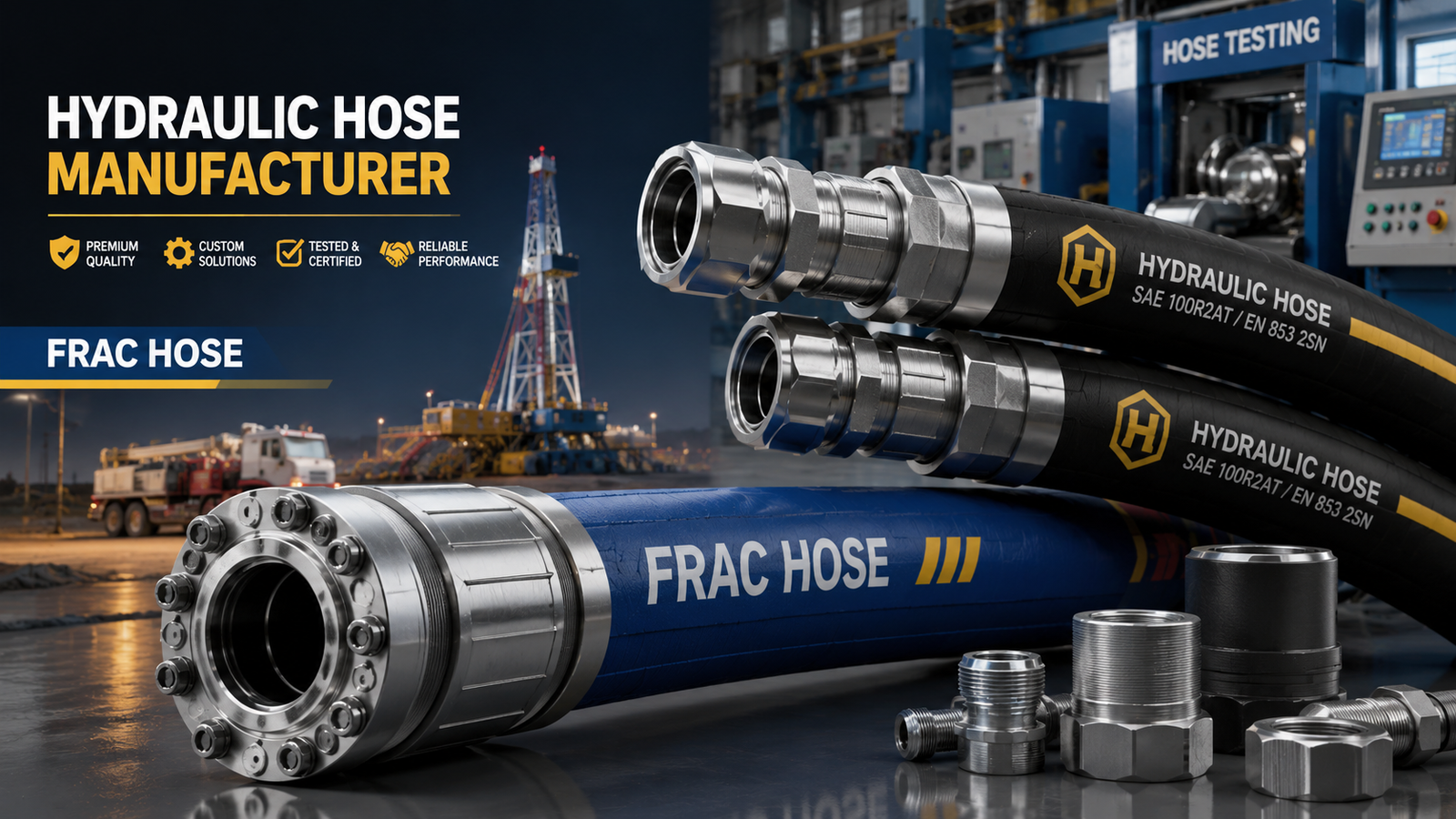
Industrial fluid-transfer systems operate under demanding conditions where pressure, temperature, abrasion, vibration, and chemical exposure can challenge ordinary components. Choosing an experienced Hydraulic Hose Manufacturer and the correct frac hose is therefore important for achieving reliable performance, workplace safety, and longer equipment life.
Hydraulic hoses are widely used to transfer pressurized hydraulic fluids in construction machinery, manufacturing equipment, mining operations, agriculture, transportation, and other industrial systems. Frac hoses, meanwhile, are designed for demanding oilfield and hydraulic fracturing environments where rugged construction and dependable fluid transfer are essential.
Understanding their construction, application requirements, pressure ratings, and selection criteria helps industrial buyers choose safer and more efficient hose solutions.
What Does a Hydraulic Hose Manufacturer Do?
A professional Hydraulic Hose Manufacturer develops flexible hose solutions capable of carrying hydraulic fluids between different components of a hydraulic system. Unlike ordinary tubing, hydraulic hoses must remain reliable while handling high pressure, movement, vibration, temperature variations, and challenging operating environments.
Manufacturers typically combine multiple engineered layers to create a hose suitable for its intended application. These may include:
- An inner tube compatible with the transported fluid
- One or more reinforcement layers
- Steel-wire braid or spiral reinforcement
- A durable outer cover
- Compatible couplings and end connections
The exact construction depends on pressure requirements, operating temperature, bend radius, fluid compatibility, and environmental conditions.
A reliable manufacturer should also maintain strong quality-control procedures covering materials, dimensions, pressure capability, fittings, and finished assemblies.
Understanding Frac Hose and Its Industrial Role
A frac hose is commonly associated with hydraulic fracturing and oilfield operations. These environments can involve demanding fluid-transfer duties, frequent equipment movement, abrasive surroundings, and elevated working pressures.
Depending on its specific design and certification, a frac hose may be used for transferring water, fracturing fluids, chemicals, slurry-related media, or other compatible materials.
Important characteristics can include:
- High-pressure capability
- Strong reinforcement
- Abrasion-resistant outer construction
- Flexibility for field installation
- Resistance to weather and industrial exposure
- Secure end connections
- Compatibility with specified operating fluids
However, not every frac hose is suitable for every fracturing application. Pressure rating, chemical compatibility, temperature limits, fitting specifications, and applicable standards should always be verified before installation.
Hydraulic Hose vs Frac Hose
Although both products are flexible industrial hoses, their intended applications can differ considerably.
| Feature | Hydraulic Hose | Frac Hose |
| Primary purpose | Hydraulic power transmission | Oilfield and fracturing fluid transfer |
| Typical environment | Machinery and industrial equipment | Fracturing and oilfield sites |
| Reinforcement | Textile, wire braid, or spiral | Heavy-duty application-specific reinforcement |
| Flexibility | Depends on hose construction | Designed around demanding field requirements |
| Selection basis | Pressure, fluid, temperature, size | Pressure, media, temperature, field conditions |
A Hydraulic Hose Manufacturer may produce multiple hose families, so buyers should specify the actual application rather than selecting a product based only on hose diameter or appearance.
Why Hose Construction Matters
The performance of a hose depends heavily on how its individual layers work together. The inner tube must be compatible with the fluid being transferred. Reinforcement provides strength against internal pressure, while the outer cover protects the reinforcement from environmental damage.
In hydraulic applications, reinforcement may consist of textile braid, steel-wire braid, or multiple spiral-wire layers. Higher-pressure applications often require stronger reinforcement, although pressure capability should always be confirmed from the manufacturer’s technical data.
For frac hose applications, resistance to abrasion can be particularly important because equipment is frequently exposed to rugged field conditions.
How to Select the Right Hydraulic or Frac Hose
Correct hose selection requires more than matching an existing hose’s dimensions. Buyers should evaluate the complete operating environment.
A practical selection process includes:
- Determine the required internal diameter.
- Identify normal and maximum operating pressure.
- Check expected fluid temperature.
- Confirm compatibility with the transferred media.
- Review minimum bend-radius requirements.
- Evaluate abrasion and environmental exposure.
- Select appropriate fittings and connections.
- Check applicable standards and certifications.
- Verify hose assembly and installation requirements.
Never assume that a hose capable of fitting a connection is automatically suitable for the application.
Importance of Working Pressure and Safety Factor
Working pressure is one of the most important specifications when choosing hydraulic or frac hoses. The selected hose should be rated appropriately for the actual system and operating conditions.
Pressure spikes and pulsation can place additional stress on assemblies. Using an incorrectly rated hose may lead to premature deterioration, leakage, or sudden failure.
A dependable Hydraulic Hose Manufacturer should provide clear technical specifications so engineers and maintenance teams can match the hose to the system correctly.
For critical oilfield applications, buyers should also verify whether the selected frac hose complies with the standards or customer specifications required for that particular project.
Benefits of Choosing a Reliable Hose Manufacturer
Selecting a qualified manufacturer can provide benefits beyond simply purchasing a replacement hose.
These may include consistent product specifications, traceable materials, technical documentation, application support, pressure-testing capabilities, suitable fitting recommendations, and quality-controlled production.
Reliable manufacturers can also help customers determine whether they need braided hydraulic hose, spiral hose, specialized oilfield hose, or another industrial hose configuration.
This application-focused approach reduces the risk of choosing products based solely on price.
Maintenance and Inspection Best Practices
Even a premium hydraulic or frac hose requires routine inspection. Hose assemblies naturally experience wear during operation, especially when exposed to repeated flexing, abrasion, heat, chemicals, or pressure cycles.
Inspect hoses regularly for:
- Cracks or cuts in the cover
- Exposed reinforcement
- Unusual bulging
- Leakage around fittings
- Kinking or excessive bending
- Abrasion damage
- Corrosion around connections
- Loose or damaged couplings
A damaged hose should be assessed and replaced according to the equipment manufacturer’s maintenance requirements and applicable safety procedures. Never attempt to locate a suspected high-pressure leak with bare hands.
Applications Across Major Industries
Products supplied by a Hydraulic Hose Manufacturer are used across numerous industries. Typical applications include excavators, loaders, cranes, agricultural machinery, manufacturing equipment, mining systems, material-handling machinery, and transportation equipment.
Frac hoses are more specialized and commonly serve energy-sector and oilfield operations.
The common requirement across these industries is dependable fluid transfer under clearly defined operating conditions.
Frequently Asked Questions
1. What is a hydraulic hose?
A hydraulic hose is a flexible reinforced conduit designed to transfer compatible hydraulic fluid between components.
2. What is a frac hose?
A frac hose is an industrial hose designed for specified fluid-transfer duties associated with hydraulic fracturing and oilfield operations.
3. Are hydraulic hoses suitable for fracturing operations?
Only hoses specifically rated and approved for the intended conditions should be used.
4. What determines hydraulic hose pressure capacity?
Construction, reinforcement, materials, size, temperature, and manufacturer specifications influence pressure ratings.
5. Why is fluid compatibility important?
Incompatible fluids can degrade the inner tube and shorten hose life.
6. How do I choose a Hydraulic Hose Manufacturer?
Review manufacturing quality, technical specifications, testing capability, product range, documentation, and application support.
7. Why is bend radius important?
Bending a hose tighter than its specified minimum radius can damage its structure and reduce service life.
8. Can a damaged hydraulic hose be reused?
A compromised hose should be evaluated according to manufacturer guidance and applicable safety requirements rather than reused automatically.
9. Are frac hoses resistant to abrasion?
Many are designed with abrasion-resistant covers, but resistance varies by product construction.
10. How often should industrial hoses be inspected?
Inspection frequency should follow manufacturer recommendations, equipment requirements, operating severity, and relevant industry procedures.