
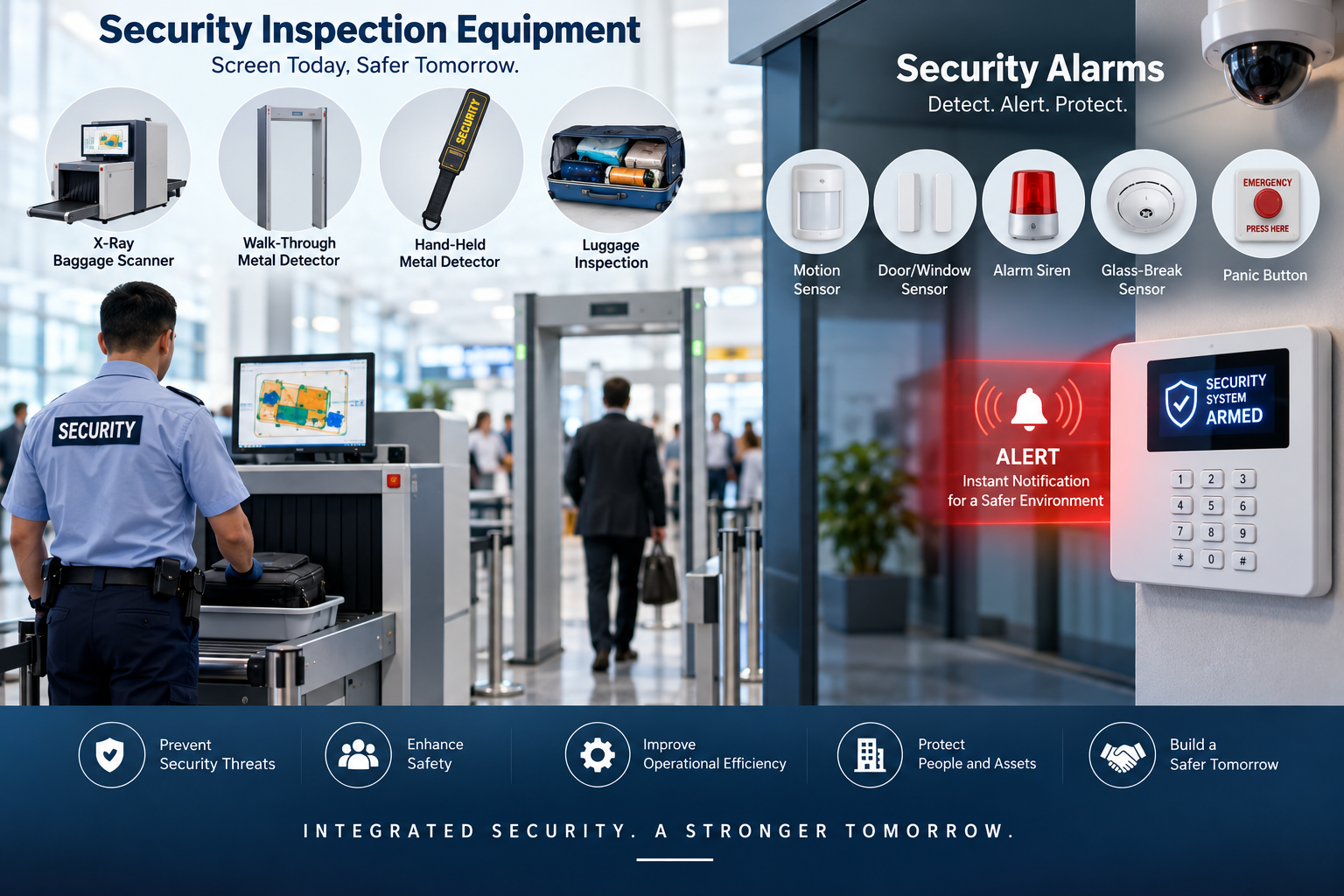
Security has always developed alongside society. As cities expanded, transportation became faster, and businesses grew more connected, traditional guards and mechanical locks were no longer enough. This need created modern Security Inspection Equipment and Security Alarms, two technologies that now protect airports, factories, offices, shopping centres, public infrastructure, warehouses, homes, and high-security facilities.
From simple bells and manual inspection methods to artificial intelligence, biometric verification, smart sensors, and automated threat detection, security technology has changed dramatically. Understanding this evolution helps organisations choose systems that address current risks while preparing for future security requirements.
The Early History of Security Inspection
Before electronic screening technology existed, security inspection depended primarily on human observation. Guards manually inspected bags, vehicles, cargo, and individuals when suspicious activity was detected.
Early security checkpoints relied on:
- Manual baggage searches
- Physical identity documents
- Security guards
- Mechanical access barriers
- Basic lighting systems
- Visual inspection of vehicles and packages
These approaches worked in controlled environments but became inefficient when airports, factories, ports, railway stations, and commercial facilities began handling larger numbers of people and goods.
Industrialisation created a clear demand for faster and more reliable Security Inspection Equipment.
The Introduction of Metal Detection Technology
Metal detectors represented one of the earliest major developments in automated security screening.
Walk-through metal detectors allowed security teams to examine people without conducting physical searches. Hand-held detectors later provided a convenient method for secondary screening.
These systems became common in:
- Airports
- Government buildings
- Courts
- Industrial facilities
- Public events
- Schools and universities
- Transportation hubs
Although traditional metal detectors mainly identify metallic objects, modern systems can determine approximate locations and provide multiple detection zones.
Their introduction established an important principle of modern security: threats should be detected quickly without unnecessarily slowing legitimate movement.
How X-Ray Security Inspection Changed Screening
X-ray systems significantly improved baggage and cargo screening.
Instead of opening every package manually, operators could examine internal contents through generated images. Different materials could be displayed according to density and composition, helping trained personnel identify suspicious items.
Modern X-ray Security Inspection Equipment is commonly used for:
- Passenger baggage
- Parcels
- Courier shipments
- Cargo
- Industrial materials
- Government facilities
- Hotels
- Metro stations
Advanced machines offer improved image resolution, automatic threat recognition, material discrimination, image enhancement, and multi-energy scanning.
This transformation made inspection faster while improving consistency.
The Historical Development of Security Alarms
The evolution of Security Alarms followed a similar path.
Early alarm systems were mechanical. Bells, trip mechanisms, and manually activated warning devices informed occupants about intrusion or danger.
Electrical technology later introduced wired alarm circuits. When a door or window was opened, the electrical circuit changed and triggered an alarm.
These systems eventually expanded into complete security networks containing:
- Door sensors
- Window contacts
- Motion detectors
- Glass-break sensors
- Panic buttons
- Sirens
- Control panels
- Smoke detectors
This development changed security from passive protection to active detection and rapid notification.
How Digital Technology Transformed Security Systems
The arrival of microprocessors and digital communication changed both inspection systems and alarms.
Instead of functioning independently, security devices became interconnected. Control rooms could monitor multiple buildings, entrances, cameras, sensors, and alarms from a central location.
Digital technology introduced features such as:
| Earlier Security Systems | Modern Security Systems |
| Manual inspection | Automated inspection |
| Local alarm bells | Remote notifications |
| Mechanical locks | Electronic access control |
| Basic metal detection | Multi-zone detection |
| Standard X-ray images | AI-assisted imaging |
| Wired communication | Wired and wireless networks |
| Limited records | Digital event histories |
These improvements also allowed organisations to investigate incidents using recorded information rather than relying only on eyewitness reports.
Security Inspection Equipment in the Present Era
Today, Security Inspection Equipment includes much more than traditional metal detectors.
Modern security environments may use:
- Baggage X-ray scanners
- Walk-through metal detectors
- Hand-held metal detectors
- Explosive trace detectors
- Vehicle inspection systems
- Parcel inspection machines
- Radiation detectors
- Body screening systems
- Biometric identity systems
The equipment selected depends on the facility and its risk profile.
An airport requires different screening technology from a warehouse, school, hotel, factory, or government office. Effective security planning therefore focuses on risk assessment instead of purchasing equipment only because it is technologically advanced.
Modern Security Alarms and Smart Monitoring
Contemporary Security Alarms have evolved into intelligent monitoring platforms.
A modern alarm system can communicate with smartphones, surveillance cameras, access-control systems, and remote monitoring centres.
Smart alarms can detect different types of events, including:
- Unauthorized entry
- Movement in restricted areas
- Broken glass
- Smoke
- Fire
- Gas leakage
- Water leakage
- Emergency button activation
Users can receive real-time notifications even when they are far from the protected location.
Integration also enables security teams to verify an event before responding. For example, an alarm activation can automatically display a nearby CCTV camera, helping operators determine whether the situation represents a genuine threat or a false trigger.
The Role of Artificial Intelligence in Future Security
Artificial intelligence is expected to become increasingly important in security inspection.
Traditional systems usually depend heavily on operators interpreting information. AI-assisted systems can analyse images and sensor data to identify potentially suspicious patterns.
Future Security Inspection Equipment may automatically highlight objects requiring closer examination.
AI could support:
- Automatic prohibited-item recognition
- Suspicious-object detection
- Behavioural pattern analysis
- Faster baggage screening
- Reduced operator fatigue
- Predictive maintenance
- False-alarm reduction
However, trained human professionals will remain essential because automated systems can make errors and security decisions often require context.
The Future of Contactless Security Inspection
Contactless screening is another important development.
High-traffic facilities increasingly need systems that provide security without creating long queues or unnecessary physical interaction.
Future screening environments may combine biometric identification, intelligent cameras, advanced sensors, and automated inspection technologies.
Instead of stopping every visitor for several separate checks, integrated systems may evaluate multiple security factors simultaneously.
This could improve passenger movement at airports, transportation centres, offices, stadiums, and major events.
The Future of Security Alarms
Future Security Alarms are likely to become more predictive rather than simply reactive.
Traditional alarms respond after a sensor detects an event. Intelligent systems may analyse several signals before an incident develops.
For example, information from motion sensors, access systems, cameras, and environmental sensors could be analysed together.
Important future developments may include:
- AI-based event classification
- Cloud-connected alarm management
- Intelligent sensor networks
- Advanced wireless communication
- Mobile security applications
- Automated emergency workflows
- Integration with building management
- Remote system diagnostics
Security systems will increasingly operate as connected ecosystems rather than isolated devices.
Cybersecurity Will Become Part of Physical Security
Connected security equipment creates new advantages but also creates cybersecurity responsibilities.
An internet-connected alarm panel, access controller, camera, or inspection device can become a potential target if poorly protected.
Future security planning therefore needs both physical and digital protection.
Organisations should consider secure passwords, encrypted communication, software updates, network segmentation, controlled administrator access, and regular security audits.
Manufacturers of Security Inspection Equipment and Security Alarms will increasingly need to design cybersecurity protections directly into their products.
Biometric Technology and Identity Verification
Biometric identification is likely to become more closely integrated with physical security.
Fingerprint recognition, facial recognition, iris scanning, and other identity technologies can help determine whether a person is authorised to enter a protected facility.
Future security checkpoints could combine identity verification with inspection technology.
For example, an authorised employee may pass through a security checkpoint where identity, access permissions, and screening results are verified simultaneously.
Privacy regulations, data protection, accuracy, and responsible deployment will remain important considerations whenever biometric systems are implemented.
Benefits of Integrating Inspection Equipment and Alarm Systems
Combining Security Inspection Equipment with Security Alarms creates stronger layered protection.
The main benefits include:
- Faster detection of suspicious activities
- Centralised security management
- Better incident records
- Faster emergency communication
- Reduced dependence on manual processes
- Improved monitoring of restricted areas
- More efficient security staff deployment
- Better coordination between different security technologies
No single security technology can prevent every possible incident. Layered security provides stronger protection because multiple systems support one another.
How to Choose Future-Ready Security Technology
Security equipment should be chosen based on actual operational requirements rather than marketing claims.
Before selecting a system, organisations should:
- Identify important assets and locations.
- Evaluate likely security threats.
- Determine inspection volume.
- Consider installation conditions.
- Review integration requirements.
- Evaluate maintenance availability.
- Examine cybersecurity features.
- Consider future expansion.
- Provide operator training.
- Schedule regular testing.
A scalable system can usually provide better long-term value than equipment that cannot communicate with future technologies.
Frequently Asked Questions
1. What is Security Inspection Equipment?
Security Inspection Equipment refers to technologies used to examine people, baggage, parcels, cargo, or vehicles for prohibited or potentially dangerous objects.
2. What are Security Alarms?
Security Alarms are systems designed to detect unauthorized access, emergencies, environmental hazards, or other predefined security events.
3. Where are X-ray security scanners commonly used?
They are frequently installed in airports, government facilities, transportation centres, commercial buildings, and logistics facilities.
4. Are metal detectors still relevant?
Yes. Walk-through and hand-held metal detectors remain widely used because they provide fast screening for metallic objects.
5. Can security alarms connect to mobile phones?
Many modern alarm systems can send notifications, alerts, and system information to authorised mobile applications.
6. How will AI improve security inspection?
AI can assist operators by identifying suspicious patterns, highlighting potential threats, analysing data, and reducing repetitive manual inspection tasks.
7. Will automated security replace human guards?
Automation can improve efficiency, but trained personnel remain important for verification, decision-making, emergency response, and contextual judgement.
8. Why is cybersecurity important for alarm systems?
Modern alarms often communicate through computer networks or the internet, making secure configuration and software maintenance essential.
9. What is integrated physical security?
It connects technologies such as alarms, surveillance cameras, inspection systems, access control, and monitoring software within a coordinated security environment.
10. What should businesses consider before purchasing security equipment?
They should evaluate risks, facility size, inspection volume, accuracy requirements, maintenance, integration, cybersecurity, training, and future scalability.