
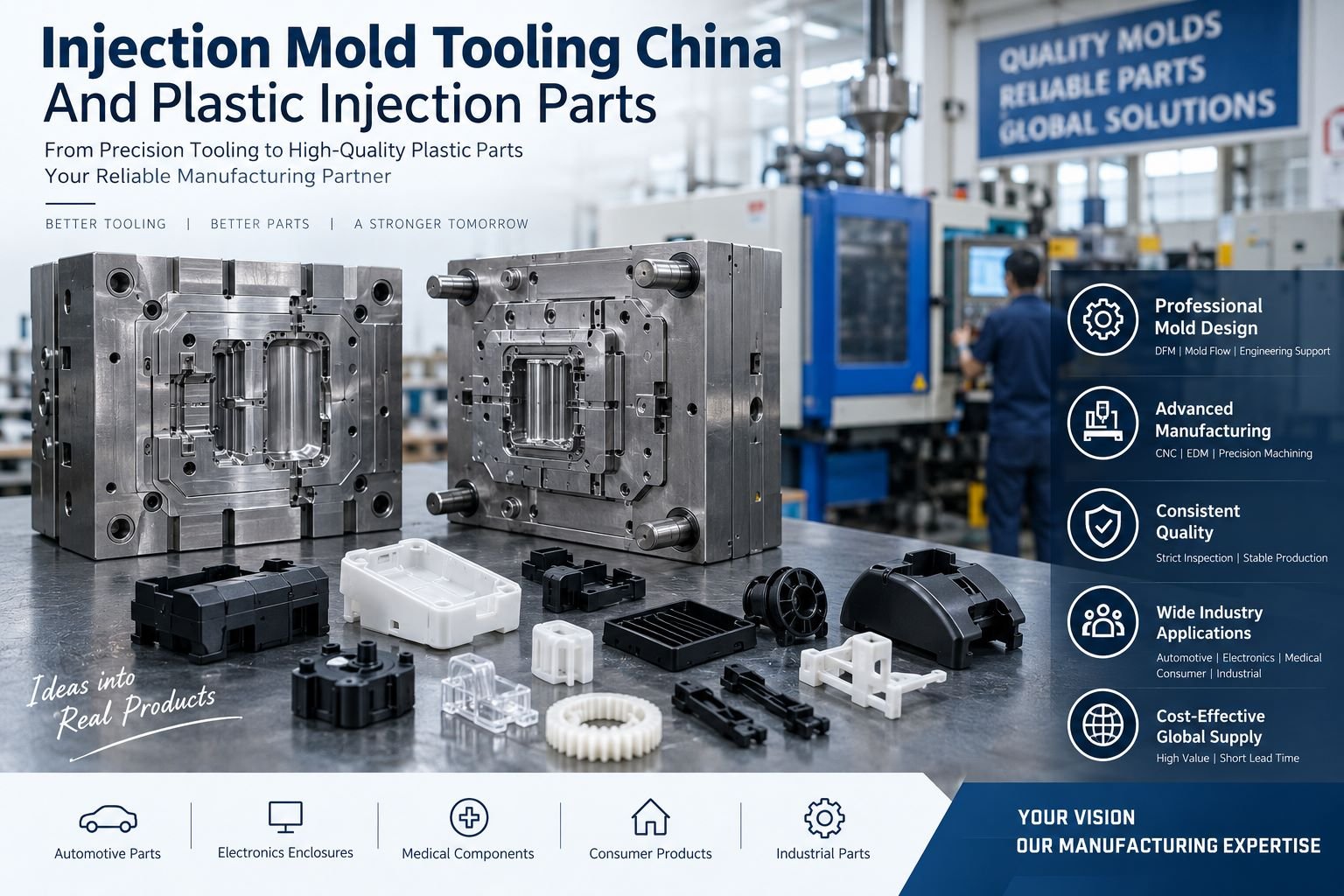
Working with an experienced Injection Mold Tooling China manufacturer can help businesses develop reliable molds, control production costs, improve component consistency, and move efficiently from prototype development to mass production. At the same time, the final quality of Plastic Injection Parts depends on mold engineering, resin selection, processing conditions, dimensional inspection, and ongoing tooling maintenance.
Understanding how these elements work together is essential for companies planning a new molded plastic product.
Understanding Injection Mold Tooling
Injection mold tooling is the specially engineered equipment used to shape molten plastic into a required component.
A mold generally consists of a cavity side and a core side. When both halves close, they create the exact geometry of the required product. Molten resin enters the mold under pressure, cools inside the cavity, and becomes a finished component.
Professional Injection Mold Tooling China manufacturers may use several precision technologies during mold construction, including:
- CNC machining
- Electrical discharge machining
- Wire cutting
- Precision grinding
- Drilling
- Surface polishing
- Laser engraving
- Tool fitting and assembly
The tooling must be accurate because small dimensional errors inside the mold can be reproduced across thousands of molded components.
Why Mold Engineering Matters
The quality of Plastic Injection Parts starts long before production begins.
Experienced mold engineers study the product design and identify areas that may create manufacturing problems. They evaluate wall thickness, draft angles, ribs, bosses, undercuts, gating positions, cooling layouts, ejector systems, and material flow.
Good engineering can reduce the possibility of defects such as:
- Sink marks
- Flash
- Short filling
- Warpage
- Weld lines
- Burn marks
- Uneven shrinkage
- Difficult part ejection
A design that looks perfect in a CAD model may not always be suitable for injection molding. This is why Design for Manufacturability analysis is normally recommended before mold manufacturing begins.
From Product Design to Finished Mold
A professional Injection Mold Tooling China project usually follows a structured development process.
The first stage involves reviewing customer drawings and 3D models. Engineers then analyze product dimensions, tolerance requirements, resin specifications, surface finishes, and expected production quantities.
After technical review, the typical process includes:
- Preparing the mold structure
- Confirming gate and parting-line locations
- Selecting suitable mold steel
- Machining core and cavity components
- Manufacturing slides, inserts, and lifters
- Creating cooling channels
- Performing mold assembly
- Running mold trials
- Measuring sample parts
- Adjusting the mold before production approval
This systematic approach helps reduce costly production problems later.
Choosing the Right Plastic Material
Material selection strongly influences the performance of Plastic Injection Parts.
Different polymers offer different combinations of strength, flexibility, heat resistance, chemical resistance, appearance, and cost.
| Plastic Material | Main Properties | Typical Uses |
| ABS | Tough and easy to process | Consumer housings |
| Polypropylene | Lightweight and chemical resistant | Containers and covers |
| Polycarbonate | Strong and impact resistant | Protective components |
| Nylon | Durable and wear resistant | Gears and mechanical parts |
| POM | Precise and low friction | Engineering components |
| TPE | Flexible and soft | Grips and seals |
Manufacturers should consider real operating conditions before selecting resin.
For example, a component exposed to heat requires different material characteristics than a decorative housing used indoors.
Mold Steel Selection and Tool Life
Mold durability depends heavily on steel selection and production conditions.
For prototype or low-volume projects, manufacturers may use softer tooling materials because they are easier to machine and usually less expensive.
High-volume production normally requires stronger mold steels capable of resisting wear over extended manufacturing cycles.
Important selection factors include:
- Expected production volume
- Plastic resin type
- Glass-fiber content
- Component dimensions
- Surface finish
- Required tolerances
- Maintenance schedule
A properly maintained mold can continue producing consistent Plastic Injection Parts for a long production period.
Single-Cavity vs Multi-Cavity Molds
Production volume plays an important role when selecting mold configuration.
A single-cavity mold creates one component during each injection molding cycle. It may be appropriate for larger products, prototype manufacturing, or lower production quantities.
Multi-cavity molds contain two or more identical cavities and manufacture several components during each cycle.
Multi-cavity tooling can provide:
- Greater production capacity
- Better efficiency for large orders
- Lower processing cost per component
- Faster order completion
However, multi-cavity molds require precise balancing so molten plastic fills every cavity evenly.
Experienced Injection Mold Tooling China engineers evaluate production requirements before deciding how many cavities are practical.
Importance of Cooling System Design
Cooling often accounts for a significant percentage of the injection molding cycle.
A well-designed cooling system removes heat evenly from the molded component and allows the part to solidify efficiently.
Poor cooling design may create:
- Warpage
- Longer production cycles
- Dimensional instability
- Uneven shrinkage
- Surface defects
Cooling channels should therefore be positioned carefully around the mold cavity.
More efficient cooling can increase production output while improving the consistency of Plastic Injection Parts.
Quality Inspection During Production
Quality control should continue throughout the complete manufacturing process.
Rather than checking only finished products, reliable manufacturers inspect tooling, trial samples, raw materials, and production components.
Important inspection points may include:
- Critical dimensions
- Component weight
- Color
- Surface condition
- Assembly fit
- Functional performance
- Material verification
- Production consistency
Precision products may be measured using coordinate measuring machines, optical equipment, gauges, micrometers, and other inspection tools.
Documenting measurements and molding parameters also helps maintain consistent production.
Advantages of Working With China Injection Mold Manufacturers
China has developed a large manufacturing infrastructure for plastic tooling and injection molding.
Businesses using Injection Mold Tooling China services can often access multiple manufacturing capabilities through one supply chain.
Potential advantages include:
- Custom mold development
- Precision CNC machining
- Prototype production
- High-volume molding
- Broad resin availability
- Tool modification services
- Component assembly
- Surface finishing
- Packaging support
However, supplier capabilities vary considerably.
Businesses should evaluate engineering knowledge, quality-control systems, tooling experience, communication, production capacity, and project management before placing an order.
How to Prepare a Successful Injection Molding Project
Customers can improve project efficiency by providing complete technical information from the beginning.
Important project details include:
- 3D CAD files
- 2D drawings
- Component tolerances
- Plastic material
- Surface texture
- Product color
- Annual production volume
- Expected mold life
- Assembly requirements
- Special testing requirements
Clear specifications allow Injection Mold Tooling China manufacturers to prepare more accurate tooling designs and quotations.
Customers should also review mold trial reports carefully before approving full-scale manufacturing.
Frequently Asked Questions
1. What does injection mold tooling mean?
Injection mold tooling refers to the mold and related components used to manufacture plastic products through injection molding.
2. Why is China popular for mold manufacturing?
China has a large tooling supply chain, experienced manufacturers, extensive machining capability, and strong injection molding infrastructure.
3. What are Plastic Injection Parts?
Plastic Injection Parts are plastic components manufactured by injecting molten polymer into a shaped mold cavity.
4. How is mold cost calculated?
Cost depends on component size, complexity, mold steel, cavity quantity, tolerance, surface finish, runner system, and tooling mechanisms.
5. Can one mold make several parts at once?
Yes. Multi-cavity molds can produce multiple identical components during one injection cycle.
6. What is a mold trial?
A mold trial is a production test used to evaluate filling, cooling, ejection, dimensions, appearance, and overall mold performance.
7. Which material is commonly used for injection molding?
ABS, PP, PC, nylon, POM, and TPE are frequently used depending on product requirements.
8. Can injection molded parts include logos?
Yes. Logos, symbols, numbers, textures, and branding elements can often be integrated into mold surfaces.
9. How can injection molding defects be reduced?
Proper mold design, correct processing temperatures, balanced pressure, good material preparation, and controlled cooling can help reduce defects.
10. Can injection molds be modified after production?
Many molds can be modified, although feasibility depends on the required design change and the existing tooling structure.