
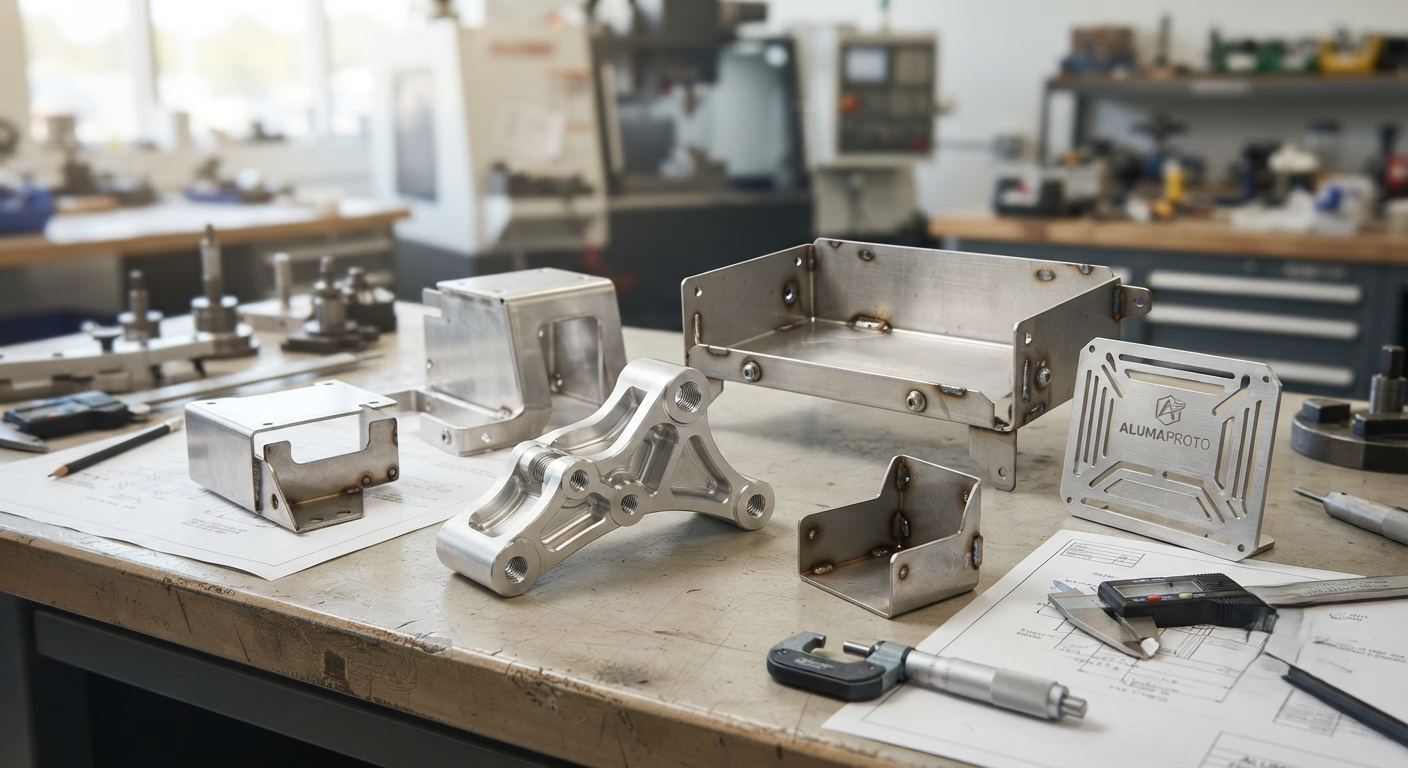
Modern product development depends on speed, accuracy, and the ability to test a design before investing in full-scale manufacturing. Two manufacturing methods that help engineers achieve these goals are aluminum prototype production and sheet metal prototyping. Both processes allow manufacturers to transform digital designs into functional physical components that can be evaluated for fit, strength, appearance, and performance.
An aluminum prototype is particularly useful when a project requires lightweight construction, corrosion resistance, good machinability, and realistic mechanical testing. Meanwhile, sheet metal prototyping is ideal for creating brackets, housings, panels, enclosures, frames, and structural parts using processes such as laser cutting, bending, punching, and welding.
Understanding how these technologies work helps companies shorten development cycles and reduce expensive manufacturing mistakes.
What Is an Aluminum Prototype?
An aluminum prototype is a pre-production component manufactured from an aluminum alloy to evaluate a product before mass production begins. Unlike visual plastic models, aluminum prototypes can closely represent the strength, weight, finish, tolerances, and functionality of production-ready metal components.
CNC machining is one of the most common methods used to produce aluminum prototypes. A computer-controlled machine removes material from an aluminum block until the desired geometry is achieved.
Common aluminum alloys used for prototypes include:
- Aluminum 6061
- Aluminum 7075
- Aluminum 5052
- Aluminum 2024
- Aluminum 6082
The correct alloy depends on mechanical strength, corrosion resistance, machining requirements, cost, and the final application.
Why Aluminum Is Popular for Prototype Manufacturing
Aluminum offers an excellent combination of low weight and mechanical performance. It is also relatively easy to machine compared with many harder metals.
Important advantages include:
- Lightweight construction
- Excellent machinability
- High strength-to-weight ratio
- Good thermal conductivity
- Natural corrosion resistance
- Multiple surface finishing possibilities
- Suitable for functional testing
These properties make aluminum prototype manufacturing valuable for automotive, aerospace, robotics, electronics, medical equipment, industrial machinery, and consumer products.
Aluminum Prototype Surface Finishing Options
Prototype components do not necessarily need to remain in a raw-machined condition. Different surface treatments can improve appearance and performance.
Common options include anodizing, bead blasting, polishing, powder coating, painting, brushing, and chemical conversion coating.
Anodizing is especially common because it improves corrosion resistance while creating an attractive and durable surface.
What Is Sheet Metal Prototyping?
Sheet metal prototyping involves manufacturing experimental or low-volume components from thin sheets of metal. Instead of removing large amounts of material, manufacturers cut and form flat sheets into three-dimensional parts.
Materials commonly used include aluminum, stainless steel, mild steel, galvanized steel, brass, and copper.
The basic process normally includes:
- Reviewing the CAD design.
- Selecting the appropriate sheet material.
- Creating the flat pattern.
- Cutting the required geometry.
- Bending the component.
- Welding or assembling parts when required.
- Applying the desired surface finish.
- Inspecting dimensions and tolerances.
This approach allows engineering teams to evaluate a realistic component before committing to expensive production tooling.
Major Sheet Metal Prototyping Processes
Several manufacturing techniques can be combined during sheet metal prototyping depending on component complexity.
Laser cutting provides accurate profiles and is suitable for complex geometries. CNC punching creates holes, slots, and repeated features efficiently. Press brake bending transforms flat sheets into accurately formed components.
Welding may then be used to join separate sections, while grinding or polishing improves the final appearance.
Modern prototype manufacturers may also use hardware insertion for threaded fasteners, nuts, studs, and other assembly components.
Aluminum Prototype vs Sheet Metal Prototyping
Although both methods support rapid product development, their manufacturing approaches are different.
| Factor | Aluminum Prototype | Sheet Metal Prototyping |
| Starting material | Solid aluminum block | Flat metal sheet |
| Main process | CNC machining | Cutting and bending |
| Complex 3D geometry | Excellent | Moderate |
| Thin enclosures | Less efficient | Excellent |
| Material waste | Higher | Usually lower |
| Functional testing | Excellent | Excellent |
| Typical products | Mechanical components | Panels and enclosures |
| Production volume | Prototype to low volume | Prototype to production |
Choosing between them depends mainly on component geometry, thickness, performance requirements, budget, and intended manufacturing method.
Applications of Aluminum Prototyping
The versatility of aluminum prototype manufacturing makes it useful across numerous industries.
Automotive engineers use aluminum prototypes for brackets, housings, drivetrain components, structural parts, and testing fixtures.
Electronics companies may create heat sinks and equipment housings because aluminum efficiently transfers heat.
Aerospace manufacturers frequently choose high-strength aluminum alloys for lightweight structural prototypes.
Other applications include:
- Robot components
- Medical equipment
- Industrial machinery
- Camera components
- Electric vehicle parts
- Consumer electronics
- Automation equipment
Because a prototype can closely replicate production performance, engineers can identify potential weaknesses early.
Applications of Sheet Metal Prototyping
Sheet metal prototyping is particularly suitable for products built from folded or fabricated metal.
Typical examples include:
- Electrical enclosures
- Equipment cabinets
- Machine guards
- Control panels
- Automotive brackets
- Battery enclosures
- Server housings
- HVAC components
- Mounting plates
- Industrial frames
Engineers can test assembly clearances, mounting positions, ventilation, accessibility, structural stability, and overall dimensions before production.
Design Considerations for Better Metal Prototypes
A technically attractive CAD model is not automatically easy to manufacture. Designing for manufacturability can significantly reduce prototype cost and production time.
Maintain Practical Tolerances
Extremely tight tolerances should only be specified where necessary. Excessive tolerance requirements increase machining difficulty, inspection requirements, and cost.
Consider Material Thickness
For sheet metal prototyping, consistent material thickness generally simplifies fabrication. Designers should also provide adequate spacing around bends and holes.
Use Appropriate Bend Radii
Very small bend radii can cause cracking or deformation. Bend radius should be selected according to material type and sheet thickness.
Think About Final Production Early
A prototype should provide information that improves production. Engineers should consider machining access, assembly methods, fastener locations, finishes, and production scalability during the design stage.
Benefits of Rapid Metal Prototyping
Combining aluminum prototype manufacturing with sheet metal prototyping can significantly improve the product-development process.
Key benefits include reduced design risk, faster testing, improved communication between engineering teams, easier assembly validation, and earlier identification of manufacturing problems.
Physical prototypes also provide information that computer simulations cannot always reveal, including ergonomics, real-world assembly difficulty, surface appearance, vibration, and user interaction.
How to Choose the Right Prototyping Method
Consider these factors before selecting a process:
- Component geometry and dimensions
- Required material properties
- Mechanical loads
- Surface finish expectations
- Dimensional tolerances
- Prototype quantity
- Development budget
- Future manufacturing process
Solid components with complex machined details usually favor an aluminum prototype, while thin-walled boxes, brackets, covers, and panels are generally better suited to sheet metal prototyping.
Frequently Asked Questions
1. What is an aluminum prototype used for?
It is used to test the dimensions, functionality, mechanical performance, appearance, and manufacturability of a product before full production.
2. Is aluminum suitable for functional prototypes?
Yes. Aluminum provides realistic strength, weight, thermal performance, and durability for functional testing.
3. What process is commonly used for aluminum prototypes?
CNC milling and CNC turning are among the most widely used processes.
4. What is sheet metal prototyping?
It is the production of prototype components by cutting, bending, forming, and joining sheets of metal.
5. Which materials can be used for sheet metal prototypes?
Common materials include aluminum, stainless steel, mild steel, brass, copper, and galvanized steel.
6. Is sheet metal prototyping expensive?
Cost depends on material, complexity, tolerances, quantity, finishing, and fabrication requirements. Simple prototypes can be relatively economical.
7. Can sheet metal prototypes receive surface finishes?
Yes. Powder coating, painting, plating, anodizing, brushing, and polishing are commonly available.
8. How accurate can an aluminum prototype be?
Modern CNC equipment can achieve very precise tolerances, although achievable accuracy depends on geometry, material, machine capability, and inspection requirements.
9. Can prototypes be produced in small quantities?
Yes. Both methods are well suited to one-off components, engineering samples, and low-volume production.
10. Which method should I choose?
Choose CNC aluminum prototyping for solid, complex components and sheet metal prototyping for thin-walled fabricated structures. Some products may require both methods.