
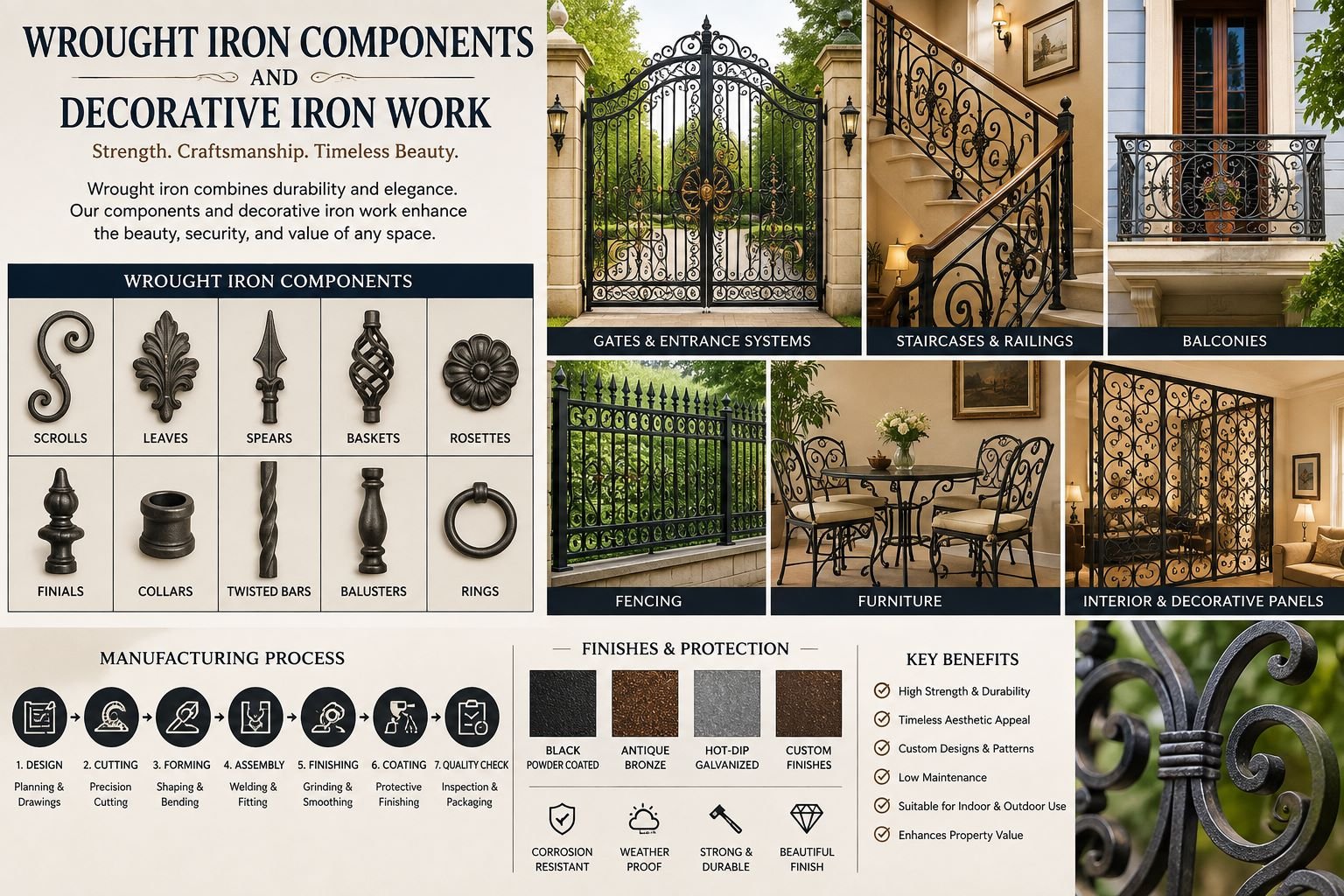
From handcrafted gates and balcony railings to ornamental furniture and boundary fences, iron has always provided a balance of strength, beauty, and artistic freedom. In earlier times, decorative metalwork depended completely on skilled blacksmiths who shaped every piece manually. Today, modern technology has changed how these components are designed, produced, finished, and installed.
The future of decorative iron work is expected to combine traditional craftsmanship with digital manufacturing, automation, sustainable production, advanced surface treatments, and highly personalized designs. This evolution is helping decorative iron remain relevant in both classical and contemporary architecture.
Wrought Iron Components in the Early Years
In the past, producing wrought iron components was a highly skilled manual process. Blacksmiths heated iron until it became flexible enough to bend, twist, flatten, or shape.
Using basic tools such as hammers, anvils, tongs, chisels, and punches, craftsmen created decorative elements one at a time.
Common traditional components included:
- Scrolls
- Forged leaves
- Flowers
- Decorative rings
- Spearheads
- Finials
- Iron baskets
- Rosettes
- Twisted bars
- Ornamental collars
Each piece reflected the craftsmanship of the person who produced it. Slight variations between components were common and were often considered part of the beauty of handmade ironwork.
How Decorative Iron Work Was Used Historically
Decorative iron work was widely used in architectural projects where security and appearance were equally important.
Large entrance gates were designed with floral patterns, scrolls, forged leaves, and decorative bars. Balcony railings and staircases often featured detailed ornamental patterns that matched the overall architecture of the property.
Traditional applications included:
- Palace gates
- Residential fences
- Stair railings
- Balcony grills
- Garden structures
- Window guards
- Decorative doors
- Furniture frames
- Public monuments
- Heritage buildings
Iron was particularly valued because it could be shaped into artistic forms while still providing structural strength.
Limitations of Traditional Iron Craftsmanship
Although traditional ironwork offered excellent artistic value, it also had several production challenges.
Manufacturing was slow because nearly every component required manual work. Producing large quantities of identical pieces was difficult, and quality depended greatly on the skills of individual craftsmen.
Traditional manufacturers often faced:
- Long production cycles
- High labor requirements
- Limited repeatability
- Manual measurement
- Inconsistent dimensions
- Basic finishing methods
- Higher customization time
These limitations eventually encouraged manufacturers to adopt mechanical and industrial fabrication techniques.
The Shift Toward Modern Iron Manufacturing
The development of industrial equipment changed the production of wrought iron components significantly.
Mechanical presses, bending machines, rolling equipment, cutting machines, and welding systems allowed manufacturers to produce components more efficiently.
Instead of shaping every scroll manually, companies could manufacture decorative elements in standardized sizes.
This made it easier to supply components for larger projects such as housing developments, hotels, commercial buildings, public spaces, and landscape installations.
Modern fabrication also improved consistency, making it possible to create repeating patterns across long railings and fences.
Decorative Iron Work in Modern Projects
Today, decorative iron work is no longer limited to traditional buildings.
It is widely used in contemporary architecture because manufacturers can create both highly ornamental and simple minimalist designs.
Modern applications include:
- Luxury entrance gates
- Staircase balustrades
- Balcony railings
- Decorative fencing
- Interior partitions
- Garden furniture
- Pergolas
- Wall panels
- Window grills
- Custom furniture
Architects can combine iron with glass, wood, stone, marble, concrete, or stainless steel.
This flexibility allows decorative metalwork to fit rustic, industrial, classical, luxury, and modern architectural styles.
Modern Production Techniques
Today’s manufacturers use advanced equipment to improve accuracy, productivity, and design possibilities.
Common production methods include:
- CNC cutting
- Laser cutting
- Mechanical bending
- Press forming
- Precision rolling
- Automated welding
- Grinding
- Polishing
- Sandblasting
- Powder coating
Digital drawings have also become an important part of the manufacturing process.
Before production starts, designers can create detailed models showing dimensions, decorative patterns, component positions, and overall proportions.
This reduces production errors and improves communication between designers, manufacturers, contractors, and customers.
Past and Future of Decorative Iron Work
| Area | Past | Future |
| Design Method | Hand sketches | Digital and AI-assisted design |
| Production | Manual forging | Automated manufacturing |
| Customization | Slow and labor-intensive | Fast digital customization |
| Accuracy | Depended on craftsmanship | Precision-controlled production |
| Finishing | Traditional paints | Advanced protective systems |
| Quality Control | Manual inspection | Smart measurement technology |
| Material Planning | Basic calculations | Software optimization |
| Sustainability | Limited focus | Recycling and waste reduction |
| Design Preview | Physical samples | 3D and virtual visualization |
| Installation | Traditional assembly | Modular systems |
The Future of Wrought Iron Components
The future of wrought iron components will likely focus on customization and efficient manufacturing.
Customers increasingly want designs that reflect the personality of a property rather than standard catalog patterns.
Digital technology will make it easier to create customized gates, railings, and decorative panels.
Designers may be able to modify:
- Pattern dimensions
- Scroll shapes
- Decorative spacing
- Panel height
- Finishes
- Component combinations
- Architectural styles
These modifications could be made digitally before any material enters production.
Artificial Intelligence in Decorative Iron Design
Artificial intelligence may become an important design tool in the ornamental metal industry.
AI-assisted software could help generate patterns according to customer preferences, available dimensions, architectural styles, and manufacturing limitations.
For example, software may help designers develop floral, geometric, classical, or minimalist patterns within seconds.
However, experienced designers and fabricators will still be important for evaluating structural requirements, proportions, materials, installation conditions, and practical manufacturing limitations.
Technology will support craftsmanship rather than completely replace it.
Sustainable Manufacturing in the Future
Sustainability will become increasingly important in decorative iron work.
Manufacturers may focus on reducing waste, improving energy efficiency, and extending product life.
Future sustainability practices may include:
- Using recycled metal
- Optimizing cutting layouts
- Reducing scrap material
- Using energy-efficient equipment
- Improving coating durability
- Recycling production waste
- Developing longer-lasting products
Because metal can be recycled, decorative iron can support circular manufacturing strategies when materials are properly recovered and reused.
Long-lasting products also reduce the frequency of replacement, which can lower overall material consumption.
Future Architectural Styles
Future decorative iron designs are likely to become cleaner, more personalized, and easier to integrate with modern buildings.
Highly detailed classical patterns will continue to be used for luxury villas, heritage properties, restoration projects, and traditional architecture.
Modern developments, however, may prefer simpler combinations.
Future trends may include:
- Minimalist geometric gates
- Laser-cut privacy panels
- Nature-inspired patterns
- Contemporary balcony screens
- Mixed glass-and-iron railings
- Modular decorative systems
- Personalized motifs
- Matte surface finishes
- Textured coatings
- Custom architectural panels
This combination of heritage craftsmanship and contemporary design will keep ornamental iron relevant for many years.
FAQ About Wrought Iron Components and Decorative Iron Work
1. How were wrought iron components made in the past?
They were mainly shaped manually by blacksmiths using heat, hammers, anvils, and traditional forging tools.
2. Where was decorative iron work commonly used?
It was widely used in gates, staircases, fences, balconies, furniture, window grills, and important architectural buildings.
3. Why was traditional ironwork difficult to manufacture?
Manual production required significant time, physical labor, and experienced craftsmen.
4. How is decorative iron produced today?
Modern manufacturers use bending machines, cutting equipment, welding systems, CNC machinery, and precision fabrication tools.
5. Can old-style wrought iron designs still be manufactured?
Yes. Traditional scrolls, leaves, baskets, flowers, and classical patterns can still be produced for new and restoration projects.
6. What is the future of wrought iron components?
The industry is expected to adopt greater automation, digital customization, sustainable manufacturing, and advanced design technology.
7. Will AI be used in decorative iron work?
AI may assist designers with pattern creation, material planning, and customization, but professional expertise will remain important.
8. Is wrought iron suitable for modern buildings?
Yes. Geometric patterns, clean lines, and mixed-material designs make decorative iron suitable for contemporary architecture.
9. Can decorative iron manufacturing become environmentally friendly?
Improved recycling, efficient material usage, reduced waste, and durable coatings can help reduce environmental impact.
10. Why will decorative iron remain popular?
Its combination of durability, customization, architectural beauty, and design flexibility makes it valuable for many types of projects.