
An important manufacturing opportunity involves producing components with multiple material characteristics without relying entirely on separate assembly operations.
The plastic manufacturing industry is exploring advanced molding techniques that allow different materials, colours, and functional characteristics to be combined within individual components. As product manufacturers seek improved usability, distinctive designs, and efficient assembly, multi-material injection molding is becoming an important engineering consideration.
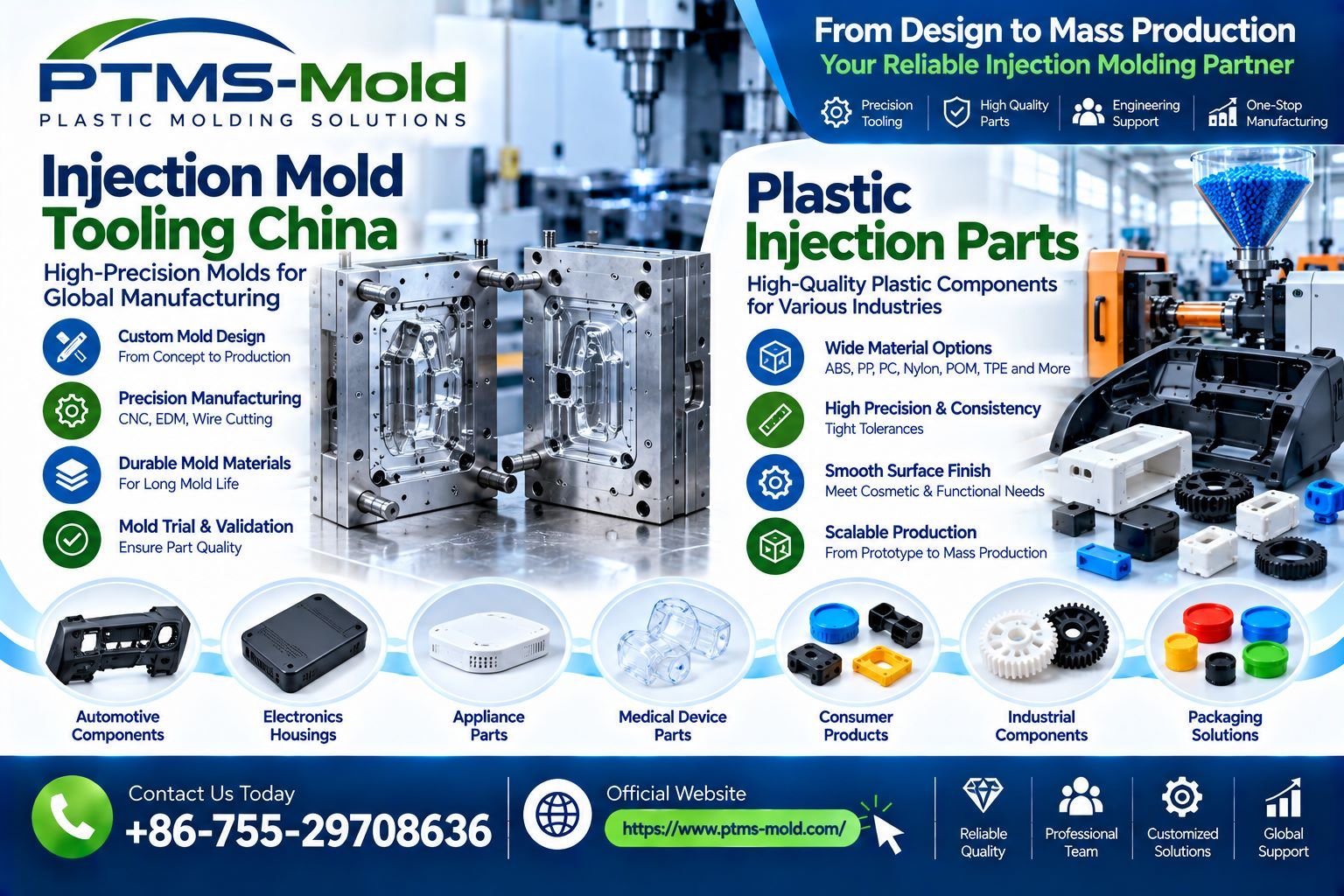
Injection Mold Tooling China offers sourcing opportunities for businesses developing specialised molds capable of supporting complex plastic component designs.
Meanwhile, demand for customised Plastic Injection Parts extends across electronics, automotive accessories, consumer appliances, industrial equipment, and other commercial applications.
For OEM manufacturers and product developers, understanding overmolding, two-shot molding, and material compatibility can help guide more effective product development decisions.
Why Multi-Material Injection Molding Matters
Conventional injection molding commonly produces components using a selected thermoplastic material.
However, some products require different characteristics within the same component.
For example, an electronic device enclosure may require a rigid structure combined with a softer gripping surface.
Similarly, an industrial handle may benefit from a durable inner body and an outer layer designed for comfortable handling.
Multi-material molding techniques can support these requirements through suitable manufacturing processes.
The appropriate approach depends on component geometry, material compatibility, production volume, and tooling investment.
Understanding Injection Mold Tooling China
Injection Mold Tooling China refers to sourcing injection mold design, engineering, and manufacturing services from tooling suppliers operating in China.
These services can support conventional molding as well as specialised processes, depending on the manufacturer’s capabilities.
Developing multi-material molds requires attention to cavity design, material flow, thermal conditions, and component positioning.
Engineers must determine how separate materials will form the desired product without creating unacceptable defects.
International buyers should evaluate relevant tooling experience, sample development capabilities, and quality-control procedures before selecting a manufacturer.
Clear engineering specifications help connect product design with practical manufacturing requirements.
What Are Multi-Material Plastic Injection Parts?
Plastic Injection Parts are components produced by injecting molten thermoplastic materials into suitable molds.
Multi-material parts incorporate two or more materials or molding stages to achieve particular functional or visual characteristics.
Possible applications include soft-touch handles, protective housings, appliance controls, and selected sealing features.
However, using multiple materials introduces additional engineering requirements.
Manufacturers must consider shrinkage differences, thermal compatibility, mechanical retention, and bonding behaviour.
The finished component should be evaluated as a complete product rather than as separate molded sections.
How Two-Shot Injection Molding Works
Two-shot injection molding is a process in which two materials or colours are molded through successive injection stages using suitable equipment and tooling.
The first material forms an initial component, while the second is introduced to create another section.
Depending on the system, the process may involve rotating or transferring the molded substrate between cavity positions.
This technique can support integrated designs with different surface characteristics.
However, successful production requires accurate alignment and compatible processing conditions.
Tooling complexity and equipment requirements may increase compared with conventional single-material molding.
Understanding Overmolding Technology
Overmolding involves molding an additional material around or onto an existing substrate.
The substrate may be a previously molded plastic component or another compatible material.
For example, a rigid plastic handle can receive a softer outer layer through an appropriate overmolding process.
This approach may reduce certain secondary assembly operations while improving product functionality.
However, the resulting connection depends on material compatibility, geometry, and processing conditions.
Manufacturers should evaluate whether chemical bonding, mechanical interlocking, or both are required.
Comparing Multi-Material Molding Processes
| Manufacturing Factor | Two-Shot Molding | Overmolding |
| Basic Process | Successive injection stages | Additional material molded onto a substrate |
| Tooling Requirements | Specialised multi-stage tooling | Suitable substrate and overmold tooling |
| Common Applications | Multi-colour and multi-material components | Grips, covers, and protective features |
| Main Advantage | Integrated production possibilities | Functional material combinations |
| Technical Challenge | Alignment and process coordination | Bonding and substrate positioning |
| Cost Consideration | Equipment and tooling complexity | Handling, tooling, and production volume |
The most suitable method depends on the complete product design and manufacturing objectives.
Why Material Compatibility Is Essential
Different polymers respond differently to temperature, pressure, and cooling.
When combining materials, manufacturers must evaluate whether their properties support the intended design.
For example, certain thermoplastic elastomers can be combined with compatible rigid plastics to create soft-touch surfaces.
However, not every elastomer bonds effectively with every substrate.
Poor compatibility may cause separation, surface defects, or premature component failure.
Engineers should review material specifications and conduct suitable adhesion or mechanical performance tests.
Selecting materials before final tooling development can reduce unnecessary redesign work.
How Tooling Accuracy Influences Product Performance
Multi-material components often require accurate positioning between molding stages.
Incorrect alignment may produce uneven surfaces, dimensional problems, or unwanted material overlap.
Mold design should address component location, cavity sealing, material flow, and cooling behaviour.
Tooling engineers may also need to consider how the first material responds to heat during the second molding stage.
Precision machining and controlled manufacturing processes are therefore important.
Physical samples help confirm whether the completed component meets approved design requirements.
Quality Testing for Multi-Material Components
A component with multiple materials requires evaluation of both individual material properties and the connection between them.
Depending on the application, suitable testing may involve:
- Adhesion Testing: Evaluating the bond between material layers.
- Dimensional Inspection: Confirming important product measurements.
- Visual Examination: Identifying incomplete filling, defects, or surface inconsistencies.
- Functional Testing: Assessing component behaviour during intended use.
- Environmental Evaluation: Reviewing performance under relevant temperature or exposure conditions.
Testing requirements should reflect the actual product application.
Manufacturers should avoid assuming that an attractive molded surface guarantees dependable long-term performance.
Choosing a Manufacturer for Advanced Injection Molding
Businesses evaluating tooling suppliers should focus on relevant engineering capabilities.
Important considerations include:
- Technical Experience: Familiarity with suitable multi-material molding methods.
- Material Knowledge: Understanding of polymer compatibility and processing behaviour.
- Tooling Precision: Accurate machining and component positioning.
- Prototype Development: Availability of representative molding trials.
- Quality Assurance: Suitable inspection and functional testing procedures.
- Production Planning: Clear communication about equipment, capacity, and costs.
A structured evaluation helps businesses determine whether specialised molding is commercially and technically appropriate.
Frequently Asked Questions (FAQs)
1. What is Injection Mold Tooling China?
It refers to injection mold engineering and manufacturing services sourced from Chinese suppliers for producing customised plastic components.
2. What are Plastic Injection Parts?
They are components manufactured by injecting molten thermoplastic material into a mold cavity and allowing it to cool into the required shape.
3. What is two-shot injection molding?
Two-shot injection molding uses successive injection stages to produce components incorporating two materials or colours.
4. What is the difference between overmolding and two-shot molding?
Overmolding adds material onto an existing substrate, while two-shot molding typically uses coordinated injection stages within specialised equipment.
5. How can businesses select suitable multi-material injection molding services?
Businesses should evaluate tooling expertise, polymer compatibility, production requirements, prototype performance, quality inspection, and technical support.
Media Contact
Department: Advanced Injection Mold Tooling and Plastic Manufacturing Enquiries
Contact: +86-755-29708636
Email: sales@ptms-mold.com
Official Website: https://www.ptms-mold.com/