
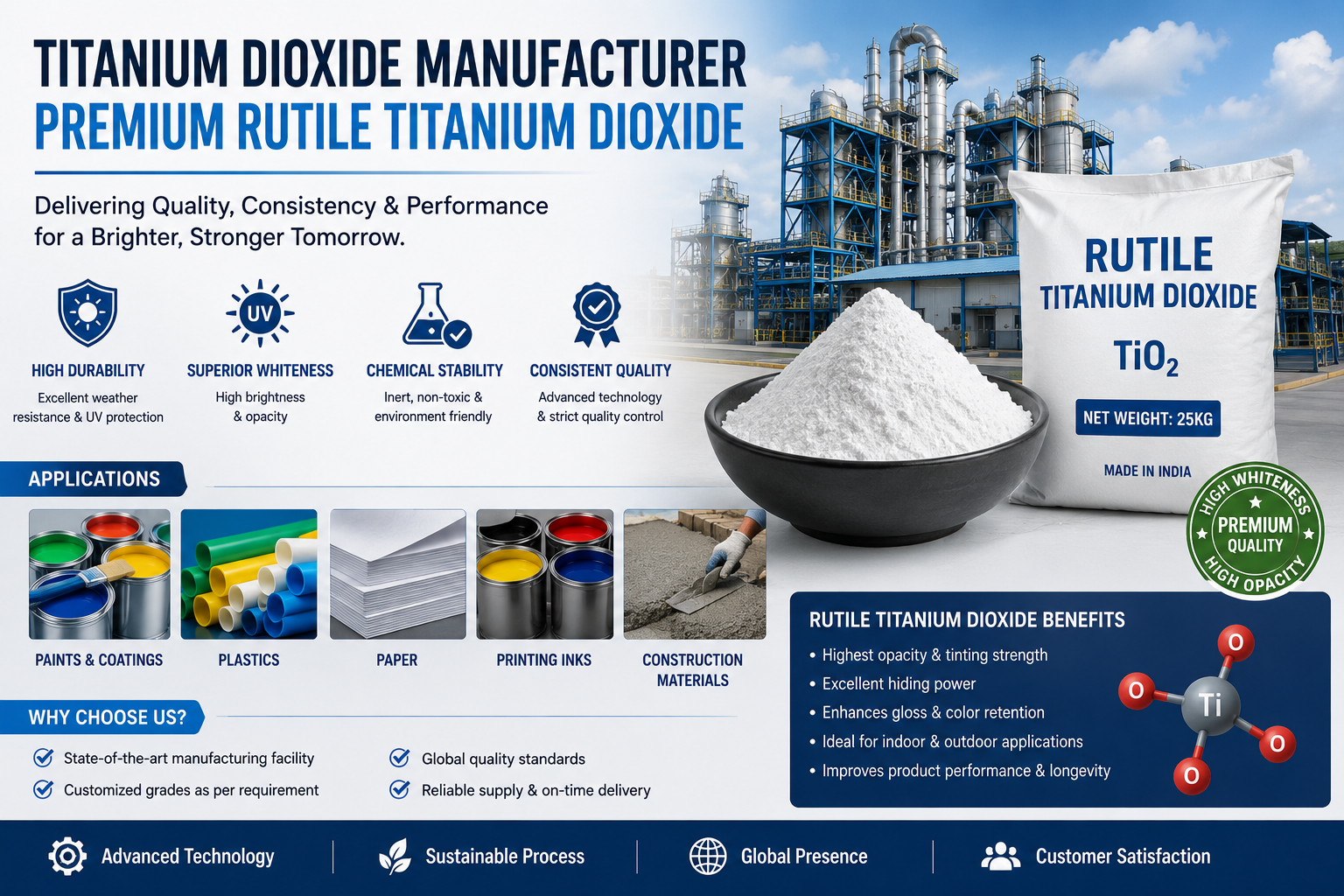
The global chemical and materials industry is witnessing steady growth in demand for titanium dioxide manufacturer products, particularly rutile titanium dioxide, due to its wide application across paints, coatings, plastics, paper, cosmetics, and industrial formulations. As industries move toward high-performance and durable materials, titanium dioxide continues to play a critical role as a white pigment and functional additive.
A reliable titanium dioxide manufacturer ensures consistent quality, particle size control, and high opacity, which directly impacts product performance across multiple sectors.
Understanding Titanium Dioxide and Its Industrial Importance
Titanium dioxide (TiO₂) is a naturally occurring oxide of titanium widely used for its brightness, whiteness, and strong UV resistance. It is one of the most important industrial pigments globally.
Among its different forms, rutile titanium dioxide is the most stable and widely used variant due to its superior durability and high refractive index.
Key Characteristics of Titanium Dioxide
- High opacity and brightness
- Excellent UV resistance
- Strong chemical stability
- Non-toxic and chemically inert
- High refractive index for superior whitening effect
What Makes Rutile Titanium Dioxide Different?
Rutile titanium dioxide is a crystalline form of TiO₂ that offers better performance compared to anatase form in many industrial applications. It is preferred in environments requiring long-term durability and weather resistance.
Applications of Rutile Titanium Dioxide
- Exterior paints and coatings
- Plastic manufacturing
- Automotive coatings
- Industrial inks
- Construction materials
- High-performance adhesives
Role of a Titanium Dioxide Manufacturer in Global Supply Chain
A professional titanium dioxide manufacturer plays a vital role in ensuring consistent supply, product quality, and compliance with international standards.
Core Responsibilities
- Raw material processing and purification
- Production of rutile titanium dioxide grades
- Quality control and laboratory testing
- Particle size and surface treatment optimization
- Export compliance and documentation
- Sustainable production practices
Comparison Between Rutile and Anatase Titanium Dioxide
| Feature | Rutile Titanium Dioxide | Anatase Titanium Dioxide |
| Crystal Structure | Dense and stable | Less dense |
| UV Resistance | High | Moderate |
| Weather Durability | Excellent | Lower |
| Industrial Use | Paints, coatings, plastics | Paper, indoor applications |
| Optical Properties | Higher opacity | Slightly lower opacity |
Key Industries Using Titanium Dioxide Manufacturer Products
1. Paint and Coatings Industry
Rutile titanium dioxide provides brightness, opacity, and long-lasting weather resistance in exterior paints.
2. Plastic Industry
It enhances whiteness, durability, and UV stability in plastic products.
3. Paper Industry
Used to improve brightness and print quality.
4. Cosmetics Industry
Acts as a pigment in sunscreens, lotions, and makeup products due to UV-blocking properties.
5. Construction Industry
Used in cement, tiles, and architectural coatings.
Why Rutile Titanium Dioxide Is Preferred in High-Performance Applications
Industries increasingly prefer rutile titanium dioxide due to its advanced performance features.
Key Advantages
- Superior weather resistance
- Higher refractive index
- Improved dispersion properties
- Long-lasting whiteness
- Better heat stability
- Enhanced durability in outdoor applications
Manufacturing Process of Titanium Dioxide
A leading titanium dioxide manufacturer typically follows advanced chemical processing methods to produce high-grade TiO₂.
Step-by-Step Process
- Extraction of titanium ore (ilmenite or rutile)
- Chemical processing (sulfate or chloride process)
- Purification and removal of impurities
- Particle size adjustment
- Surface treatment for improved performance
- Drying and packaging for industrial use
Global Market Trends for Titanium Dioxide Manufacturer Industry
The demand for titanium dioxide manufacturer products is growing steadily due to expansion in construction, automotive, and packaging industries.
Emerging Trends
- Shift toward eco-friendly production methods
- Increasing demand in Asia-Pacific region
- Growth in automotive coatings sector
- Rising use in UV-protective cosmetics
- Technological advancements in pigment dispersion
Challenges Faced by Titanium Dioxide Manufacturers
Despite strong demand, manufacturers face several challenges.
Key Challenges
- Raw material price fluctuations
- Environmental regulations
- Energy-intensive production processes
- Competition from alternative pigments
- Supply chain disruptions
How to Choose the Right Titanium Dioxide Manufacturer
Selecting a reliable titanium dioxide manufacturer is crucial for product quality and performance.
Key Factors to Consider
- Product purity and consistency
- Availability of rutile titanium dioxide grades
- Certifications (ISO, REACH compliance)
- Technical support and customization options
- Bulk supply capability
- Export experience and documentation support
Future Outlook of Rutile Titanium Dioxide Industry
The future of rutile titanium dioxide looks promising as industries continue to demand high-performance materials.
Expected Developments
- Sustainable production technologies
- Nano-grade titanium dioxide innovations
- Expansion in solar and energy applications
- Increased use in smart coatings
- Strong growth in developing economies
Frequently Asked Questions (FAQs)
1. What is titanium dioxide used for?
It is widely used as a white pigment in paints, plastics, paper, cosmetics, and coatings.
2. What is rutile titanium dioxide?
It is the most stable form of TiO₂ with high durability and strong UV resistance.
3. Why is rutile titanium dioxide preferred?
Because it offers better weather resistance, opacity, and long-term performance.
4. What does a titanium dioxide manufacturer do?
They produce and supply titanium dioxide for industrial and commercial applications.
5. Is titanium dioxide safe?
Yes, it is generally considered safe for approved industrial and cosmetic uses.
6. Which industries use titanium dioxide the most?
Paints, plastics, cosmetics, construction, and paper industries.
7. What is the difference between rutile and anatase TiO₂?
Rutile is more stable and durable, while anatase is used mainly for indoor applications.
8. How is titanium dioxide manufactured?
It is produced using sulfate or chloride chemical processes from titanium ores.
9. Why is titanium dioxide important in paints?
It provides brightness, opacity, and long-lasting color stability.
10. What should I look for in a titanium dioxide manufacturer?
Quality consistency, certifications, supply capacity, and technical support.