
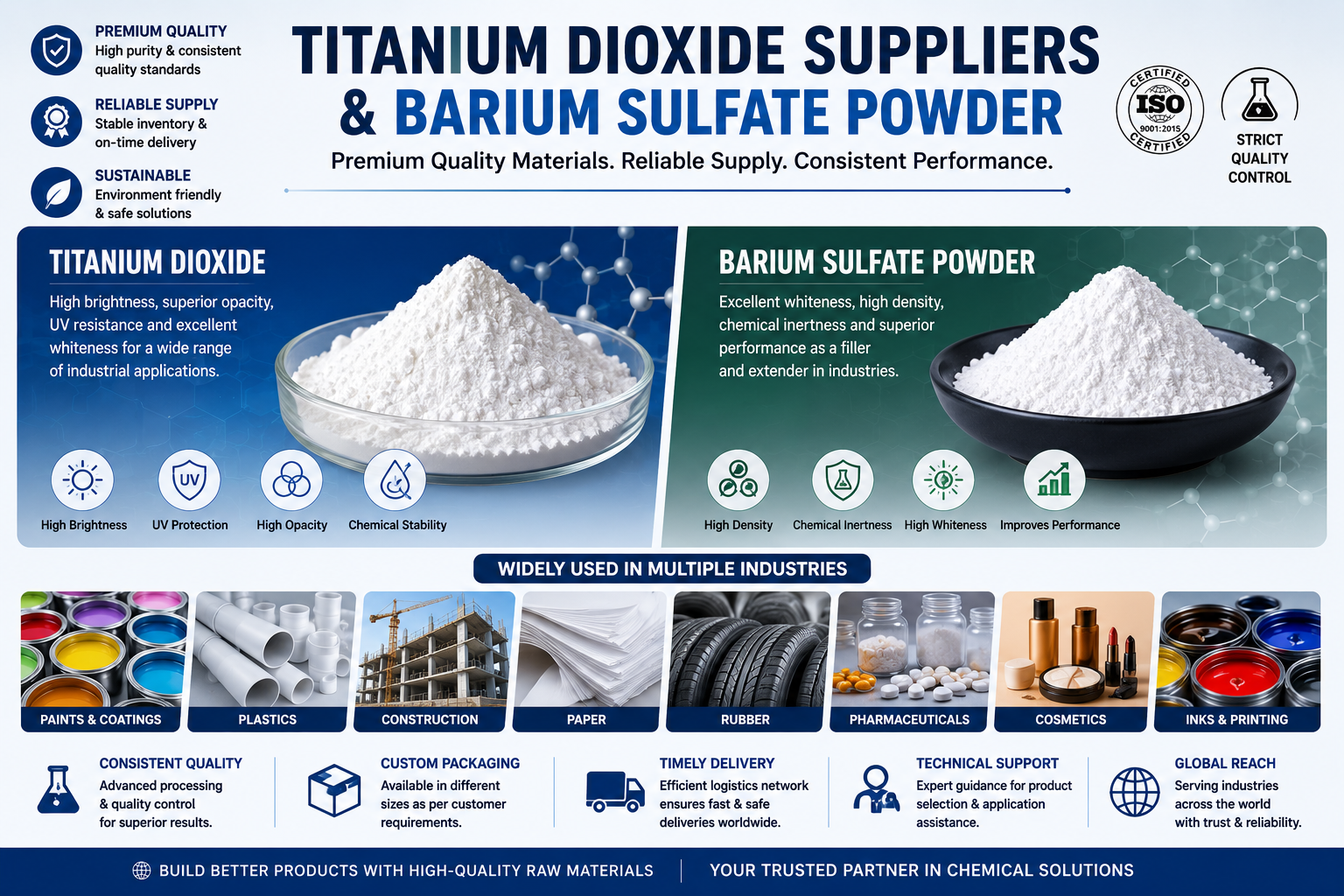
The global manufacturing and chemical processing industries are experiencing steady growth in demand for high-performance raw materials such as Titanium Dioxide suppliers and Barium Sulfate Powder. These two industrial compounds play a crucial role in enhancing product quality, durability, brightness, and performance across multiple sectors including paints, plastics, coatings, paper, rubber, and pharmaceuticals.
As industries move toward higher quality standards and cost-efficient formulations, the importance of reliable sourcing for these materials continues to rise significantly.
Understanding Titanium Dioxide Suppliers and Their Industrial Role
Titanium Dioxide (TiO₂) is one of the most widely used white pigments in the world. It is valued for its brightness, high refractive index, and excellent opacity. Reliable Titanium Dioxide suppliers ensure consistent quality material for industrial applications.
Key Characteristics of Titanium Dioxide
- High whiteness and brightness
- Strong UV resistance
- Excellent opacity and coverage
- Chemical stability
- Non-toxic and safe for industrial use
Common Applications
- Paints and coatings industry
- Plastic manufacturing
- Paper production
- Cosmetics and personal care products
- Printing inks
- Food-grade applications (regulated use)
Importance of Reliable Titanium Dioxide Suppliers
- Ensures consistent product quality
- Reduces production defects
- Maintains color stability in final products
- Supports large-scale industrial manufacturing
- Provides different grades (rutile and anatase)
Understanding Barium Sulfate Powder and Its Industrial Applications
Barium Sulfate Powder is a naturally occurring or synthetic mineral compound widely used as a functional filler in industrial applications. It is known for its high density, chemical inertness, and excellent brightness.
Key Properties of Barium Sulfate Powder
- High density and specific gravity
- Insoluble in water
- Chemically inert and stable
- Good whiteness and brightness
- Non-toxic nature
Applications of Barium Sulfate Powder
- Paints and coatings (as extender pigment)
- Plastic and rubber industries
- Oil and gas drilling fluids
- Pharmaceuticals (radiocontrast imaging)
- Paper and textile industry
- Powder coatings and adhesives
Titanium Dioxide vs Barium Sulfate Powder
| Feature | Titanium Dioxide | Barium Sulfate Powder |
| Primary Function | White pigment & opacity agent | Filler & extender |
| Brightness | Very high | Moderate to high |
| Density | Medium | High |
| UV Resistance | Excellent | Low |
| Cost Efficiency | Higher cost | Cost-effective |
| Industry Usage | Premium applications | Bulk industrial use |
Industrial Importance of Titanium Dioxide Suppliers
Choosing the right Titanium Dioxide suppliers is essential for industries that require consistent pigment performance and high-quality end products.
Why Supplier Selection Matters
- Impacts final product appearance
- Ensures batch-to-batch consistency
- Reduces production waste
- Maintains compliance with industry standards
- Supports large-scale manufacturing efficiency
Types of Titanium Dioxide Grades Offered
- Rutile Grade TiO₂
- Anatase Grade TiO₂
- Surface-treated specialty grades
- Industrial and cosmetic grades
Industrial Importance of Barium Sulfate Powder Suppliers
Reliable sourcing of Barium Sulfate Powder is critical for industries relying on filler materials that enhance product structure and reduce production costs.
Why Quality Matters in Barium Sulfate Powder
- Affects dispersion in formulations
- Impacts surface smoothness
- Ensures chemical stability
- Enhances durability of final products
- Reduces raw material consumption costs
Applications Across Key Industries
Paints and Coatings Industry
- Improves whiteness and opacity
- Enhances surface smoothness
- Provides weather resistance
Plastics Industry
- Increases product strength
- Enhances dimensional stability
- Improves surface finish
Rubber Industry
- Adds weight and density
- Improves mechanical performance
Pharmaceutical Industry
- Used in diagnostic imaging (barium sulfate suspension)
- Ensures safe internal contrast imaging
Key Factors When Choosing Titanium Dioxide Suppliers and Barium Sulfate Powder Suppliers
Selection Criteria
- Product purity and grade consistency
- Manufacturing and processing standards
- Particle size distribution control
- Supply chain reliability
- Bulk availability and packaging options
- Technical support and documentation
Red Flags to Avoid
- Inconsistent whiteness levels
- Poor dispersion in formulations
- Lack of technical data sheets
- Unstable pricing without justification
- No certification or quality reports
Market Trends and Industry Outlook
The demand for Titanium Dioxide suppliers and Barium Sulfate Powder is growing due to expanding industrial applications and infrastructure development.
Key Trends
- Increasing demand in construction coatings
- Growth in plastics and polymer industries
- Rising use in eco-friendly formulations
- Shift toward high-purity industrial minerals
- Expansion of export-oriented manufacturing
Frequently Asked Questions (FAQs)
1. What is Titanium Dioxide used for?
It is mainly used as a white pigment in paints, plastics, paper, and coatings.
2. Why are Titanium Dioxide suppliers important?
They ensure consistent quality and supply of pigment for industrial production.
3. What is Barium Sulfate Powder used for?
It is used as a filler in paints, plastics, rubber, and pharmaceutical applications.
4. Is Barium Sulfate Powder safe?
Yes, it is chemically inert and considered safe for industrial and medical use.
5. What is the difference between Titanium Dioxide and Barium Sulfate?
Titanium Dioxide is primarily a pigment, while Barium Sulfate is mainly a filler.
6. Which industries use Titanium Dioxide the most?
Paints, coatings, plastics, cosmetics, and paper industries.
7. Why is particle size important in these materials?
It affects dispersion, brightness, and performance in final products.
8. Can Barium Sulfate replace Titanium Dioxide?
No, both serve different functions in industrial formulations.
9. How do I choose a reliable supplier?
Check purity levels, certifications, consistency, and technical support.
10. Are these materials environmentally safe?
Yes, both are widely used under regulated industrial standards.