
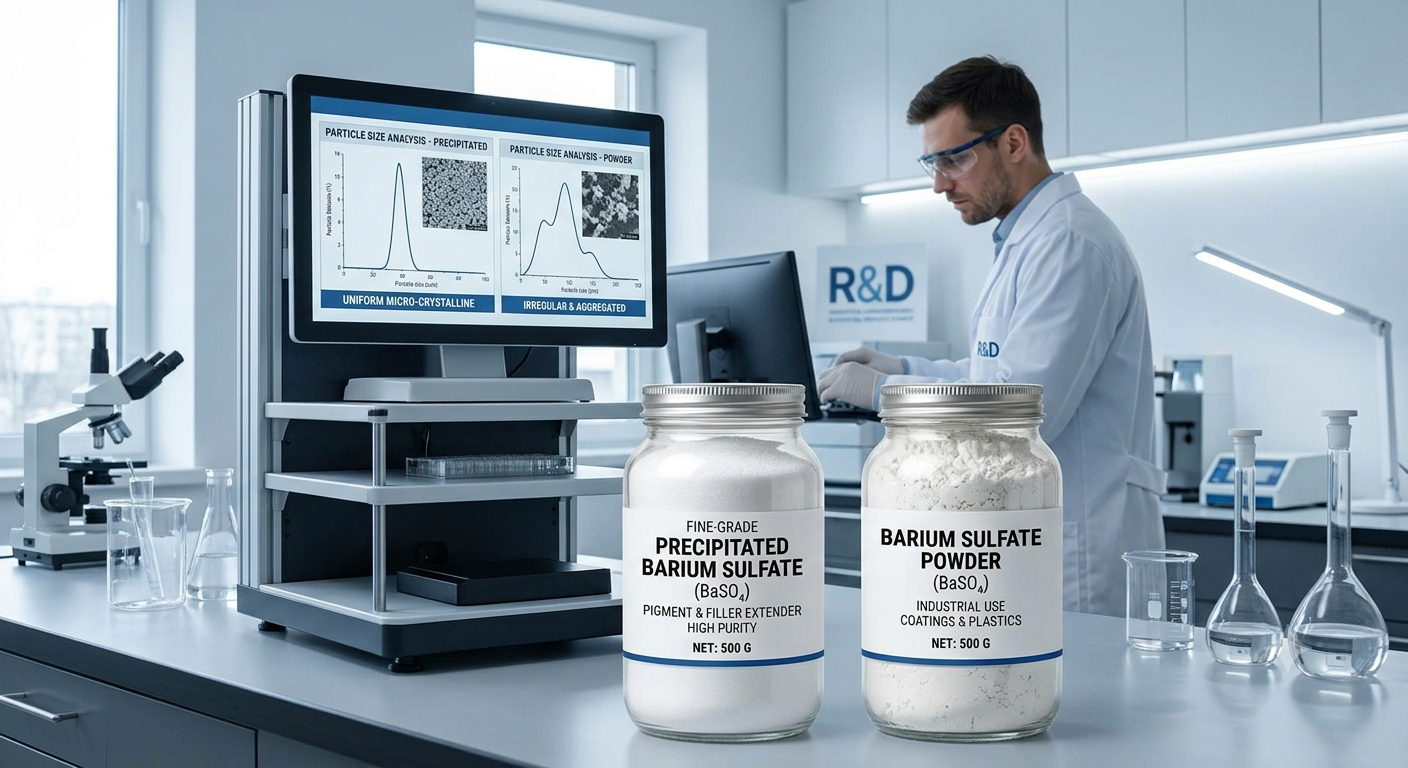
In recent years, precipitated barium sulfate and barium sulfate powder have gained significant attention across multiple industries, including paints, plastics, coatings, oil & gas, and pharmaceuticals. Known for their high purity, chemical stability, and excellent brightness, these materials are becoming essential raw inputs in modern manufacturing processes.
As industries continue to focus on quality, durability, and performance, the demand for refined mineral additives like barium sulfate powder is steadily increasing in global markets.
Understanding Precipitated Barium Sulfate
Precipitated barium sulfate is a highly purified form of barium sulfate produced through a chemical precipitation process. Unlike naturally mined barite, this form is synthetically manufactured to achieve superior particle control and consistency.
Key Characteristics
- Ultra-fine particle size distribution
- High whiteness and brightness
- Low impurities
- Excellent chemical inertness
- High density and stability
How It Is Produced
- Selection of high-purity raw materials
- Chemical reaction between barium salts and sulfate sources
- Controlled precipitation process
- Filtration and washing
- Drying and micronization
What Is Barium Sulfate Powder?
Barium sulfate powder is a naturally occurring or processed mineral compound widely used as a filler, extender, and functional additive. It is commonly derived from barite ore and refined for industrial applications.
Key Properties
- High specific gravity
- Insoluble in water
- Non-toxic and chemically inert
- Excellent opacity and brightness
- Thermal stability
Difference Between Precipitated Barium Sulfate and Barium Sulfate Powder
| Feature | Precipitated Barium Sulfate | Barium Sulfate Powder |
| Origin | Chemically synthesized | Naturally mined (barite) |
| Purity | Very high | Moderate to high |
| Particle Size | Ultra-fine and uniform | Coarser particles |
| Brightness | Superior whiteness | Slightly lower |
| Cost | Higher | More economical |
| Applications | High-end coatings, pharma | General industrial use |
Industrial Applications of Barium Sulfate Powder
Barium sulfate powder is widely used across multiple sectors due to its versatility and stability.
Major Applications
- Paints and coatings industry
- Plastic and polymer manufacturing
- Rubber industry
- Oil and gas drilling fluids
- Paper industry as filler
- Pharmaceutical imaging (medical contrast agents)
Why Industries Prefer It
- Improves product density
- Enhances surface finish
- Increases durability
- Reduces production costs
- Provides chemical resistance
Applications of Precipitated Barium Sulfate
Precipitated barium sulfate is preferred where high precision and purity are required.
Key Uses
- High-end automotive coatings
- Premium plastics and masterbatches
- Cosmetics and personal care formulations
- Pharmaceutical-grade applications
- Specialty chemical formulations
Role in Paints, Coatings, and Plastics Industry
Both precipitated barium sulfate and barium sulfate powder play a critical role in improving product performance.
Benefits in Coatings
- Improves gloss and smoothness
- Enhances weather resistance
- Provides excellent dispersion
- Increases film durability
Benefits in Plastics
- Improves mechanical strength
- Enhances thermal resistance
- Acts as an effective filler
- Reduces material shrinkage
Comparison of Industrial Performance
| Application Area | Precipitated Barium Sulfate | Barium Sulfate Powder |
| Automotive Coatings | Excellent finish quality | Good performance |
| Plastic Compounding | High precision | Cost-effective filler |
| Pharmaceuticals | High purity grade | Limited use |
| Oil Drilling Fluids | Rare use | Widely used |
| Cosmetics | Suitable | Not commonly used |
Key Benefits for Manufacturers
Advantages of Using These Materials
- Improved product quality consistency
- Cost optimization in bulk production
- Better chemical stability
- Enhanced product performance
- Compatibility with multiple industrial formulations
Market Trends and Industry Growth
The global demand for barium sulfate powder and precipitated barium sulfate is increasing due to:
- Expansion of construction and automotive sectors
- Rising demand for high-performance coatings
- Growth of plastics and polymer industries
- Increasing use in healthcare and pharmaceuticals
- Focus on eco-friendly and non-toxic materials
Manufacturers are also investing in advanced processing technologies to improve particle uniformity and purity levels.
How to Choose the Right Grade of Barium Sulfate
Selection Guidelines
- Identify application requirements
- Check particle size distribution
- Evaluate whiteness and purity levels
- Consider compatibility with base materials
- Compare cost vs performance balance
Industrial Tip
High-end applications like automotive paints require precipitated barium sulfate, while general industrial fillers can use standard barium sulfate powder.
Frequently Asked Questions (FAQs)
1. What is precipitated barium sulfate?
It is a high-purity synthetic form of barium sulfate produced through chemical precipitation.
2. What is barium sulfate powder used for?
It is used in paints, plastics, rubber, oil drilling, and various industrial applications.
3. What is the main difference between the two?
Precipitated barium sulfate is synthetic and purer, while barium sulfate powder is often mined and processed.
4. Is barium sulfate toxic?
No, it is chemically inert and considered non-toxic in industrial use.
5. Why is barium sulfate used in paints?
It improves brightness, durability, and surface smoothness.
6. Can it be used in pharmaceuticals?
Yes, high-purity grades are used in medical imaging as contrast agents.
7. Is precipitated barium sulfate more expensive?
Yes, due to its higher purity and controlled manufacturing process.
8. What industries use barium sulfate powder the most?
Paints, plastics, rubber, and oil & gas industries are the major users.
9. Does particle size matter?
Yes, finer particles provide better dispersion and smoother finishes.
10. How is precipitated barium sulfate produced?
It is produced by reacting barium salts with sulfate sources under controlled conditions.