
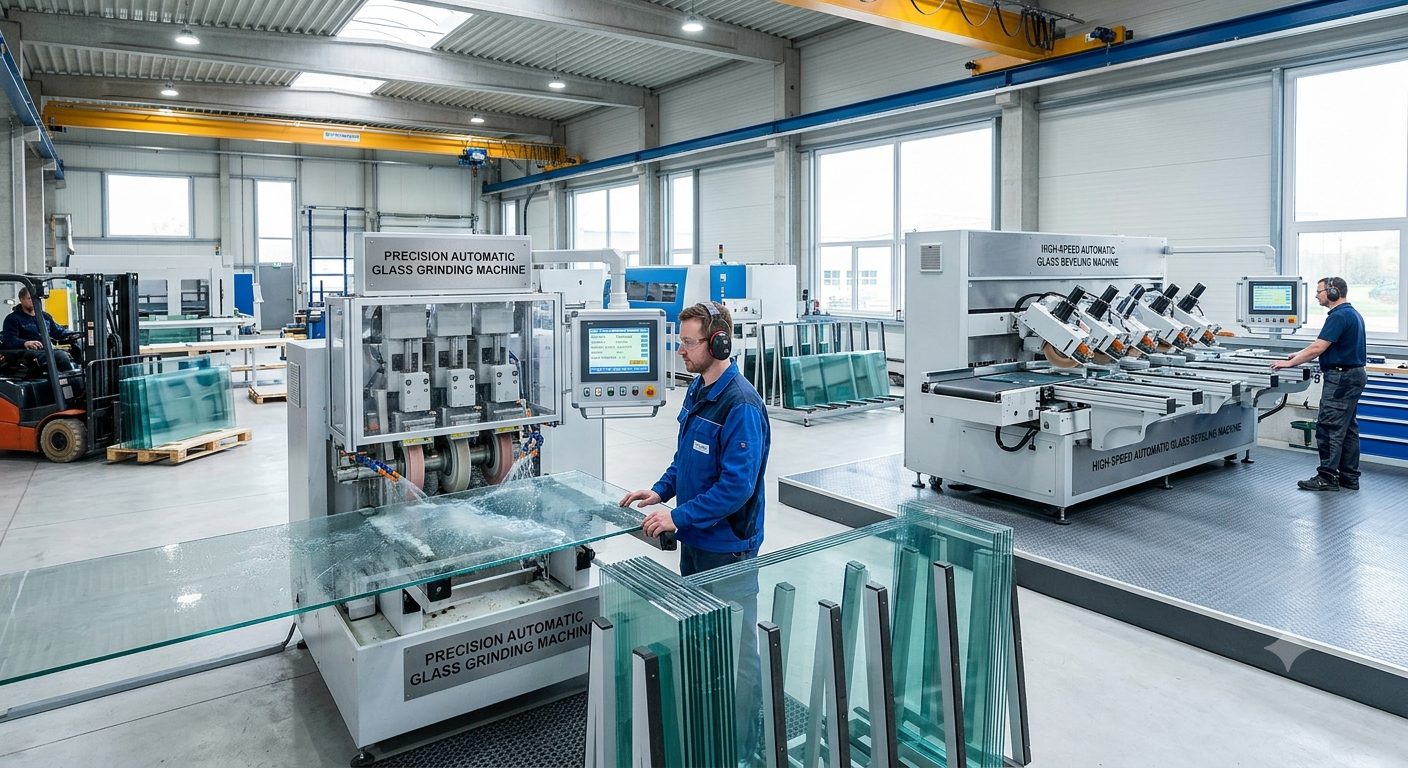
The global glass processing industry has evolved rapidly with increasing demand for precision finishing, decorative glass, architectural glazing, and industrial applications. In this growing landscape, the glass grinding machine and glass beveling machine play a critical role in shaping, smoothing, and enhancing glass surfaces for both functional and aesthetic purposes.
From furniture manufacturers to construction companies, these machines ensure accuracy, safety, and high-quality finishing in every glass product.
What is a Glass Grinding Machine?
A glass grinding machine is an industrial tool used to smooth, shape, and refine the edges of glass after it has been cut. It removes sharp edges, improves safety, and prepares glass for further processing such as polishing or coating.
Key Functions of Glass Grinding Machine
- Edge smoothing and shaping
- Removal of sharp and uneven edges
- Surface refinement before polishing
- Preparation for lamination or toughening
- Enhancing product safety and durability
Why It Is Important
- Prevents injuries from sharp edges
- Improves product finishing quality
- Increases durability of glass components
- Ensures compliance with safety standards
Understanding Glass Beveling Machine
A glass beveling machine is used to create angled edges (bevels) on glass surfaces. This process is widely used in decorative glass manufacturing, mirrors, furniture, and architectural glass applications.
Key Functions of Glass Beveling Machine
- Creating decorative beveled edges
- Enhancing optical reflection effects
- Improving aesthetic value of glass products
- Preparing glass for mirrors and luxury interiors
- Precision angle cutting and polishing
Glass Grinding Machine vs Glass Beveling Machine
| Feature | Glass Grinding Machine | Glass Beveling Machine |
| Purpose | Edge smoothing and shaping | Decorative angled finishing |
| Output | Safe, smooth edges | Polished beveled edges |
| Application | Industrial glass processing | Decorative and architectural glass |
| Precision Level | Functional accuracy | High aesthetic precision |
| Usage | Construction, automotive, industrial | Interior design, mirrors, luxury glass |
How a Glass Grinding Machine Works
A glass grinding machine operates using abrasive wheels or belts that gradually remove rough edges from glass surfaces.
Working Process
- Glass is placed on a conveyor or holding platform
- Grinding wheels rotate at high speed
- Edge is carefully polished and smoothed
- Cooling system prevents overheating
- Final inspection ensures uniform finishing
Key Components
- Grinding wheels
- Water cooling system
- Motor drive system
- Conveyor belt
- Control panel
How a Glass Beveling Machine Works
A glass beveling machine uses angled grinding wheels to create precise beveled edges on glass sheets.
Working Process
- Glass sheet is fixed on the machine table
- Diamond wheels grind the edge at specific angles
- Multiple polishing stages refine the bevel
- Final buffing gives a glossy finish
- Output is checked for uniform angle and clarity
Key Components
- Diamond grinding wheels
- Angle adjustment system
- Polishing heads
- Cooling and lubrication system
- Automated control system
Applications of Glass Grinding Machine and Glass Beveling Machine
These machines are widely used across multiple industries.
Industrial Applications
- Architectural glass panels
- Automotive windshields
- Furniture glass tops
- Shower enclosures
- Mirrors and decorative glass
- Solar panel glass processing
- Industrial safety glass
Benefits of Using Glass Grinding Machine
Key Advantages
- Ensures safety by removing sharp edges
- Improves glass durability
- Increases production efficiency
- Reduces manual labor
- Provides consistent finishing quality
Benefits of Glass Beveling Machine
Key Advantages
- Enhances visual appeal of glass
- Creates premium decorative effects
- Improves light reflection in mirrors
- Suitable for luxury interior design
- Offers high precision finishing
Types of Glass Grinding Machines
1. Manual Glass Grinding Machine
- Used for small-scale operations
- Requires operator control
2. Semi-Automatic Machine
- Combines manual and automatic features
- Suitable for medium production units
3. Fully Automatic Glass Grinding Machine
- High-speed industrial production
- Minimal human intervention
Types of Glass Beveling Machines
1. Straight-Line Beveling Machine
- Used for flat glass edges
- Common in mirror production
2. Shape Beveling Machine
- Handles curved or custom shapes
- Used in decorative glass design
3. CNC Glass Beveling Machine
- Computer-controlled precision
- High-end industrial applications
Key Features to Consider Before Buying
Important Factors
- Machine speed and efficiency
- Grinding precision level
- Power consumption
- Build quality and durability
- Automation level
- Maintenance requirements
- Safety features
Maintenance Tips for Long Life Performance
Best Practices
- Regular cleaning of grinding wheels
- Proper lubrication of moving parts
- Timely replacement of abrasive tools
- Monitoring cooling system efficiency
- Routine calibration checks
Latest Trends in Glass Processing Machinery
The glass industry is rapidly adopting advanced technology.
Emerging Trends
- CNC-based automation systems
- AI-assisted quality control
- Energy-efficient machines
- High-speed precision polishing systems
- Smart monitoring and diagnostics
Frequently Asked Questions (FAQs)
1. What is a glass grinding machine used for?
It is used to smooth and shape glass edges for safety and finishing.
2. What is a glass beveling machine used for?
It creates angled decorative edges on glass surfaces.
3. Is grinding necessary before beveling?
Yes, grinding ensures smooth edges before beveling begins.
4. Can both machines be used together?
Yes, many production lines use both for complete finishing.
5. What industries use glass grinding machines?
Construction, automotive, furniture, and glass manufacturing industries.
6. What is the difference between grinding and polishing?
Grinding removes rough edges, while polishing creates a smooth shiny surface.
7. Are glass beveling machines automatic?
Modern machines can be fully automatic or CNC-controlled.
8. What materials can be processed?
They are mainly used for float glass, mirror glass, and tempered glass.
9. How important is cooling in these machines?
Cooling prevents overheating and ensures precision finishing.
10. Are these machines suitable for small businesses?
Yes, smaller models are available for workshops and small-scale production.