
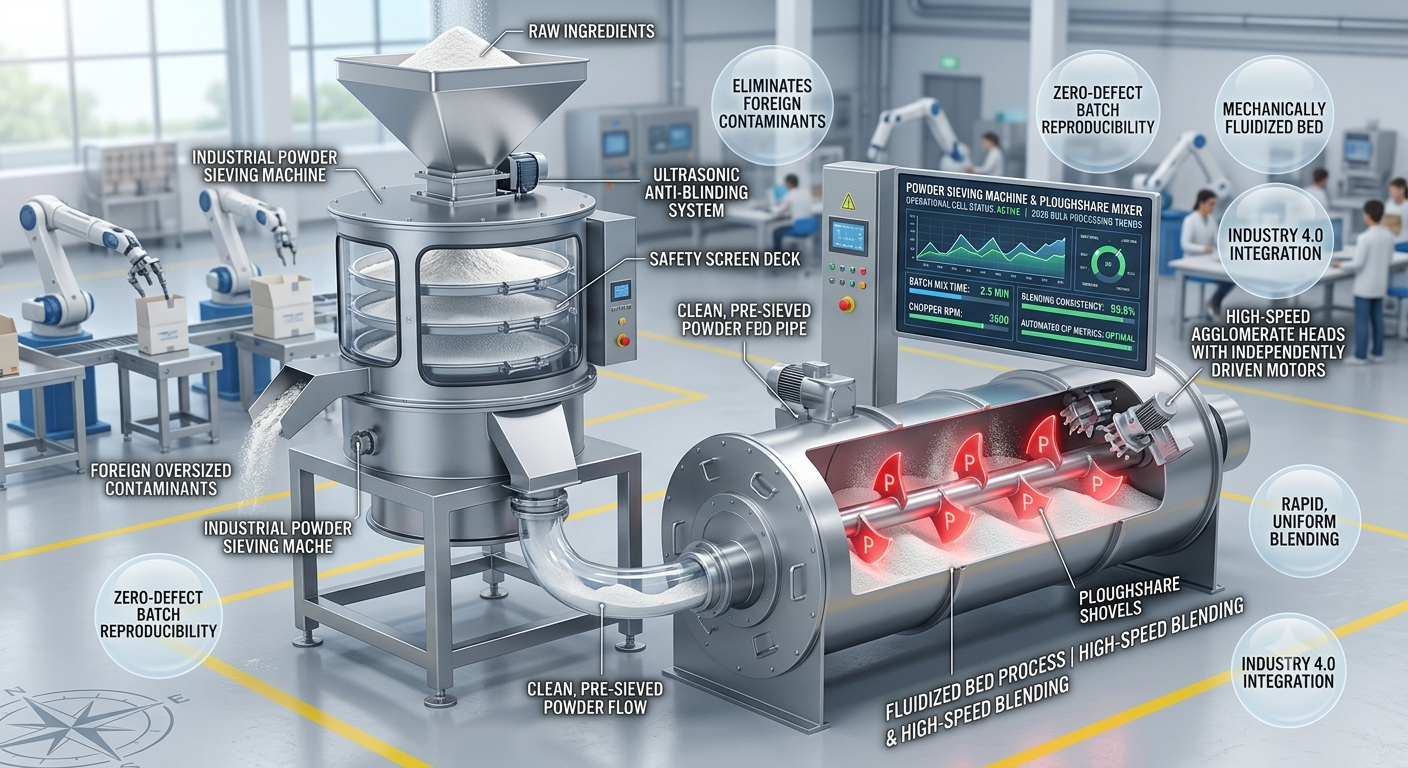
In today’s fast-growing manufacturing environment, precision and consistency in powder processing have become critical. Industries such as pharmaceuticals, food processing, chemicals, cosmetics, and construction materials increasingly rely on equipment like the powder sieving machine and ploughshare mixer to ensure uniform quality and contamination-free production.
These machines play a vital role in improving product efficiency, maintaining batch consistency, and meeting strict quality control standards. As industries scale up production, the demand for advanced mixing and sieving technology continues to rise globally.
What Is a Powder Sieving Machine?
A powder sieving machine is an industrial device used to separate and classify powder materials based on particle size. It ensures that unwanted impurities, oversized particles, and contaminants are removed before the material enters production or packaging stages.
Key Functions of Powder Sieving Machine
- Separation of fine and coarse particles
- Removal of foreign contaminants
- Ensuring uniform particle size distribution
- Improving product consistency
- Enhancing downstream processing efficiency
Types of Powder Sieving Machines
- Vibratory sieving machines
- Rotary sieve separators
- Ultrasonic sieving systems
- Centrifugal sifters
- Linear screening machines
Key Benefits
- High precision particle separation
- Improved product quality
- Reduced material wastage
- Faster production cycles
- Compliance with industry standards
What Is a Ploughshare Mixer?
A ploughshare mixer is a high-intensity industrial mixing machine used for blending powders, granules, and pastes. It is widely used in industries requiring homogeneous mixing within short processing times.
This equipment uses plough-shaped mixing elements that rotate at high speed, creating a fluidized mixing zone inside the chamber.
Core Working Principle
The plough-shaped blades rotate and lift the material, generating a three-dimensional mixing motion that ensures uniform blending without damaging the particles.
Key Applications of Ploughshare Mixer
- Chemical powder blending
- Pharmaceutical formulations
- Food ingredient mixing
- Construction material preparation
- Fertilizer and agrochemical production
Main Advantages
- Extremely fast mixing cycle
- High homogeneity output
- Suitable for dry and wet mixing
- Low heat generation during process
- Handles fragile and dense materials efficiently
Working Process of Powder Sieving Machine and Ploughshare Mixer
Powder Sieving Process
- Raw material is fed into the sieving chamber
- Vibrations or rotation initiate particle movement
- Fine particles pass through mesh screens
- Oversized particles are separated
- Clean, uniform powder is collected
Ploughshare Mixing Process
- Raw ingredients are loaded into mixing chamber
- Plough blades rotate at high speed
- Material is lifted, dispersed, and mixed in multiple directions
- Optional choppers break agglomerates
- Homogeneous mixture is discharged
Powder Sieving Machine vs Ploughshare Mixer
| Feature | Powder Sieving Machine | Ploughshare Mixer |
| Function | Particle separation | Material blending |
| Process Type | Classification | Homogenization |
| Output | Uniform particle size | Uniform mixture |
| Industry Use | Pre-processing stage | Production stage |
| Technology | Vibratory/rotary motion | High-speed mechanical mixing |
| Result | Clean, graded powder | Consistent product batch |
Industrial Applications of Powder Sieving Machine and Ploughshare Mixer
Pharmaceutical Industry
- Drug powder filtration
- Active ingredient blending
- Contamination removal
Food Industry
- Spices and flour sieving
- Beverage powder mixing
- Nutritional supplement blending
Chemical Industry
- Pigment blending
- Resin and polymer processing
- Fine chemical classification
Construction Industry
- Cement and mortar mixing
- Additive blending
- Sand and filler classification
Cosmetics Industry
- Face powder preparation
- Cream base mixing
- Pigment uniformity control
Why Industries Prefer Powder Sieving Machine and Ploughshare Mixer
Modern manufacturing requires precision and speed. These machines ensure both.
Key Reasons for Adoption
- High production efficiency
- Consistent batch quality
- Reduced human error
- Compliance with GMP standards
- Scalable industrial output
- Improved product shelf life
Technological Advancements in Powder Processing Equipment
Industrial mixing and sieving systems are evolving rapidly with modern innovations.
Latest Developments
- Automated control systems
- Stainless steel hygienic designs
- Dust-free operation technology
- PLC-based monitoring systems
- Energy-efficient motor systems
- Easy-clean modular construction
How to Choose the Right Powder Sieving Machine and Ploughshare Mixer
Important Selection Factors
- Material type and density
- Required batch capacity
- Particle size requirements
- Mixing uniformity level
- Hygiene and industry standards
- Maintenance and cleaning ease
Common Mistakes to Avoid
- Choosing incorrect mesh size
- Ignoring material compatibility
- Overlooking machine capacity
- Neglecting cleaning requirements
- Not considering long-term maintenance cost
Maintenance Guidelines for Long-Term Efficiency
Proper maintenance ensures durability and performance.
Best Practices
- Regular cleaning after each batch
- Periodic inspection of sieves and blades
- Lubrication of moving parts
- Calibration of vibration systems
- Replacement of worn-out screens
Frequently Asked Questions (FAQs)
1. What is a powder sieving machine used for?
It is used to separate powders based on particle size and remove impurities.
2. What is a ploughshare mixer used for?
It is used for fast and uniform mixing of powders, granules, and dry materials.
3. Which industries use these machines?
Pharmaceutical, food, chemical, cosmetic, and construction industries.
4. What is the main difference between them?
A sieving machine separates materials, while a ploughshare mixer blends them.
5. Can a ploughshare mixer handle wet materials?
Yes, it can handle both dry and wet mixing processes.
6. Is a powder sieving machine suitable for fine powders?
Yes, especially with fine mesh or ultrasonic systems.
7. How fast does a ploughshare mixer work?
It typically achieves uniform mixing within minutes depending on batch size.
8. Does a sieving machine improve product quality?
Yes, it ensures uniform particle size and removes contaminants.
9. Are these machines automated?
Modern versions often include PLC-based automation systems.
10. What materials are commonly processed?
Chemicals, food powders, pharmaceutical ingredients, cement, and cosmetics.