
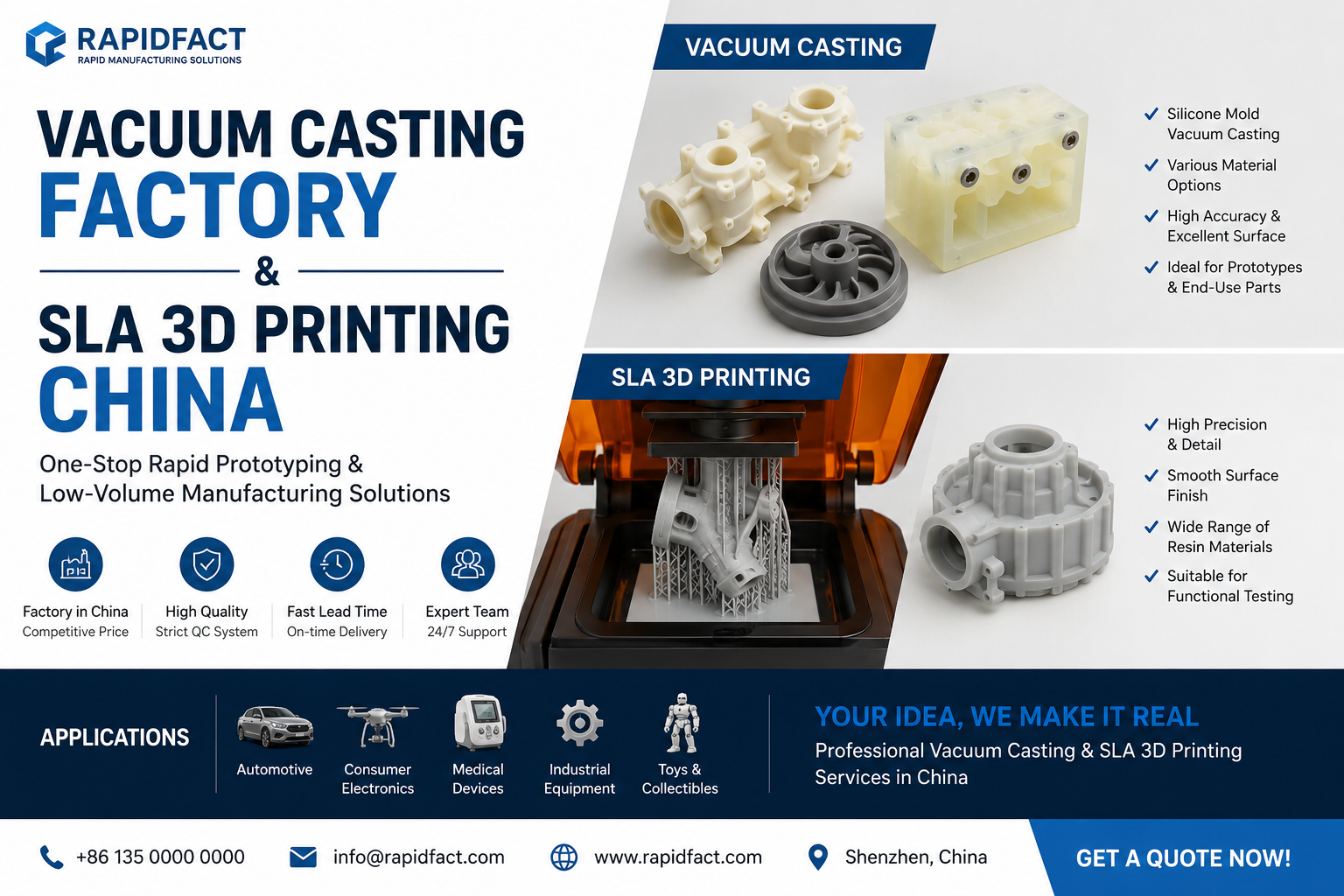
The manufacturing industry is evolving rapidly as businesses seek faster, more accurate, and cost-effective production methods. Among the most significant innovations driving this transformation are vacuum casting factory services and SLA 3D Printing China solutions. Together, these advanced manufacturing technologies enable companies to develop prototypes, test product designs, and produce low-volume components with exceptional precision and efficiency.
Manufacturers across automotive, medical, aerospace, electronics, robotics, and consumer product industries increasingly rely on these technologies to reduce development cycles and accelerate product launches. With China’s well-established manufacturing ecosystem and advanced production capabilities, sourcing from a trusted vacuum casting factory and utilizing SLA 3D Printing China services has become a strategic choice for businesses worldwide.
Understanding a Vacuum Casting Factory
A vacuum casting factory specializes in producing high-quality plastic and silicone parts using vacuum casting technology. This manufacturing process is widely used for rapid prototyping and small-batch production because it accurately replicates the appearance, texture, and mechanical properties of injection-molded components.
Vacuum casting begins with a master model, which is commonly produced using high-resolution 3D printing. A silicone mold is then created around the master model. Once the mold is ready, liquid polyurethane resin is poured into the cavity under vacuum conditions to eliminate air bubbles and ensure excellent surface quality.
Primary Features
- High-precision component manufacturing
- Smooth surface finish
- Low-volume production capability
- Excellent dimensional accuracy
- Multiple material options
- Cost-effective tooling
- Fast production turnaround
What Is SLA 3D Printing China?
SLA 3D Printing China refers to stereolithography-based additive manufacturing services offered by advanced Chinese manufacturing companies. SLA (Stereolithography Apparatus) is one of the most accurate 3D printing technologies available, producing detailed prototypes with outstanding surface quality.
This technology uses ultraviolet laser beams to cure liquid photopolymer resin layer by layer until a complete three-dimensional object is formed.
Because of its exceptional precision, SLA printing is commonly used for concept models, engineering prototypes, medical devices, and complex product designs.
Key Characteristics
- Ultra-high printing accuracy
- Smooth and detailed surfaces
- Excellent dimensional consistency
- Suitable for intricate geometries
- Fast prototype development
- Wide range of engineering resins
Why Manufacturers Combine Vacuum Casting with SLA 3D Printing
Modern product development often combines SLA 3D Printing China with services from a vacuum casting factory.
The SLA printer creates an extremely accurate master model, while vacuum casting reproduces that master into multiple identical components without the expense of injection mold tooling.
Typical Manufacturing Workflow
- Create CAD design.
- Produce master model using SLA printing.
- Manufacture silicone mold.
- Prepare casting materials.
- Vacuum casting process.
- Component curing.
- Finishing and quality inspection.
- Delivery to customer.
Industries Using Vacuum Casting Factory Services
Numerous industries benefit from vacuum casting technology.
Major Applications
- Automotive component development
- Medical device prototyping
- Consumer electronics
- Industrial equipment
- Aerospace engineering
- Robotics
- Smart home devices
- Packaging prototypes
- Wearable technology
- Educational research
Applications of SLA 3D Printing China
High-resolution SLA printing supports product innovation across many industries.
Common Uses
- Functional prototypes
- Product concept models
- Engineering validation
- Medical surgical guides
- Transparent components
- Architectural models
- Consumer product design
- Electronic housing prototypes
- Investment casting patterns
Advantages of Choosing a Vacuum Casting Factory
Manufacturers continue to prefer vacuum casting factory services because they provide flexibility, affordability, and excellent product quality.
Major Benefits
- Lower tooling costs
- Faster production compared to injection molding
- High-quality surface finish
- Excellent detail reproduction
- Flexible material selection
- Ideal for low-volume manufacturing
- Short product development cycle
- Easy design modifications
Benefits of SLA 3D Printing China
China has become a global leader in SLA manufacturing due to its advanced infrastructure and production capabilities.
Key Advantages
- Precision manufacturing
- Competitive pricing
- Experienced engineering teams
- Rapid project turnaround
- Advanced industrial equipment
- Global shipping support
- Consistent production quality
- Large manufacturing capacity
Vacuum Casting Factory vs Injection Molding
| Feature | Vacuum Casting Factory | Injection Molding |
| Production Volume | Low to medium | High volume |
| Tooling Cost | Low | High |
| Development Time | Fast | Longer |
| Design Flexibility | Excellent | Limited after tooling |
| Surface Finish | Excellent | Excellent |
| Best For | Prototypes and short runs | Mass production |
SLA 3D Printing China vs FDM 3D Printing
| Feature | SLA 3D Printing | FDM Printing |
| Surface Finish | Very smooth | Moderate |
| Accuracy | Extremely high | Moderate |
| Detail Quality | Excellent | Good |
| Printing Speed | Moderate | Fast |
| Material Type | Photopolymer Resin | Thermoplastic Filament |
| Best Application | Precision prototypes | Functional basic models |
How to Select the Right Manufacturing Partner
Choosing a reliable manufacturing company is essential for achieving consistent product quality.
Factors to Evaluate
- Industry experience
- Engineering expertise
- Quality certifications
- Modern equipment
- Material availability
- Production capacity
- Communication efficiency
- Customer support
- Delivery timelines
- Quality inspection process
Emerging Trends in Rapid Manufacturing
The manufacturing sector continues adopting new technologies to improve efficiency and sustainability.
Industry Innovations
- AI-assisted manufacturing optimization
- Digital quality inspection
- Automated production systems
- Sustainable resin development
- Cloud-based project management
- Advanced material engineering
- Hybrid manufacturing technologies
- Smart factory integration
Frequently Asked Questions (FAQs)
1. What is a vacuum casting factory?
A vacuum casting factory manufactures high-quality plastic parts using silicone molds and vacuum casting technology for prototypes and low-volume production.
2. What is SLA 3D Printing China?
It refers to precision stereolithography 3D printing services provided by advanced manufacturing companies in China.
3. Why is vacuum casting used?
It offers cost-effective production of high-quality prototype and short-run components with excellent surface finishes.
4. Which industries use SLA printing?
Automotive, aerospace, medical, electronics, consumer products, and industrial manufacturing all benefit from SLA printing.
5. Is vacuum casting suitable for mass production?
It is best suited for low- and medium-volume production rather than large-scale manufacturing.
6. What materials are used in SLA printing?
SLA printers use liquid photopolymer resins that cure under ultraviolet laser exposure.
7. How accurate is SLA 3D printing?
SLA technology is among the most accurate additive manufacturing processes available today.
8. Why do companies choose manufacturing services in China?
China offers advanced production capabilities, competitive pricing, experienced engineers, and efficient global logistics.
9. Can vacuum casting produce transparent parts?
Yes. Depending on the resin used, transparent and semi-transparent components can be produced.
10. How long does a typical vacuum casting project take?
Most prototype projects can be completed within several days to a few weeks, depending on complexity and production volume.