
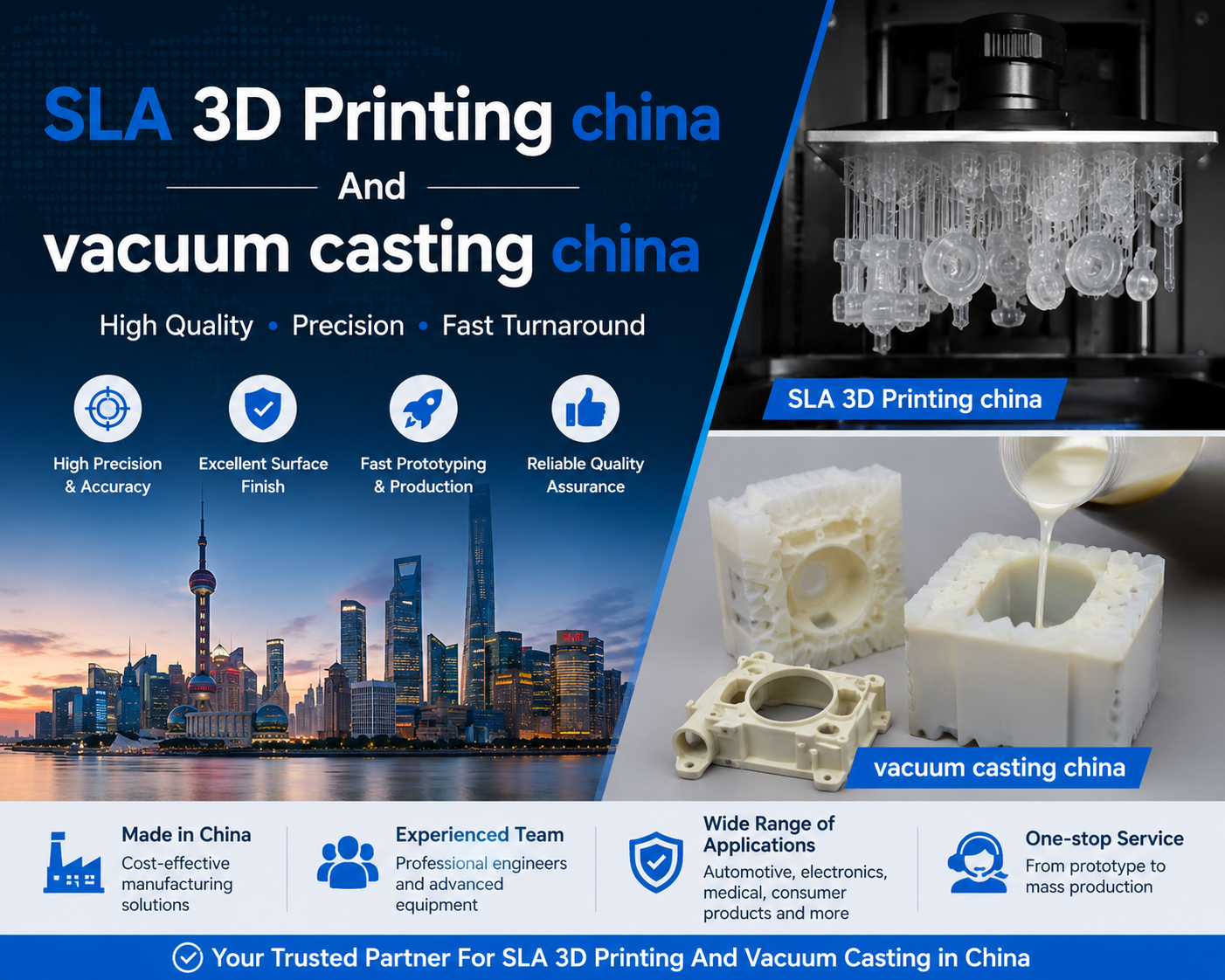
As industries continue to accelerate product development and reduce time-to-market, advanced manufacturing technologies have become indispensable. Among the most widely adopted solutions are SLA 3D Printing China and vacuum casting China, both of which offer exceptional precision, cost efficiency, and flexibility for prototype development and low-volume production.
China has established itself as a global manufacturing hub by combining skilled engineering, state-of-the-art production facilities, and competitive pricing. Companies across the automotive, medical, aerospace, electronics, robotics, and consumer product sectors increasingly rely on these manufacturing methods to transform innovative ideas into high-quality functional products.
Understanding SLA 3D Printing China
SLA 3D Printing China refers to the use of Stereolithography (SLA) technology by Chinese manufacturing companies to produce highly detailed plastic prototypes and production parts. This additive manufacturing process uses a laser to cure liquid photopolymer resin layer by layer, creating components with excellent surface finishes and intricate geometries.
SLA technology is widely preferred for projects requiring exceptional dimensional accuracy, fine details, and smooth surfaces.
Key Characteristics
- High-resolution printing
- Excellent dimensional accuracy
- Smooth surface finish
- Complex geometric capabilities
- Rapid prototype production
- Wide range of engineering-grade resins
What Is Vacuum Casting China?
Vacuum casting China is a manufacturing process used to produce high-quality plastic parts by pouring polyurethane resin into silicone molds under vacuum conditions. The vacuum environment eliminates trapped air bubbles, resulting in highly accurate components with outstanding surface quality.
Vacuum casting is particularly suitable for low-volume manufacturing before investing in expensive injection molding tools.
Major Features
- Excellent surface quality
- Accurate reproduction of fine details
- Cost-effective small-batch production
- Multiple material options
- Fast production turnaround
- Ideal for functional prototypes
Why China Leads the Global Prototype Manufacturing Industry
China has become a preferred destination for prototype manufacturing because of its strong industrial infrastructure and advanced engineering capabilities.
Key Advantages
- Modern manufacturing facilities
- Skilled engineering professionals
- Competitive production costs
- Advanced quality control systems
- Fast international shipping
- Comprehensive manufacturing solutions
- Extensive material availability
Applications of SLA 3D Printing China
The versatility of SLA 3D Printing China makes it suitable for a wide range of industries.
Common Applications
- Product design validation
- Engineering prototypes
- Medical device components
- Consumer electronics
- Automotive parts
- Aerospace components
- Architectural models
- Dental models
- Educational projects
- Customized industrial components
Industries That Benefit from Vacuum Casting China
Vacuum casting China supports businesses that require production-quality prototypes and limited production runs.
Popular Industries
- Automotive manufacturing
- Healthcare and medical equipment
- Industrial machinery
- Consumer electronics
- Home appliances
- Robotics
- Aerospace engineering
- Telecommunications
- Packaging development
Advantages of SLA 3D Printing China
Manufacturers choose SLA 3D Printing China because it delivers exceptional precision and flexibility.
Primary Benefits
- Superior surface finish
- High dimensional accuracy
- Rapid design verification
- Reduced product development time
- Ability to manufacture intricate designs
- Minimal material waste
- Easy design modifications
Benefits of Vacuum Casting China
Businesses frequently select vacuum casting China when they need production-quality parts without the expense of injection molding.
Major Benefits
- Lower tooling costs
- Short production cycles
- High-quality appearance
- Functional testing capability
- Excellent material simulation
- Consistent part quality
- Flexible batch quantities
SLA 3D Printing China vs Vacuum Casting China
| Feature | SLA 3D Printing China | Vacuum Casting China |
| Manufacturing Method | Additive manufacturing | Silicone mold casting |
| Best Use | Rapid prototypes | Low-volume production |
| Surface Finish | Excellent | Excellent |
| Production Quantity | Single parts to small batches | Small to medium batches |
| Tooling Requirement | None | Silicone mold required |
| Production Speed | Very fast | Fast after mold creation |
| Material Type | Photopolymer resin | Polyurethane resin |
Typical Manufacturing Workflow
Although both processes differ technically, the general production workflow remains similar.
Production Process
- Receive customer CAD files.
- Review design specifications.
- Select appropriate material.
- Manufacture prototype or master model.
- Perform quality inspection.
- Complete finishing processes.
- Deliver finished components.
Factors to Consider Before Choosing a Manufacturing Method
Selecting the right production process depends on several project requirements.
Important Considerations
- Production quantity
- Material requirements
- Surface finish expectations
- Mechanical performance
- Delivery schedule
- Budget
- Product complexity
- End-use application
Quality Standards in Chinese Manufacturing
Leading manufacturers maintain international quality standards throughout production.
Quality Control Measures
- Dimensional inspection
- Material verification
- Surface quality assessment
- Functional testing
- Precision measurement
- Final visual inspection
- Packaging verification
Emerging Trends in Prototype Manufacturing
Rapid manufacturing technologies continue evolving with innovation.
Industry Developments
- AI-assisted production planning
- Automated quality inspection
- Sustainable manufacturing materials
- Smart factory integration
- Digital production monitoring
- Faster international logistics
- Hybrid manufacturing technologies
Frequently Asked Questions (FAQs)
1. What is SLA 3D Printing China?
It is a high-precision additive manufacturing process that produces detailed resin parts using stereolithography technology.
2. What is vacuum casting China?
It is a manufacturing process that creates polyurethane parts using silicone molds under vacuum conditions.
3. Which process is better for prototypes?
Both are excellent. SLA is ideal for highly detailed prototypes, while vacuum casting is better for functional low-volume production.
4. How accurate is SLA 3D printing?
SLA offers excellent dimensional accuracy and smooth surface finishes.
5. What materials are used in vacuum casting?
Most vacuum casting processes use polyurethane resins that simulate production plastics.
6. Is vacuum casting suitable for mass production?
It is generally recommended for low- to medium-volume production rather than large-scale manufacturing.
7. Why do companies choose China for prototype manufacturing?
China offers advanced technology, experienced engineers, competitive pricing, and efficient production capabilities.
8. Can SLA printed parts be painted?
Yes. SLA components can be sanded, primed, painted, and polished for improved appearance.
9. How long does prototype manufacturing take?
Depending on project complexity, production can range from a few days to a couple of weeks.
10. How do I choose between SLA 3D Printing China and vacuum casting China?
The choice depends on your project goals, production quantity, material requirements, budget, and desired finish.