
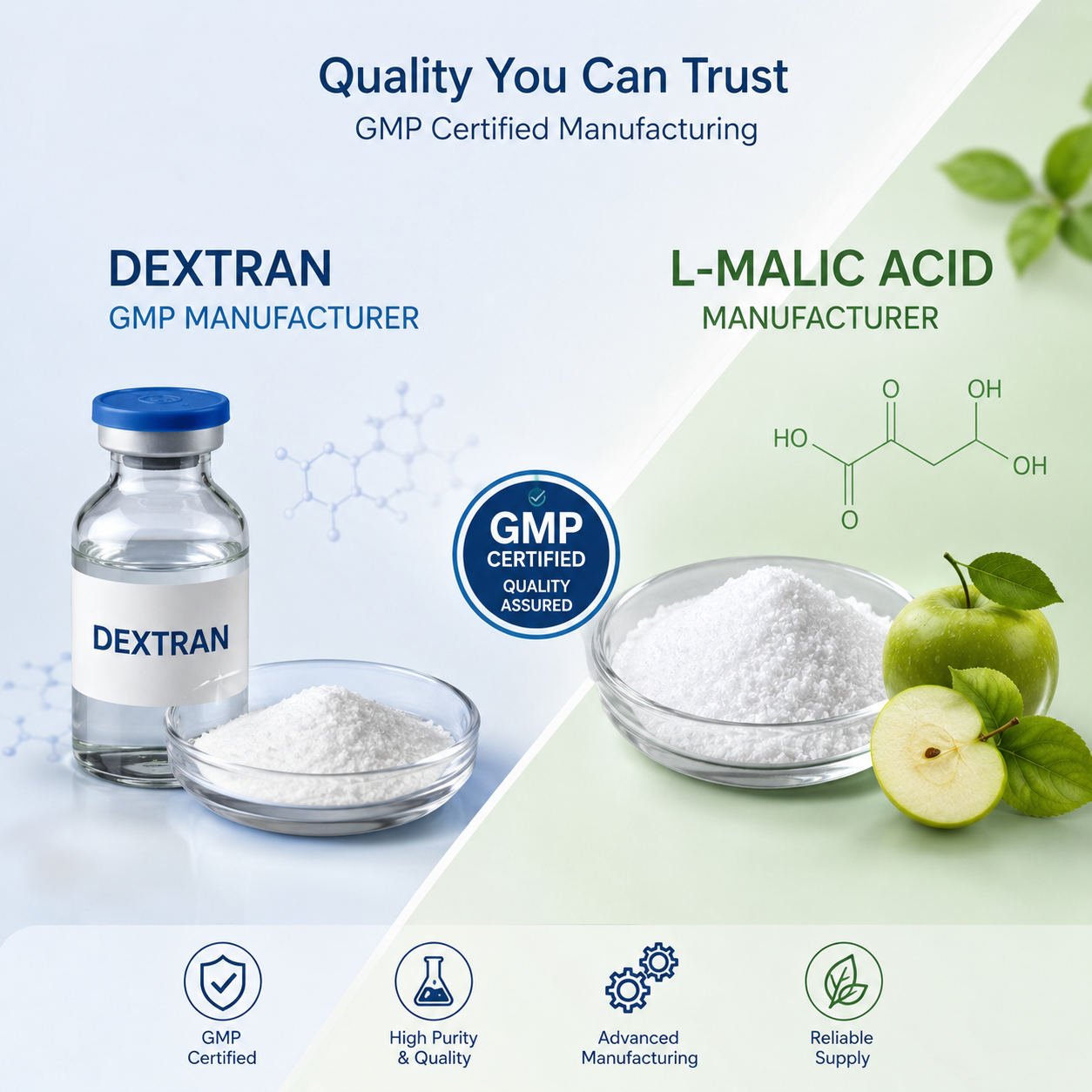
The pharmaceutical, biotechnology, and healthcare industries depend on reliable raw material suppliers that can deliver consistent quality, regulatory compliance, and advanced manufacturing capabilities. With increasing demand for high-purity ingredients, companies are focusing on experienced dextran GMP manufacturer and L-malic acid manufacturer partners that follow strict quality standards.
Modern manufacturing requires more than just production capacity. It demands advanced technology, Good Manufacturing Practices (GMP), detailed quality control systems, and strong expertise in pharmaceutical-grade ingredient development. A trusted supplier helps businesses maintain product safety, improve research outcomes, and meet international regulatory expectations.
Growing Importance of High-Quality Pharmaceutical Ingredients
The global pharmaceutical sector is continuously evolving with advancements in drug development, biotechnology applications, and medical research. Ingredients such as dextran and L-malic acid play important roles across multiple industries, including pharmaceuticals, diagnostics, food processing, and biotechnology.
A professional dextran GMP manufacturer focuses on producing high-quality dextran products under controlled manufacturing environments. Dextran is a versatile polysaccharide widely used in medical and pharmaceutical applications because of its excellent biocompatibility and functional properties.
Similarly, an experienced L-malic acid manufacturer provides high-purity malic acid solutions used in pharmaceutical formulations, nutritional products, and industrial applications.
Understanding Dextran and Its Industrial Applications
Dextran is a natural polysaccharide produced through microbial fermentation. Due to its unique molecular structure, it offers excellent stability, solubility, and compatibility with biological systems.
A reliable dextran GMP manufacturer ensures that every production stage follows strict quality management practices, from raw material selection to final packaging.
Common applications of dextran include:
- Pharmaceutical formulations
- Plasma volume expansion solutions
- Drug delivery systems
- Medical research applications
- Biotechnology processes
- Laboratory and diagnostic products
High-quality dextran manufacturing requires advanced fermentation technology, purification systems, and analytical testing procedures to achieve consistent performance.
Role of a Professional L-Malic Acid Manufacturer
L-malic acid is an organic acid naturally found in fruits and biological systems. It is widely used because of its excellent acidity regulation properties, stability, and compatibility with various formulations.
A dependable L-malic acid manufacturer provides pharmaceutical and industrial-grade solutions that meet customer-specific requirements.
Major applications of L-malic acid include:
- Pharmaceutical formulations
- Nutraceutical products
- Food and beverage processing
- Cosmetic formulations
- Biochemical research
- pH adjustment applications
Manufacturers focus on maintaining purity, accurate specifications, and reliable supply chains to support global industries.
Key Qualities of a Reliable Manufacturing Partner
Choosing the right ingredient supplier is essential for companies operating in highly regulated markets. A trusted manufacturer should provide:
- GMP-compliant production facilities
- Advanced quality testing laboratories
- International regulatory support
- Batch-to-batch consistency
- Technical documentation
- Customized manufacturing solutions
- Transparent supply chain management
These qualities help businesses reduce production risks while ensuring high-quality final products.
Comparison Between Dextran GMP Manufacturer and L-Malic Acid Manufacturer
| Feature | Dextran GMP Manufacturer | L-Malic Acid Manufacturer |
| Primary Product | Pharmaceutical-grade dextran | High-purity L-malic acid |
| Production Method | Microbial fermentation and purification | Organic acid production and purification |
| Main Industries | Pharmaceutical, biotechnology, medical research | Pharmaceutical, food, nutraceutical, cosmetic |
| Quality Focus | Molecular weight control and purity testing | Purity, stability, and formulation compatibility |
| Regulatory Requirement | GMP compliance and pharmaceutical standards | GMP, quality certifications, and safety standards |
| Common Applications | Drug delivery, medical solutions, diagnostics | pH regulation, supplements, pharmaceutical formulations |
Manufacturing Standards and Quality Assurance
Quality assurance is one of the most important factors when selecting a pharmaceutical ingredient supplier. Leading manufacturers implement strict testing procedures throughout the production process.
Important quality control measures include:
- Raw material inspection to ensure safety and consistency.
- Advanced analytical testing for purity and composition.
- Controlled manufacturing environments.
- Documentation and traceability systems.
- Final product testing before shipment.
A professional dextran GMP manufacturer follows GMP principles to minimize contamination risks and maintain product reliability. Likewise, an established L-malic acid manufacturer ensures that every batch meets defined quality specifications.
Benefits of Partnering With Certified Ingredient Manufacturers
Working with an experienced supplier provides several advantages:
- Improved product quality and reliability
- Compliance with international standards
- Reduced manufacturing challenges
- Better supply chain stability
- Access to technical expertise
- Faster product development support
Businesses can achieve better efficiency by collaborating with manufacturers that understand industry requirements and regulatory expectations.
Future Trends in Pharmaceutical Ingredient Manufacturing
The demand for pharmaceutical-grade ingredients is expected to increase as biotechnology, personalized medicine, and advanced healthcare solutions continue to grow.
Future manufacturing trends include:
- Increased automation in production facilities
- Sustainable manufacturing practices
- Advanced purification technologies
- Improved quality monitoring systems
- Greater demand for customized ingredients
Both dextran and L-malic acid manufacturers are adapting to these trends by investing in research, technology, and quality improvement.
Frequently Asked Questions (FAQ)
1. What does a dextran GMP manufacturer do?
A dextran GMP manufacturer produces pharmaceutical-grade dextran using Good Manufacturing Practices to ensure quality, safety, and regulatory compliance.
2. Why is GMP certification important for dextran manufacturing?
GMP certification ensures controlled production processes, proper documentation, and consistent product quality for pharmaceutical applications.
3. What are the main uses of dextran?
Dextran is used in medical formulations, drug delivery systems, biotechnology research, and diagnostic applications.
4. What is L-malic acid used for?
L-malic acid is used in pharmaceuticals, nutraceuticals, food products, cosmetics, and biochemical applications.
5. How does an L-malic acid manufacturer ensure quality?
A professional L-malic acid manufacturer uses advanced testing methods, quality control systems, and strict production standards.
6. Are dextran products suitable for pharmaceutical applications?
Yes, pharmaceutical-grade dextran produced under GMP conditions is widely used for healthcare and biotechnology applications.
7. What factors should companies consider when selecting a manufacturer?
Companies should evaluate manufacturing standards, certifications, quality systems, production capacity, and technical expertise.
8. Can manufacturers provide customized ingredient solutions?
Many experienced manufacturers offer customized specifications based on customer requirements and application needs.
9. Why is purity important in pharmaceutical ingredients?
High purity helps ensure product effectiveness, safety, stability, and compliance with regulatory standards.
10. How can businesses verify a reliable ingredient supplier?
Businesses should review certifications, quality documentation, manufacturing capabilities, and industry experience before choosing a supplier.