
The days of uncomfortable dental impressions, endless laboratory waiting, and complicated manual workflows are slowly becoming a thing of the past.
Today, a patient can sit in a dental chair while a dentist digitally captures the entire oral structure in minutes. That digital information can then move through sophisticated software and into a 3D printing workflow to create models, appliances, temporary restorations, and other customized dental solutions.
This isn’t science fiction.
It is the new face of digital dentistry.
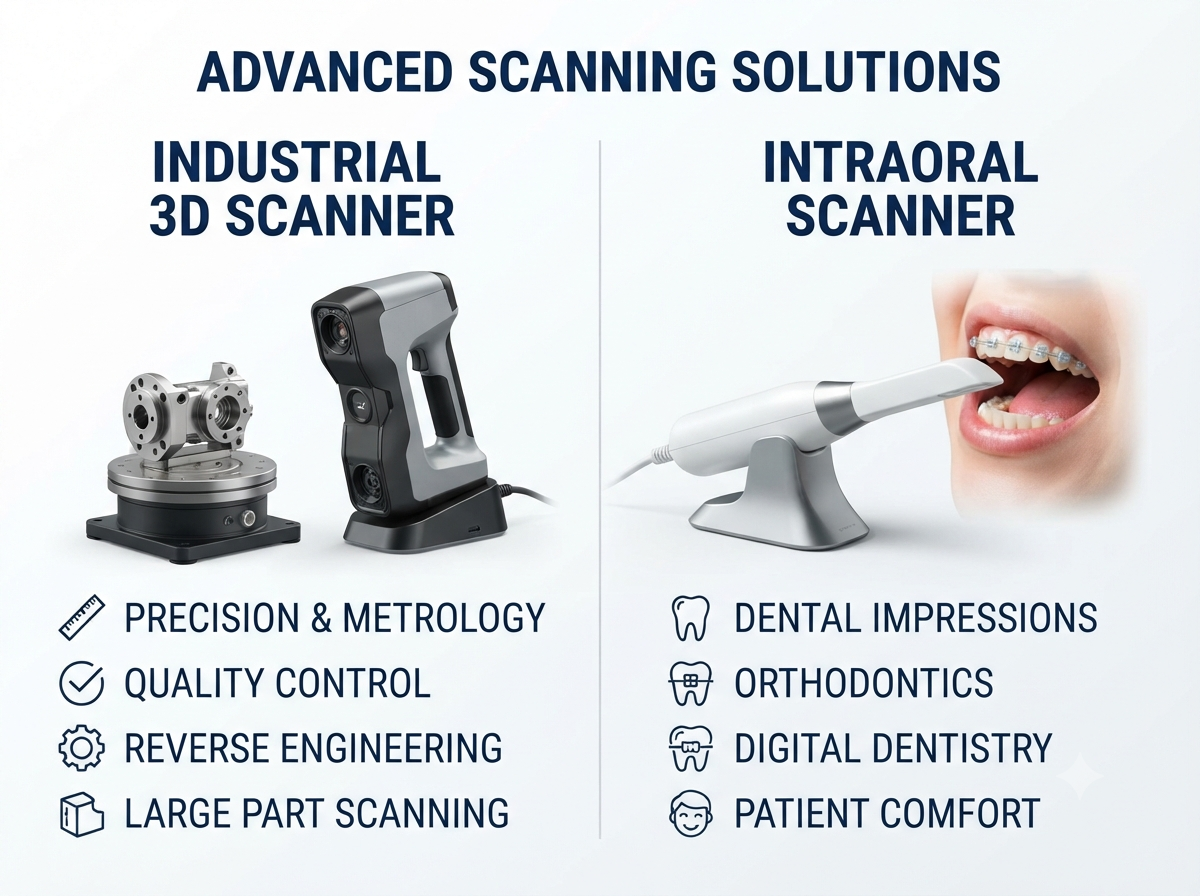
At the center of this transformation is the intraoral scanner—a technology that is helping dentists replace traditional impressions with fast, convenient, and highly detailed digital data. At the same time, advanced scanning technologies, including the industrial 3d scanner, are contributing to the broader world of precision manufacturing, product development, and digital workflows.
When scanning meets 3D printing, dentistry becomes faster, smarter, and more connected.
The Big Shift: Dentistry Moves From Physical to Digital
For decades, dental professionals relied heavily on physical impressions and laboratory-based production. The process worked, but it could be slow and involved several stages.
A modern digital workflow changes the equation.
Instead of starting with impression material, the dentist can use an intraoral scanner to capture digital information from the patient’s mouth. That data can then be transferred to specialized software where dental professionals can analyze, design, and prepare the next stage of treatment.
The workflow becomes:
Scan → Design → Print → Process → Treat
Fewer manual steps can mean fewer delays.
And for patients, that can translate into a smoother experience.
Why Is Everyone Talking About Digital Dentistry?
The answer comes down to one thing: efficiency.
Modern dental practices are under constant pressure to provide high-quality treatment while managing costs, time, patient expectations, and competition.
Digital technology can help address all four.
Cut Unnecessary Costs
Every time a dental case is outsourced, there may be additional laboratory fees, shipping costs, communication delays, and waiting periods.
With the right equipment and trained team, certain workflows can potentially be brought into the practice.
3D printing may help dental clinics produce selected models and appliances internally, reducing dependence on external services for appropriate applications.
This doesn’t mean every procedure should be handled in-house.
It means practices can identify the workflows where in-house digital manufacturing makes financial and operational sense.
Turn Hours Into Minutes
Traditional impressions require preparation, material handling, setting time, disinfection, and transportation.
An intraoral scanner can simplify the data-capture stage by creating a digital impression that can immediately enter a computer-based workflow.
This can help eliminate several manual steps and allow the dental team to move more quickly from patient examination to treatment planning.
Create More Personalized Solutions
Every patient’s dental structure is different.
Digital scanning and 3D printing make customization easier because designs can be created around individual patient data.
Instead of relying exclusively on standardized products, digital workflows can support the development of customized solutions for specific clinical needs.
That’s where the real power of digital dentistry becomes visible.
The Intraoral Scanner: The New Digital Gateway
If 3D printing is the manufacturing engine, the intraoral scanner is the data gateway.
It captures detailed information about a patient’s teeth and surrounding oral structures and converts that information into a digital file.
That file can potentially be used for:
- Digital treatment planning
- Orthodontic workflows
- Restorative dentistry
- Crown and bridge planning
- Dental model production
- Appliance design
- Patient communication
- CAD/CAM workflows
The biggest advantage is connectivity.
Once the information exists digitally, it can move through compatible software systems without the physical limitations of traditional impressions.
Where Does an Industrial 3D Scanner Come Into the Story?
An industrial 3d scanner operates in a different environment but follows the same fundamental concept: converting physical objects into highly detailed digital information.
In industrial applications, 3D scanning can be used for inspection, reverse engineering, quality control, prototyping, and manufacturing.
The same digital mindset is increasingly influencing the dental sector.
Dental laboratories, manufacturers, researchers, and technology developers can use advanced scanning solutions to capture physical models, components, prototypes, and products for digital analysis and development.
This creates a fascinating connection between industrial manufacturing and modern dentistry.
The underlying idea is the same:
Capture reality digitally. Improve it digitally. Manufacture it digitally.
5 Ways 3D Printing Can Supercharge a Dental Practice
1. Dental Models Without the Traditional Wait
Dental models are one of the easiest entry points into 3D printing.
A digital impression captured through an intraoral scanner can be converted into a printable model. Depending on the application, these models may be used for orthodontics, restorative planning, retainers, mouth guards, and other workflows.
The practice gains greater control over production and turnaround times.
2. Occlusal Splints: A Potential ROI Champion
If a dental practice is looking for an application with strong financial potential, occlusal splints may be worth exploring.
Instead of outsourcing every case, a practice with the right digital setup may be able to scan the patient, design the splint, and manufacture it internally.
This can reduce laboratory expenses and shorten turnaround times.
For high-volume practices, even small savings per case can add up significantly over time.
3. Temporary Restorations on Demand
Temporary crowns and bridges can sometimes become a bottleneck in traditional workflows.
Digital dentistry can help streamline the process.
The dentist can use digital scan data to create a virtual design and then manufacture an appropriate temporary restoration using compatible materials and equipment.
The result?
A potentially faster path from patient scan to finished temporary solution.
4. Smile Visualization Becomes More Real
Patients don’t always understand technical dental explanations.
Show them instead.
Digital scanning and 3D printing can help dentists create visual or physical representations that make proposed treatments easier to understand.
A patient who can see a potential result may feel more confident about discussing treatment options.
Technology isn’t replacing communication.
It’s making communication more visual.
5. Same-Day Dentistry Gets Smarter
One of the most exciting possibilities of digital dentistry is reducing the number of appointments required for selected treatments.
Imagine a workflow where the patient is scanned, the digital design is prepared, and the required restoration or appliance is manufactured within the practice.
In suitable cases, this can potentially compress multiple steps into a much shorter timeframe.
The result could be:
Less waiting. Fewer appointments. Better convenience.
The Real Secret to ROI Isn’t the Printer
Buying a 3D printer doesn’t automatically create a profitable dental practice.
The real ROI comes from using the technology intelligently.
Before investing, practices should ask:
- How many cases are currently outsourced?
- What are the laboratory costs?
- Which procedures have the longest turnaround time?
- How frequently will the equipment be used?
- What materials are required?
- Who will operate the system?
- What training is needed?
- How much maintenance will the equipment require?
A practice that answers these questions can create a more realistic technology investment plan.
The smartest strategy is not necessarily buying the most expensive equipment.
It is choosing technology that solves real business and clinical problems.
Why the Cheapest Printer May Cost More Later
Price is tempting.
But in dentistry, consistency matters.
A low-cost consumer printer may appear attractive at first, but dental workflows can demand reliable accuracy, repeatability, suitable materials, and predictable results.
Professional dental 3D printers are developed with specific dental workflows in mind. When paired with approved materials and appropriate post-processing systems, they may provide a more controlled production environment.
The same principle applies to scanning technology.
When selecting an intraoral scanner, practices should look beyond the initial price tag and consider:
- Scanning speed
- Accuracy
- Ease of use
- Software compatibility
- File export options
- Workflow integration
- Training requirements
- Technical support
The goal is to build a digital ecosystem—not simply purchase individual machines.
The Digital Dental Workflow of Tomorrow
Picture the dental practice of the future.
A patient arrives.
The dentist uses an intraoral scanner to capture the required digital data.
The information instantly enters the digital workflow.
The dental professional designs the required solution using CAD software.
A 3D printer manufactures the physical product.
The patient receives treatment without unnecessary delays.
Meanwhile, advanced scanning technologies such as an industrial 3d scanner continue to support the wider manufacturing ecosystem by helping companies capture, inspect, and develop high-precision products and components.
This is the bigger digital revolution.
It’s not about one scanner.
It’s not about one printer.
It’s about connecting every stage of the process.
https://newsgrow.blogspot.com/2026/07/best-3d-scanner-and-best-dental-scanner.html
https://newsgrow.blogspot.com/2026/07/how-3d-scanning-and-3d-printing-are.html