
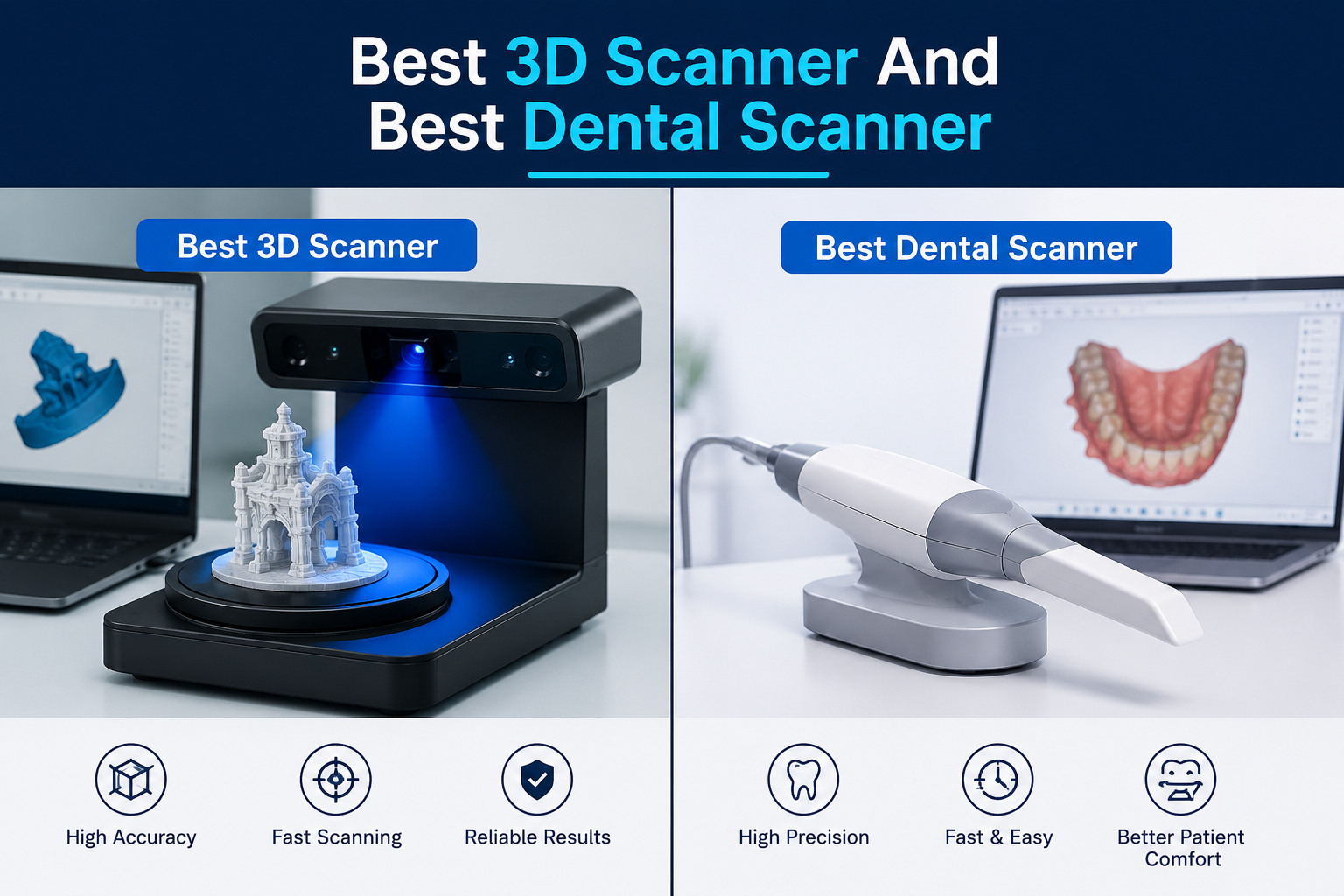
The rapid adoption of digital dentistry is reshaping how dental professionals capture patient data, plan treatments, and deliver restorative and orthodontic solutions. As clinics and laboratories move away from traditional impression-based workflows, advanced 3D scanning technology is emerging as a key driver of this transformation.
The growing demand for the Best 3D Scanner and Best Dental Scanner reflects a wider shift toward faster, more accurate, and digitally connected dental workflows.
From general dentistry and orthodontics to implantology and dental laboratories, professionals are increasingly evaluating scanning solutions based on accuracy, speed, ergonomics, software capabilities, connectivity, and long-term workflow value.
Digital Scanning Becomes a Strategic Priority for Dental Practices
Traditional dental impressions have long been used to capture information about a patient’s teeth and oral structures. However, digital scanning is offering dental professionals a more streamlined approach to collecting and sharing this information.
Modern intraoral scanners can capture digital representations of the oral environment and integrate the resulting data into a broader digital workflow.
Depending on the application, digital scans can support:
- Crown and bridge procedures
- Orthodontic treatment planning
- Clear aligner workflows
- Implant dentistry
- Restorative dentistry
- Prosthodontics
- Digital smile planning
- Dental laboratory production
This shift is making the selection of the Best Dental Scanner an increasingly important decision for practices seeking to modernize their operations.
What Defines the Best 3D Scanner?
As the number of 3D scanning products continues to grow, dental professionals are looking beyond basic specifications.
The Best 3D Scanner for one organization may not necessarily be the right choice for another.
A general dental clinic may prioritize ease of use and affordability, while an implant specialist may require advanced scanning capabilities for complex cases. A dental laboratory may place greater emphasis on data compatibility and CAD/CAM integration.
Several factors are therefore influencing purchasing decisions.
Accuracy and Data Quality
Reliable digital data is essential for many dental applications.
Professionals evaluating the Best Dental Scanner often consider how consistently the system captures detailed information across different clinical situations.
For demanding restorative, orthodontic, and implant workflows, the quality of digital data can play an important role in the overall treatment process.
Scanning Speed
Time is an important consideration in modern dental practices.
Faster scanning can help reduce appointment times and improve operational efficiency, particularly in high-volume environments.
However, speed must be balanced with dependable image capture and data quality.
Ergonomic Design
Dental professionals may use scanners repeatedly throughout the day, making comfort an important consideration.
Lightweight designs, intuitive controls, compact scanner heads, and improved handling can contribute to a more comfortable user experience.
For many clinicians, the Best 3D Scanner is one that combines advanced technology with practical everyday usability.
Software Is Becoming as Important as Hardware
The scanner itself is only one component of a modern digital dentistry ecosystem.
Software plays an increasingly important role in how dental professionals manage, review, process, and share digital scan data.
Depending on the system, software may support:
- Digital case management
- Scan editing
- Patient visualization
- Laboratory communication
- CAD/CAM integration
- Cloud-based collaboration
- Treatment planning
This is why dental practices evaluating the Best Dental Scanner are increasingly looking at the complete technology ecosystem rather than focusing only on the physical device.
A scanner that integrates smoothly with existing systems may deliver greater long-term value than a device with impressive specifications but limited workflow compatibility.
Wireless and Wired Scanners Offer Different Advantages
The growing availability of wireless scanning technology is also influencing the dental scanner market.
Wireless systems can offer greater freedom of movement and reduce cable clutter around the treatment area.
Wired scanners, meanwhile, may provide a consistent connection without concerns about battery charging or wireless connectivity.
The ideal choice depends on the individual practice.
Clinicians should consider factors such as:
- Daily scanning volume
- Operatory layout
- Battery requirements
- Scanner weight
- Connectivity
- Workflow preferences
Rather than assuming one configuration is universally superior, dental professionals can select the technology that best matches their working environment.
Implant Dentistry Drives Demand for Advanced Scanning
Implant dentistry is becoming an important area of innovation within the digital scanning sector.
Complex implant procedures, particularly full-arch cases, can place greater demands on digital data capture.
Advanced scanning technologies are being developed to support more precise digital workflows for implant planning and restoration.
For specialists handling complex cases, the Best Dental Scanner may need to offer capabilities beyond those required for routine restorative dentistry.
This is encouraging dental professionals to evaluate scanners based on specific clinical applications rather than simply comparing general specifications.
Choosing the Right Scanner for Different Dental Applications
The growing variety of scanners means that dental professionals can increasingly select technology based on their specific needs.
For general dentistry, ease of use, scanning speed, ergonomics, and overall value may be major priorities.
For orthodontic practices, software functionality and digital model management may be particularly important.
For dental laboratories, open data compatibility and CAD/CAM integration can influence purchasing decisions.
For implant specialists, advanced accuracy and specialized full-arch capabilities may carry greater weight.
This makes the search for the Best 3D Scanner a highly application-specific decision.
Digital Workflows Continue to Expand
The rise of 3D scanning is not happening in isolation.
It is part of a broader transformation in digital dentistry.
A modern workflow can connect several stages:
Scan → Design → Plan → Manufacture → Deliver
Digital scan data can be transferred to software platforms, laboratories, 3D printers, milling systems, and other technologies.
This connected approach can reduce dependence on physical impressions and improve communication between dental professionals and laboratories.
As digital manufacturing technologies become more accessible, the importance of reliable scanning data is expected to increase.
Cost Is Only One Part of the Investment
While price remains an important factor, dental practices are increasingly considering the total value of a scanner.
A lower-cost device may be suitable for basic applications, while a premium system may provide advanced capabilities that justify the additional investment for specialist practices.
Before choosing the Best Dental Scanner, practices may consider:
- Number of patients scanned each day
- Primary clinical applications
- Required scanning accuracy
- Software capabilities
- Data export options
- Laboratory compatibility
- Wireless or wired operation
- Maintenance and support
- Long-term ownership costs
This approach allows buyers to evaluate technology according to its actual contribution to their workflow.
The Future of 3D Dental Scanning
The next generation of scanning technology is expected to focus increasingly on automation, artificial intelligence, improved image processing, and deeper integration with digital manufacturing.
AI-assisted features may help simplify scan management and identify unwanted data.
Cloud-based systems may make collaboration between dentists and laboratories more efficient.
Meanwhile, advances in 3D printing and CAD/CAM manufacturing are creating opportunities for increasingly connected digital workflows.
These developments could make scanning a central component of a fully integrated digital dental ecosystem.
Industry Outlook
The growing interest in the Best 3D Scanner and Best Dental Scanner reflects the broader modernization of the dental industry.
As clinics seek to improve efficiency and patients increasingly expect comfortable, technology-driven experiences, digital scanning is becoming an important part of contemporary dental care.
However, there is no universal scanner that can be considered the best for every practice.
The right choice depends on clinical requirements, workflow preferences, software compatibility, scanning performance, ergonomics, and budget.
Read more – https://newsgrow.blogspot.com/2026/07/best-3d-scanner-and-best-dental-scanner.html