
Solar energy is rapidly transforming the global power landscape. Across deserts, industrial zones, and open rural land, massive solar farms are being built to meet the growing demand for cleaner electricity.
But here is something many people overlook: solar panels cannot generate energy without a reliable structure supporting them.
Behind every successful photovoltaic installation is a network of steel components engineered to withstand wind, rain, snow, heat, and years of outdoor exposure. Among these components, ERW steel tubes have become an increasingly important choice for solar mounting systems and tracking structures.
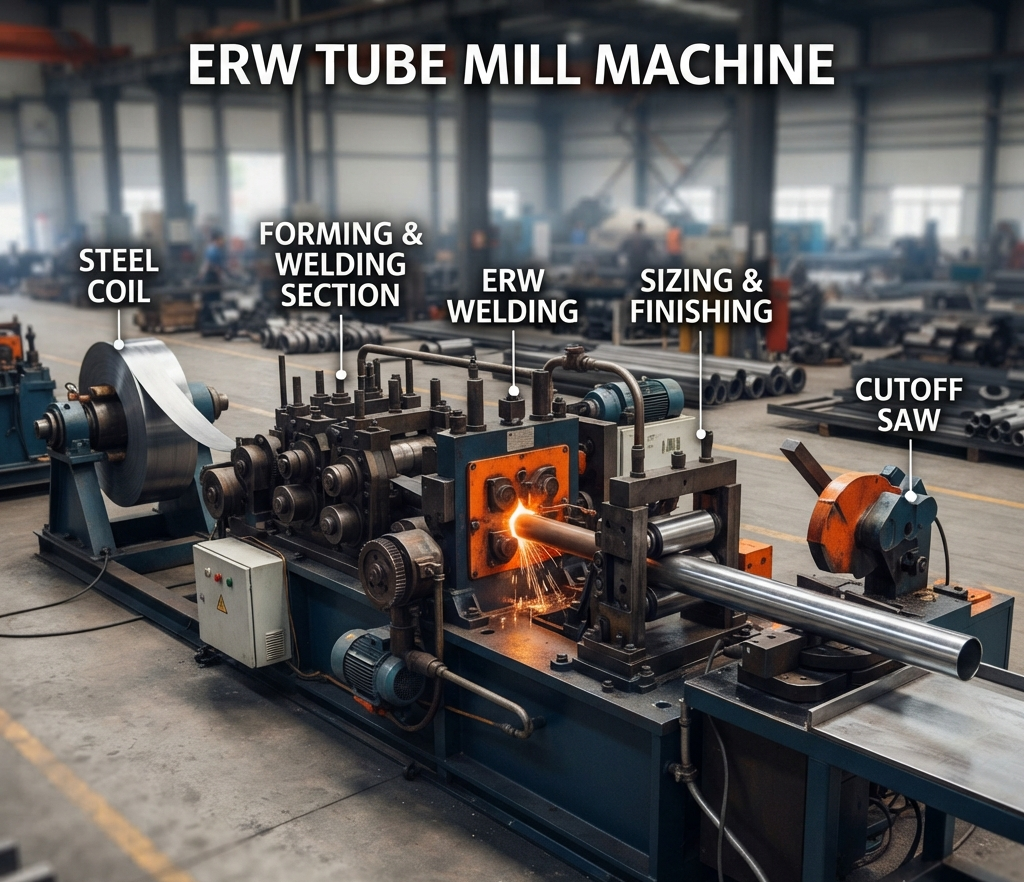
At the heart of this growing manufacturing sector is the Tube Mill Machine, which enables producers to manufacture high-quality steel tubes with consistent dimensions, efficient production rates, and the flexibility required for modern solar projects.
The Hidden Engineering Behind Solar Power
When people think about solar energy, photovoltaic panels are usually the first thing that comes to mind. However, a solar farm is much more than a collection of PV modules.
The entire system depends on structural components such as:
- Torque tubes
- Support posts
- Piles
- Crossbeams
- Bracing components
- Mounting frames
These parts must work together to keep solar panels securely positioned and correctly aligned.
A structural failure could result in expensive repairs, reduced energy production, or significant downtime. This is why the selection of structural steel materials is a critical part of solar project planning.
ERW tubes have gained popularity because they provide a practical combination of strength, accuracy, production efficiency, and cost control.
What Makes ERW Tubes Different?
ERW stands for Electric Resistance Welded. These tubes are manufactured by forming steel strip or coil into the desired shape and joining the edges through an electric resistance welding process.
The technology allows manufacturers to produce tubes in a wide range of dimensions and profiles.
Compared with some alternative manufacturing methods, ERW production can offer:
- Consistent wall thickness
- Excellent dimensional control
- High production efficiency
- Competitive costs
- Flexible profile options
- Compatibility with corrosion-resistant coatings
For large-scale solar projects where thousands of structural components may be required, these advantages can have a significant impact on overall project economics.
Solar Trackers Need Stronger Structural Solutions
One of the most exciting developments in solar technology is the increasing use of solar tracking systems.
Unlike fixed-tilt structures, trackers allow PV panels to change their orientation throughout the day. By following the sun’s movement, these systems can improve the amount of solar energy captured by the panels.
However, moving structures introduce additional engineering challenges.
The torque tube, for example, acts as a major structural element within the tracking mechanism. It must handle rotational forces and maintain structural stability while exposed to wind and other environmental stresses.
This is where accurately manufactured ERW tubes can provide an important advantage.
Square, rectangular, and polygonal profiles can be selected according to the mechanical requirements of the tracking system. Their geometry can provide the stiffness and connection surfaces required for efficient integration with bearings, clamps, and drive components.
The Importance of Solar Foundation Components
Not every solar installation uses trackers.
Fixed-tilt photovoltaic systems remain widely used, particularly where a simpler structural arrangement is preferred. These installations also require dependable steel components.
ERW tubes can be used in:
- Ground-mounted posts
- Driven piles
- Structural columns
- Crossmembers
- Diagonal bracing
- Support frames
The consistent dimensions of ERW products can help ensure predictable assembly and load distribution throughout the structure.
When combined with appropriate structural design and corrosion protection, these components can contribute to the long-term reliability of solar installations.
Why ERW Tubes Are Gaining Attention
The solar industry is growing rapidly, but project developers still need to control costs. Structural materials must therefore provide performance without unnecessary expense.
This is one reason ERW tubes have become attractive for solar applications.
1. Accurate Manufacturing
Solar tracker systems depend on precise mechanical movement. Even small dimensional inconsistencies can create installation challenges or affect component alignment.
Modern production equipment helps manufacturers maintain consistent tube dimensions and geometry.
2. Efficient Large-Scale Production
Utility-scale solar farms can require huge volumes of steel components.
A modern ERW Tube Mill Machine can support continuous and efficient tube manufacturing, allowing producers to meet demanding production schedules while maintaining consistent output.
3. Strong Structural Performance
The right steel grade and tube profile can provide the strength required for solar structures while avoiding excessive material usage.
This balance can help reduce the weight of components and simplify transportation and installation.
4. Competitive Production Costs
ERW manufacturing is well suited to high-volume production. For solar projects operating under strict cost targets, efficient tube manufacturing can help improve the economics of the overall supply chain.
5. Protection Against Corrosion
Solar structures spend most of their lives outdoors.
Depending on the location, they may be exposed to:
- Rain
- Humidity
- Coastal salt
- Dust
- Extreme temperatures
- Industrial pollutants
Protective coating systems such as hot-dip galvanizing and zinc-aluminum-magnesium coatings can help improve the durability of steel components.
The appropriate solution depends on project specifications and local environmental conditions.
Round, Square, or Octagonal: Which Tube Is Better?
There is no universal answer because the ideal profile depends on the application.
Round tubes may be suitable for certain structural components and fixed mounting systems. However, solar tracker designs often use square, rectangular, or polygonal profiles.
These shapes can provide flat surfaces for mounting components and offer useful torsional characteristics.
The choice should ultimately be based on:
- Structural loads
- Wind conditions
- Tracker design
- Connection method
- Installation requirements
- Steel grade
- Corrosion environment
A professional engineering assessment is essential before selecting the final tube profile.
What Should Solar Tube Manufacturers Look For?
Companies producing steel tubes for solar projects should carefully evaluate their production requirements before investing in equipment.
Important factors include:
Production Range
The equipment should be capable of producing the required tube sizes, wall thicknesses, and profiles.
Automation
Higher levels of automation can improve production consistency and reduce dependence on manual operations.
Quality Control
Manufacturers should consider systems for monitoring weld quality, dimensional accuracy, straightness, and surface condition.
Changeover Efficiency
Solar projects may require different tube specifications. Efficient changeover systems can help manufacturers switch between products while reducing downtime.
Future Scalability
The solar industry continues to evolve. Selecting equipment with the flexibility to support future product development can provide long-term value.
How Important Is Weld Quality?
The welded seam is a fundamental part of an ERW tube, making welding quality a critical consideration.
Modern high-frequency ERW technology is designed to create a strong bond between the steel edges. However, production quality control remains essential.
Depending on applicable standards and customer requirements, manufacturers may use testing methods such as:
- Eddy current testing
- Ultrasonic testing
- Weld inspection
- Dimensional measurement
- Mechanical testing
- Surface inspection
Proper quality control helps ensure that tubes meet the required specifications before they are shipped to solar project sites.
The Bigger Picture: Building the Infrastructure for Clean Energy
The transition toward renewable energy is creating opportunities throughout the manufacturing sector.
Solar panels may be the visible face of the clean energy revolution, but the steel structures supporting those panels are equally important.
As solar farms become larger and tracking systems become more sophisticated, the demand for accurately manufactured structural tubes is expected to remain strong.
For manufacturers, the combination of ERW technology and advanced production equipment offers a practical pathway to serve this expanding market.
https://shopnets.com/erw-tube-mill-line-redefines-high-efficiency-steel-tube-manufacturing/
https://newsgrow.blogspot.com/2026/07/erw-tube-mill-line-powerful-technology.html
https://newsgrow.blogspot.com/2026/07/how-tube-mill-technology-is-powering.html