
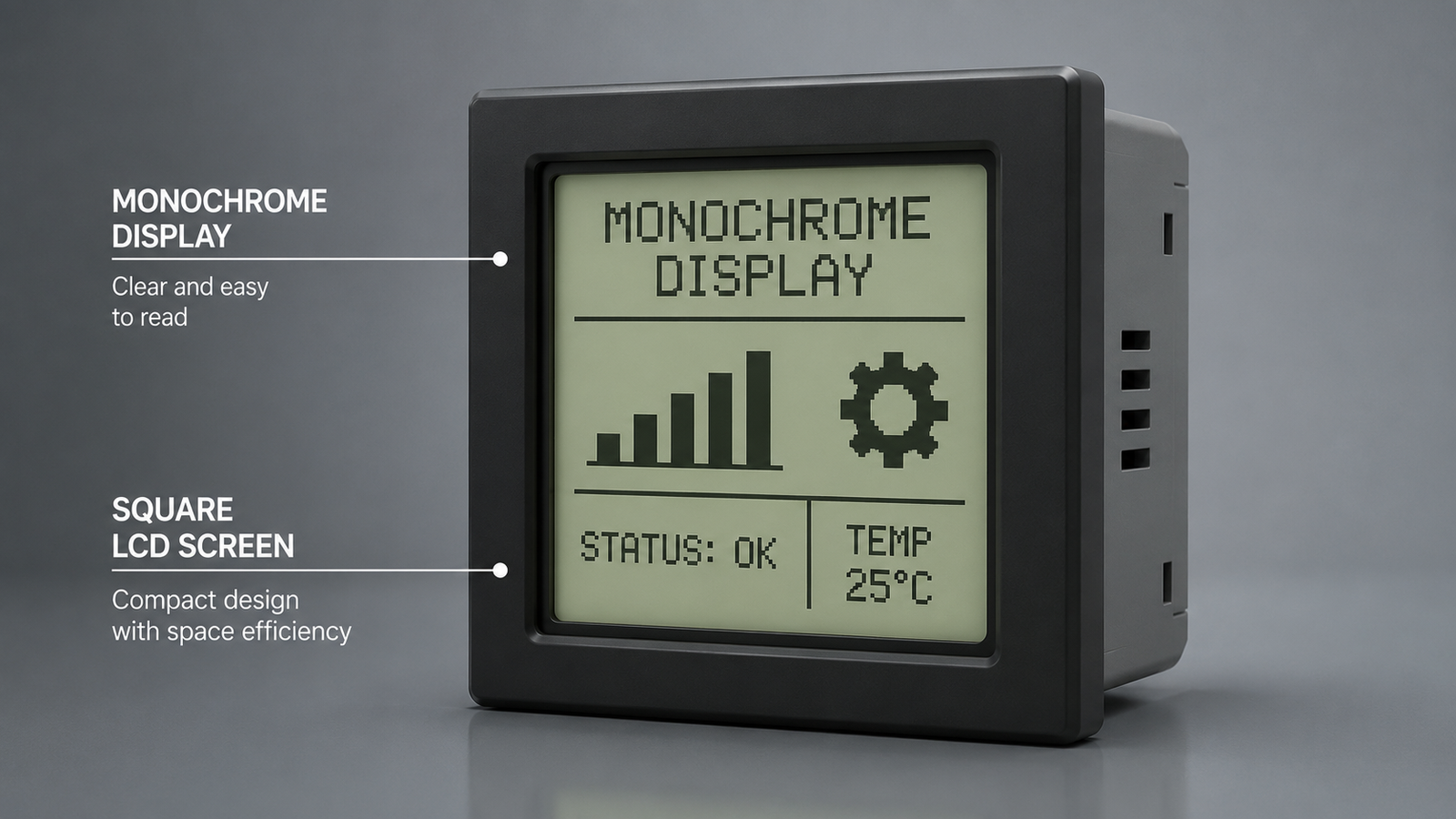
In today’s world of vibrant OLED panels and ultra-high-definition displays, it’s easy to assume that monochrome technology has become obsolete. Surprisingly, the opposite is true. The Monochrome Display continues to power millions of products worldwide, from industrial automation systems and healthcare equipment to automotive dashboards and smart home devices.
At the same time, the Square LCD Screen has become a favorite among product designers who want compact, elegant, and highly functional user interfaces. Its symmetrical design makes it ideal for modern electronics where efficient space utilization and clean aesthetics matter.
If you’re designing an embedded system or selecting a display for your next product, understanding these technologies can help you make a smarter investment.
Why Monochrome Displays Continue to Dominate Industrial Electronics
A Monochrome Display presents information using a single display color against a contrasting background. Instead of focusing on vibrant visuals, it prioritizes clarity, reliability, and energy efficiency.
This makes monochrome LCDs ideal for applications where users need to read information quickly under different lighting conditions.
Some of the biggest advantages include:
- Extremely low power consumption
- Outstanding readability
- Long operational lifespan
- Stable performance in demanding environments
- Lower production costs
- Minimal maintenance
- High reliability for continuous operation
These qualities explain why monochrome LCDs remain essential in industries where performance is more important than visual effects.
Understanding the Science Behind a Monochrome Display
Every Monochrome Display is built using liquid crystal technology.
Inside the display, liquid crystal molecules are positioned between two transparent glass panels coated with conductive layers. When electrical voltage is applied, these molecules change their orientation, controlling how light passes through the display.
Each pixel can either block or transmit light, allowing numbers, symbols, icons, and graphics to appear clearly on the screen.
Since the display controls light rather than generating it, power consumption stays remarkably low, making monochrome LCDs perfect for battery-powered products.
Why Square LCD Screen Designs Are Becoming More Popular
As electronic products become smaller and smarter, manufacturers increasingly choose the Square LCD Screen over traditional rectangular displays.
Its balanced dimensions allow designers to create cleaner interfaces while maximizing available space inside the device.
A square LCD offers several advantages:
- Better screen symmetry
- Improved interface organization
- Easier installation
- Compact product design
- Modern appearance
- Flexible mounting options
Today, square displays are commonly found in:
- Smart thermostats
- Medical monitors
- Industrial control units
- Digital instruments
- IoT gateways
- Portable diagnostic devices
- Home automation panels
Twisted Nematic (TN): The Original LCD Technology
The foundation of every modern Monochrome Display begins with Twisted Nematic technology.
TN displays work by twisting polarized light using liquid crystal molecules.
Their popularity comes from several benefits:
- Affordable manufacturing
- Fast response time
- Low power requirements
- Proven reliability
- Simple construction
Although newer LCD technologies provide better visual quality, TN remains one of the most economical display solutions available.
STN Technology Delivers Better Contrast
Super Twisted Nematic (STN) technology enhances traditional TN displays by improving optical performance.
Compared with conventional TN panels, STN displays offer:
- Higher image contrast
- Reduced operating voltage
- Improved readability
- Better battery efficiency
- Faster display updates
These improvements make STN displays a common choice for portable electronics and industrial equipment.
FSTN and DFSTN for Premium Visual Performance
Applications requiring sharper images often use Film Super Twisted Nematic (FSTN) or Double Film Super Twisted Nematic (DFSTN) technology.
Additional optical films reduce unwanted color effects while increasing display contrast.
Benefits include:
- Darker backgrounds
- Sharper text
- Cleaner graphics
- Higher readability
- Better overall viewing experience
Although these technologies increase manufacturing costs, they significantly improve display quality.
HTN Displays Built for Extreme Conditions
High Twisted Nematic (HTN) displays were developed for environments where reliability is critical.
Key advantages include:
- Excellent temperature resistance
- Very low driving voltage
- Stable long-term performance
- High durability
HTN technology is especially popular in automotive dashboards and industrial machinery exposed to harsh operating conditions.
Choosing Between Positive and Negative LCD Displays
The appearance of a monochrome LCD depends largely on its operating mode.
Positive Display
Positive displays feature:
- Bright background
- Dark characters
- Excellent daylight readability
- Reduced energy consumption
- Optional backlight operation
These displays are commonly used in handheld devices and battery-powered products.
Negative Display
Negative displays reverse the color arrangement.
Features include:
- Dark background
- Bright illuminated characters
- Premium appearance
- Superior nighttime visibility
- Continuous backlight requirement
They are frequently selected for automotive interiors and stylish consumer electronics.
Three Ways LCD Displays Handle Light
The way light travels through an LCD greatly affects performance.
Reflective LCD
Reflective displays rely entirely on external light.
Advantages include:
- No backlight required
- Ultra-low power usage
- Excellent outdoor visibility
These displays are ideal for calculators and portable instruments.
Transmissive LCD
Transmissive displays use an integrated backlight.
Benefits include:
- Bright indoor viewing
- Uniform illumination
- Reliable night operation
Because the backlight stays active, they consume more power than reflective displays.
Transflective LCD
Transflective displays combine both technologies.
Their unique design allows users to:
- Read the screen in sunlight
- Use internal illumination at night
- Reduce battery consumption
- Improve outdoor visibility
This balance makes transflective LCDs highly versatile.
Modern Backlighting Technologies
LED technology has transformed LCD illumination.
Edge-Lit Backlighting
Edge lighting positions LEDs around the display perimeter.
Benefits include:
- Slim profile
- Uniform brightness
- Lower manufacturing costs
- Excellent energy efficiency
Direct LED Backlighting
Direct backlighting places LEDs behind the display.
Advantages include:
- Higher brightness
- Improved uniformity
- Better illumination control
This solution is often reserved for premium displays.
Viewing Angle Can Impact User Experience
Not every LCD performs equally when viewed from different directions.
A high-quality Monochrome Display should maintain:
- Strong contrast
- Clear text
- Stable brightness
- Easy readability
Advanced LCD technologies significantly improve viewing performance compared to earlier designs.
Color Choices Extend Beyond Black and White
Although monochrome displays use only one display color, manufacturers can create numerous visual combinations.
Popular options include:
- White
- Blue
- Amber
- Green
- Yellow-green
- Gray
- Black
Selecting the right color combination enhances usability while complementing the product’s overall design.
Why Designers Love the Square LCD Screen
The Square LCD Screen is becoming the preferred choice for many new electronic products because it provides greater flexibility during product development.
Its balanced shape allows:
- Cleaner interface layouts
- Better icon placement
- Simplified PCB design
- More attractive product styling
- Efficient use of enclosure space
These benefits make square displays increasingly popular across multiple industries.
Types of Monochrome LCD Displays
Different applications require different display structures.
Segment Displays
Ideal for:
- Digital clocks
- Calculators
- Thermometers
- Control panels
Advantages include low manufacturing costs and extremely low power consumption.
Character LCD Displays
Character displays are widely used in:
- Embedded systems
- Industrial machines
- Educational electronics
- Medical devices
They display predefined letters, numbers, and symbols with excellent reliability.
Graphic LCD Displays
Graphic LCDs provide complete pixel-level control.
They support:
- Custom fonts
- Company logos
- Graphs
- Icons
- Waveforms
- Images
Although more sophisticated, they offer maximum flexibility for user interface development.
Applications Across Modern Industries
The combination of Monochrome Display and Square LCD Screen technology is widely used in:
- Industrial automation
- Medical equipment
- Consumer electronics
- Automotive systems
- Home automation
- Laboratory instruments
- Smart energy meters
- Telecommunications
- Security devices
- Agricultural equipment
- Retail terminals
- IoT solutions
Their proven durability makes them ideal for mission-critical applications.
Selecting the Right LCD for Your Project
Before choosing a display, evaluate:
- Environmental conditions
- Viewing distance
- Power availability
- Screen size
- Resolution requirements
- User interface complexity
- Temperature range
- Contrast performance
- Budget
A carefully selected LCD improves both product performance and user satisfaction.
The Future of Monochrome Display Technology
The future of Monochrome Display technology remains promising as manufacturers continue to improve:
- Optical clarity
- Power efficiency
- Contrast ratios
- LED illumination
- Viewing angles
- Compact Square LCD Screen formats
- Industrial-grade durability
- Smart controller compatibility
These advancements ensure monochrome LCDs remain indispensable across industrial and embedded electronics.
Read more – https://newsgrow.blogspot.com/2026/07/monochrome-display-and-square-lcd.html