
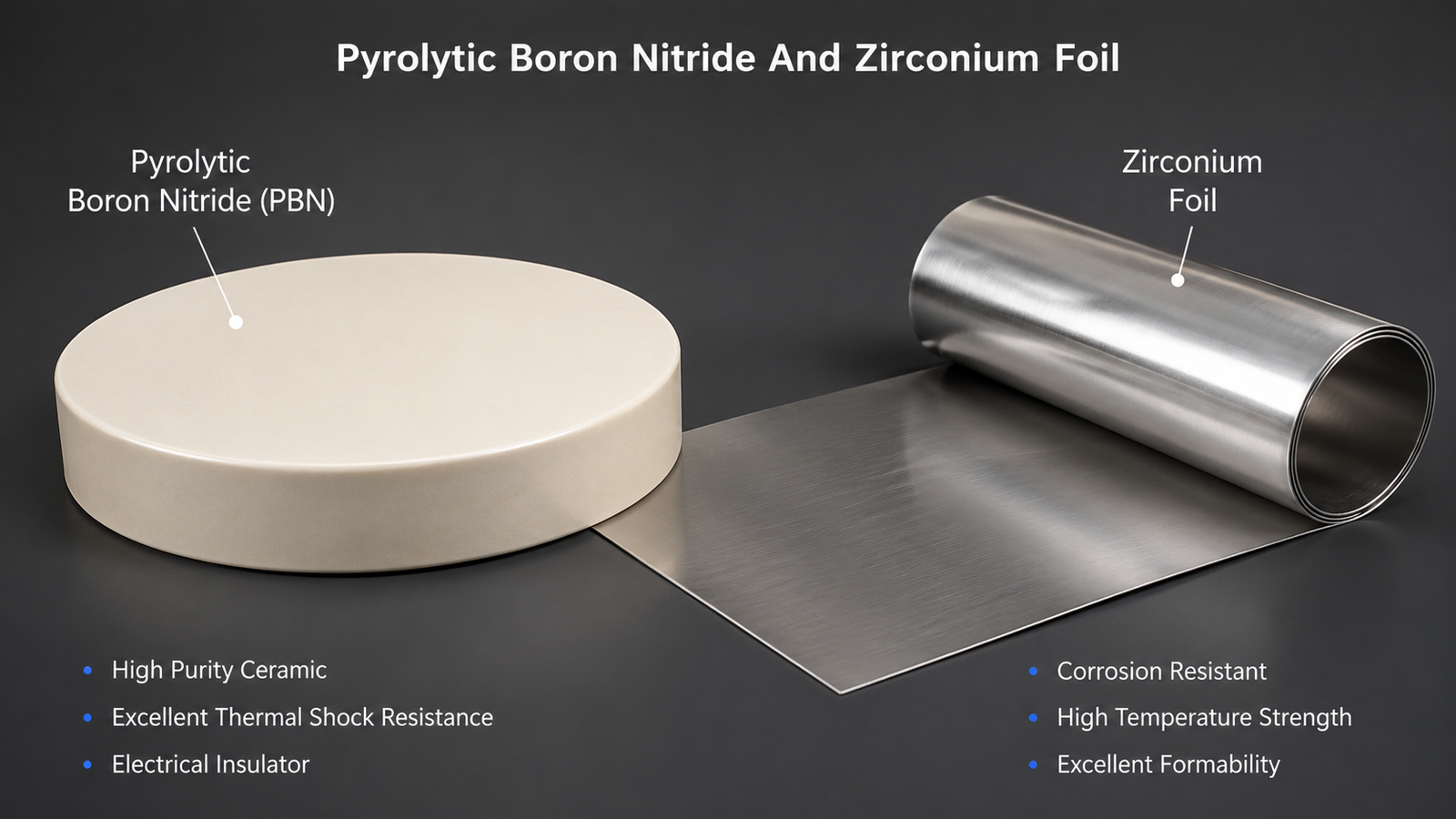
In industries where heat, purity, and resistance to harsh environments matter most, ordinary materials are not enough. That is exactly why Pyrolytic Boron Nitride and Zirconium Foil have become so important in modern manufacturing. These two high-performance materials are trusted in semiconductor production, vacuum systems, aerospace engineering, laboratory equipment, and other demanding applications where reliability cannot be compromised.
Pyrolytic boron nitride is known for its ultra-high purity, excellent thermal stability, and strong resistance to chemical attack. Zirconium foil, on the other hand, is valued for its corrosion resistance, strength, and excellent performance in high-temperature and vacuum environments. Together, they represent the kind of advanced material solution that supports next-generation technology.
What Makes Pyrolytic Boron Nitride Unique
Pyrolytic Boron Nitride, often called PBN, is a special type of boron nitride made through chemical vapor deposition. Unlike conventional ceramic materials, it is produced without binders or sintering additives, which helps it maintain exceptional purity and performance.
This material belongs to the hexagonal boron nitride family and is often compared to graphite because of its layered structure. However, its real advantage lies in how it behaves under extreme conditions. It remains stable at very high temperatures, resists contamination, and performs reliably in environments where many other materials would fail.
Because of these characteristics, PBN is widely chosen for crucibles, tubes, sheets, rings, and coated components used in advanced industrial systems.
The Structure Behind Its Strength
The layered crystal structure of Pyrolytic Boron Nitride is one of the main reasons for its remarkable performance. The atoms are arranged in highly oriented layers, giving the material excellent thermal and electrical properties. This structure also helps it withstand sudden temperature changes without cracking.
Since it grows in a highly controlled deposition process, the resulting product is dense, smooth, and nearly free from pores. That smooth surface is especially valuable in semiconductor applications, where contamination and material sticking can affect product quality.
Why Pyrolytic Boron Nitride Is So Highly Valued
The demand for Pyrolytic Boron Nitride and Zirconium Foil continues to rise because both materials deliver performance that standard materials cannot match. PBN is particularly respected for its purity and stability.
It offers strong resistance to acids, alkalis, salts, molten metals, and many chemical compounds. It also has excellent thermal shock resistance, which means it can handle fast heating and cooling cycles without damage. In addition, it provides strong electrical insulation while still maintaining excellent performance in high-temperature vacuum systems.
These qualities make PBN a dependable choice for applications that require precision, cleanliness, and long service life.
Pyrolytic Boron Nitride in Semiconductor Manufacturing
One of the most important uses of Pyrolytic Boron Nitride is in the semiconductor industry. The production of compound semiconductor crystals requires an extremely clean and stable environment. Even the smallest impurity can affect the final product, so the container material must be as pure and reliable as possible.
PBN crucibles are widely used for crystal growth processes involving materials such as GaAs and InP. They are also used in molecular beam epitaxy and OLED manufacturing, where controlled evaporation and contamination resistance are critical.
Because PBN does not react easily with the materials being processed, it helps ensure better crystal quality and more consistent production results.
Zirconium Foil and Its Industrial Value
While Pyrolytic Boron Nitride is known for ceramic purity and thermal stability, Zirconium Foil brings its own set of powerful advantages. Zirconium is a corrosion-resistant metal with excellent mechanical performance, making it useful in harsh chemical and high-temperature environments.
When processed into foil form, it becomes a thin yet durable material that can be used in demanding industrial setups. Its strength, flexibility, and resistance to aggressive media make it suitable for advanced engineering, vacuum systems, and specialized research equipment.
Zirconium foil is often selected where lightweight metal performance and reliable corrosion protection are needed.
Main Advantages of Zirconium Foil
Zirconium Foil stands out because it combines several useful properties in one material. It resists attack from many acids and corrosive solutions, performs well under heat, and remains dependable in vacuum conditions. It also has a strong strength-to-weight ratio, which is useful in aerospace and technical applications.
Another important advantage is its compatibility with highly controlled environments. In laboratory, nuclear, and semiconductor systems, zirconium foil can help improve durability while reducing unwanted contamination risks.
How Pyrolytic Boron Nitride and Zirconium Foil Are Used Together
In advanced manufacturing, Pyrolytic Boron Nitride and Zirconium Foil may serve different roles, but both contribute to high-performance systems. PBN is often used for crucibles, coatings, insulators, sheets, and support parts, while zirconium foil is used where corrosion resistance and thin metal performance are essential.
Together, they support operations that involve extreme heat, vacuum pressure, and sensitive materials. This makes them valuable across industries such as semiconductors, aerospace, medical technology, and scientific research.
Applications of Pyrolytic Boron Nitride
Pyrolytic Boron Nitride is used in a wide range of industries because it can perform under conditions that are too harsh for many other materials. In semiconductor crystal growth, it serves as a reliable container for high-purity processing. In MBE systems, it supports controlled evaporation with minimal contamination. In OLED manufacturing, it helps maintain precision during material deposition.
PBN is also made into rings, sheets, and tubes for use in high-temperature vacuum environments. In addition, it is applied as a coating to protect graphite parts and heating elements from oxidation and volatilization.
Its versatility makes it one of the most valuable advanced ceramics in modern manufacturing.
Applications of Zirconium Foil
Zirconium Foil is used in industries that demand corrosion resistance, thermal stability, and mechanical reliability. It can be found in vacuum furnaces, chemical processing systems, aerospace equipment, nuclear applications, and specialized laboratory devices.
Because it is thin, strong, and resistant to many reactive environments, it is often used as a protective barrier or structural element in advanced technical systems. Its performance in extreme conditions makes it a trusted material for precision engineering.
Why These Materials Matter for the Future
The future of advanced technology depends on materials that can support higher temperatures, cleaner processing, and more exact manufacturing standards. That is why Pyrolytic Boron Nitride and Zirconium Foil are becoming more important across modern industries.
As semiconductors become more advanced, aerospace systems become more demanding, and scientific research pushes into new territory, materials like PBN and zirconium foil will continue to play a central role. Their combination of purity, durability, and resistance to harsh conditions makes them essential for innovation.
Conclusion
Pyrolytic Boron Nitride and Zirconium Foil are not just technical materials; they are enabling materials for the next generation of high-performance industries. Pyrolytic boron nitride offers ultra-high purity, thermal shock resistance, and excellent chemical stability, while zirconium foil provides corrosion resistance, strength, and dependable performance in extreme environments.
From semiconductor manufacturing to aerospace and vacuum systems, these materials help industries achieve greater precision, cleaner processing, and longer-lasting results. As technology continues to advance, the importance of Pyrolytic Boron Nitride and Zirconium Foil will only grow stronger.
https://newsgrow.blogspot.com/2026/07/pyrolytic-boron-nitride-crucible-and.html
https://newsgrow.blogspot.com/2026/07/pyrolytic-boron-nitride-and-zirconium.html