
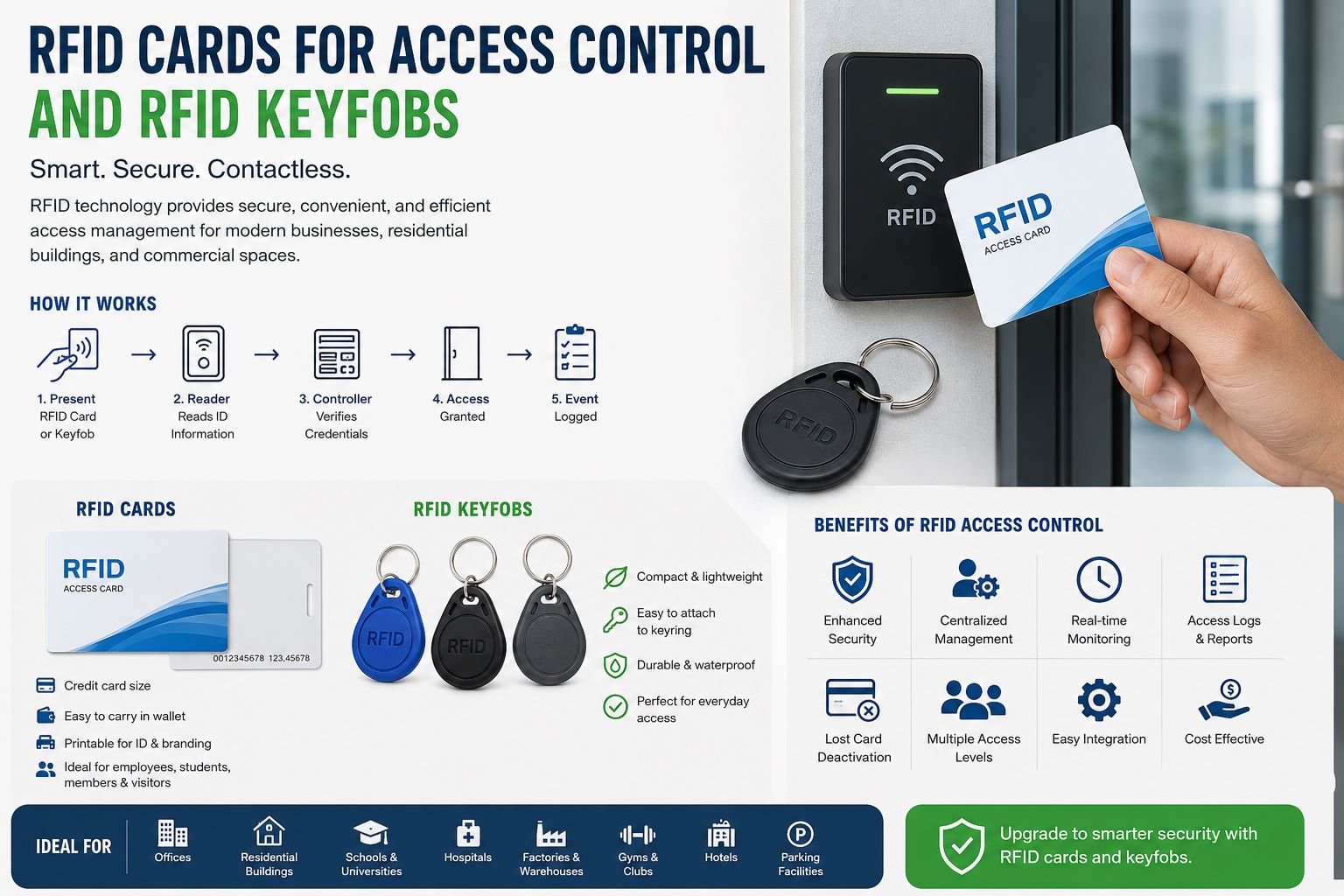
Walk into a modern office, apartment complex, hotel, warehouse, or educational facility and there is a good chance that opening a secured door no longer requires a conventional key. A card or compact keyfob presented near a reader can provide access within moments.
Behind this simple interaction is an increasingly sophisticated security infrastructure. RFID cards for access control and RFID keyfobs are helping organizations move toward centrally managed access, where authorization can be assigned according to identity, location, working hours, and security requirements.
For businesses evaluating an access-control upgrade, understanding how RFID credentials actually work—and where their limitations lie—is essential before choosing a system.
Why Businesses Are Rethinking the Traditional Door Key
Mechanical keys have an obvious advantage: simplicity. However, simplicity can become a weakness as an organization grows.
Consider a facility with 200 employees and 30 controlled rooms. Different teams may require different access privileges. Contractors might need temporary authorization, while employees changing roles may need their permissions modified.
Managing this entirely with physical keys quickly becomes complicated.
RFID cards for access control address the problem differently. Instead of creating access based solely on possession of a physical key, electronic systems can associate credentials with individual users and predefined permissions.
If someone’s responsibilities change, administrators can modify their authorization within the access-management environment.
An RFID Card Is Only One Part of the System
It is easy to think that the RFID card itself decides whether a door opens. In most access-control architectures, however, the credential is only one component.
A typical installation can include:
- RFID credential
- RFID reader
- Access controller
- Management software
- Credential database
- Electronic locking hardware
- Door sensors
- Exit devices
When a credential is presented, the reader communicates with it and passes relevant information into the access infrastructure.
The controller or associated system then determines whether the requested access complies with configured rules.
What Happens During an RFID Access Transaction?
The process can be broken into several stages.
- The user approaches a secured entrance.
- The card or keyfob enters the reader’s operating field.
- The reader communicates with the supported credential technology.
- Relevant credential information is processed.
- The system identifies the credential’s permissions.
- Door, location, and schedule rules are evaluated.
- Entry is granted or denied.
- The transaction may be logged.
To the user, this feels almost instantaneous.
From a security perspective, however, an important authorization decision has occurred.
Why RFID Cards Remain Popular in Professional Environments
The physical format of RFID cards for access control makes them particularly useful for organizations that require both security credentials and visible employee identification.
Cards can potentially be printed with a photograph, employee name, company logo, department, designation, identification number, or validity information.
This allows one card to work as both a visual ID and an electronic credential.
RFID Cards Can Support Role-Based Entry
A well-designed access system does not need to treat every employee equally.
For example, an organization could configure permissions so that:
- General staff access common areas.
- Finance employees enter accounting rooms.
- IT personnel access technology areas.
- Warehouse teams enter inventory sections.
- Management accesses executive facilities.
- Security staff receive broader permissions.
This role-based approach helps organizations align physical access with actual responsibilities.
Why RFID Keyfobs Offer a Different Kind of Convenience
Not every user wants or needs an identification badge.
For these environments, RFID keyfobs offer a compact alternative.
A keyfob packages the credential into a small enclosure that can usually remain attached to everyday keys. This reduces the likelihood that users will leave a separate access card in another wallet, bag, or badge holder.
Keyfobs are therefore particularly practical for apartments, gyms, parking facilities, gated communities, storage spaces, small offices, and membership-based premises.
Convenience Does Not Determine Security
An important point is often overlooked: the shape of a credential does not necessarily determine how secure it is.
A card and keyfob can potentially use comparable credential technologies.
Security depends more heavily on factors such as credential architecture, authentication, reader configuration, system design, and administrative practices.
Understanding RFID Frequencies Before Purchasing Credentials
One of the most common mistakes when replacing RFID credentials is ordering them based only on appearance.
Two white cards can look identical but be technically incompatible.
The same applies to RFID keyfobs.
125 kHz RFID
125 kHz low-frequency technology is commonly found in traditional proximity access systems.
These credentials are typically used for relatively short-range applications and remain installed in many existing buildings.
13.56 MHz RFID
13.56 MHz high-frequency technology is associated with numerous contactless smart-card platforms.
Depending on the technology, these systems can support additional authentication, security, memory, and application capabilities.
Why Frequency Alone Cannot Identify the Correct Card
Knowing that a reader operates at 13.56 MHz is not necessarily enough to purchase a compatible credential.
Two technologies may operate on the same frequency but use different protocols, chip architectures, credential formats, or security configurations.
Before purchasing RFID cards for access control, identify the reader model and supported credential technology.
RFID Cards vs RFID Keyfobs: Which Is More Practical?
| Factor | RFID Card | RFID Keyfob |
| Visual identification | Excellent | Limited |
| Photo printing | Suitable | Usually unsuitable |
| Portability | High | Very high |
| Keyring attachment | Requires accessory | Built for it |
| Corporate branding | Excellent | Limited |
| Employee use | Excellent | Good |
| Residential use | Good | Excellent |
| Gym access | Good | Excellent |
| Permission control | System-dependent | System-dependent |
| Technical compatibility | Reader-dependent | Reader-dependent |
Organizations do not necessarily have to select only one format. Compatible systems may allow different credential types to serve different user groups.
The Lost-Key Problem Looks Different With RFID
Suppose a building master key is lost.
Because the key cannot simply be remotely disabled, facility managers may have to consider whether affected locks should be changed.
Electronic access provides another approach.
When an employee loses one of their RFID cards for access control, the administrator can generally deactivate the associated credential in the management system.
The missing credential can then lose its authorization while other users continue operating normally.
Lost RFID keyfobs can typically be handled using the same principle.
Rapid reporting remains essential because a lost credential may represent a risk until its permissions are revoked.
Time-Based Access Can Reduce Unnecessary Exposure
Electronic access control can become particularly useful when employees and contractors need access only during specific periods.
Imagine an external maintenance team authorized to enter between 8:00 AM and 5:00 PM for one week.
Issuing unrestricted permanent keys would provide more access than necessary.
A compatible access-control platform may instead allow temporary credentials to be restricted according to date, time, door, or security zone.
This principle helps organizations provide necessary access without automatically providing unlimited access.
Access Logs Can Improve Security Investigations
Traditional keys leave little digital evidence.
RFID access systems may generate event records when credentials are presented.
Depending on system configuration, administrators might review information including:
- Credential identity
- Door location
- Date and time
- Access granted
- Access denied
These records can support incident investigations, compliance reviews, and facility-security assessments.
Organizations should simultaneously implement appropriate privacy, data-protection, and record-retention policies.
Strong Access Control Requires More Than Buying RFID Cards
Installing an RFID reader does not automatically create a high-security environment.
Security depends on the entire architecture.
Organizations should evaluate credential technology, authentication methods, reader communication, controller security, software administration, credential issuance procedures, and lost-card policies.
Layered Security for Sensitive Areas
Higher-risk areas may justify combining RFID with another authentication method.
Possible approaches include:
- RFID card plus PIN
- RFID card plus fingerprint
- RFID credential plus biometric authentication
- Credential plus additional security approval
A layered approach can reduce dependence on possession of one physical credential.
Frequently Asked Questions
What are RFID cards for access control?
They are contactless electronic credentials used with compatible access systems to identify users and manage physical entry permissions.
How do RFID keyfobs work?
They communicate with compatible RFID readers using radio-frequency technology when presented within the reader’s supported range.
Do RFID cards need batteries?
Many commonly used access credentials are passive and therefore do not require their own battery.
Can one RFID credential access several rooms?
Yes. Administrators can potentially assign multiple authorized doors or zones to one credential.
Can RFID access be restricted at night?
Many systems support time-based schedules that can prevent credentials from operating outside approved periods.
Can a lost RFID card be blocked?
Yes. Administrators can generally deactivate its authorization through the access-control system.
Are RFID cards and keyfobs interchangeable?
Not necessarily. They must use credential technologies supported by the installed reader.
Which RFID frequency is used for access control?
125 kHz and 13.56 MHz technologies are commonly encountered, although the exact credential technology matters more than frequency alone.
Can RFID cards display employee information?
Yes. Printable credentials can contain photographs, names, employee numbers, departments, logos, and other visual information.
Are RFID keyfobs better for residential properties?
They are often convenient for residential use because they are compact and can remain attached to everyday keys.
https://newsgrow.blogspot.com/2026/08/from-pocket-sized-tools-to-digital.html
https://freeseobacklinks.online/why-nfc-tags-and-smart-wristbands-are-changing-the-future-of-events/
https://blogstream.net/event-technology-enters-a-new-phase-as-nfc-wristbands-gain-wider-attention/
https://newsgrow.blogspot.com/2026/08/nfc-tag-china-market-advances-as-nfc.html
https://bhoomijanatural.info/rfid-cards-and-keyfobs-move-to-the-center-of-modern-access-security/