
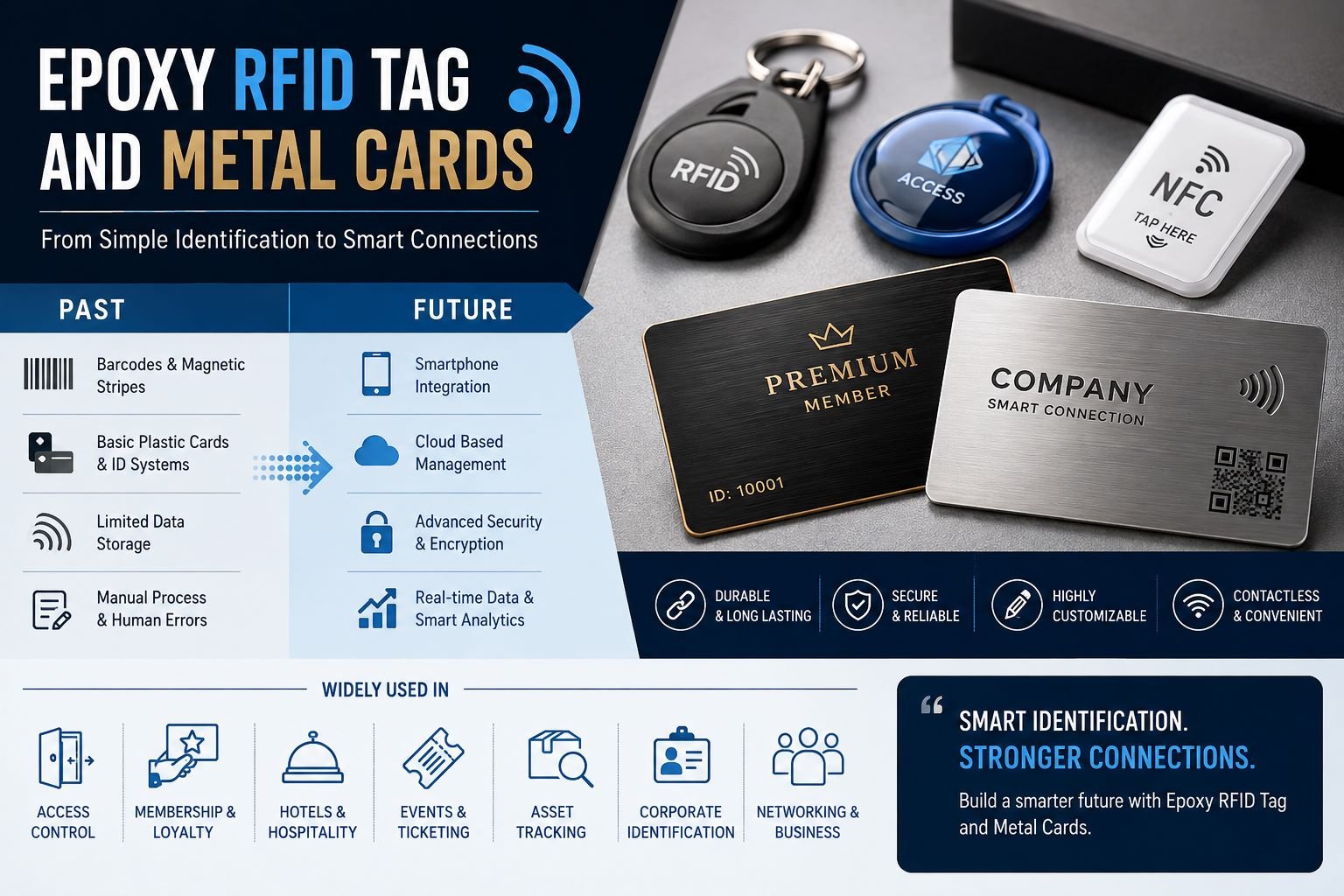
The humble identification tag and business card are undergoing a technology-driven makeover. As organizations increasingly adopt contactless systems, the Epoxy RFID tag and metal cards are emerging as notable examples of how familiar physical products can evolve into connected business tools.
The change has been gradual. Earlier identification systems focused primarily on proving identity or displaying information. Today’s solutions can interact with electronic readers, smartphones and software platforms. Looking ahead, greater integration with cloud technology, the Internet of Things (IoT) and digital identity systems could further expand what these small physical products can accomplish.
A Look Back at the Identification Industry
For many years, organizations depended on straightforward identification methods. Paper passes, printed ID cards, plastic membership cards, magnetic stripes and barcodes were widely adopted because they were relatively simple to produce and manage.
These technologies solved important problems, but many involved manual interaction.
Users needed to show a card, swipe it through a reader or position a barcode correctly for scanning. As businesses looked for faster and increasingly automated processes, contactless identification attracted greater attention.
RFID helped introduce a new model in which compatible tags could communicate with readers through radio frequency technology.
That transition laid the foundation for products such as the modern Epoxy RFID tag.
Epoxy RFID Tags Move Into Customer-Facing Environments
RFID was once viewed mainly as an industrial technology associated with warehouses, logistics and inventory.
Its role has expanded substantially.
Smaller components and customizable formats have made RFID practical for applications where the tag itself is visible to the user. The Epoxy RFID tag combines electronic identification with a surface that can support customized visual design.
More Than an Ordinary Key Tag
Epoxy protection gives the printed area a distinctive smooth finish while helping protect the design during regular handling.
Businesses can potentially customize tags with:
- Brand logos
- Identification numbers
- Custom artwork
- QR codes
- Personalized text
- Different shapes
- Corporate colors
This combination has allowed the Epoxy RFID tag to find applications in offices, hotels, clubs, educational institutions, events and membership-based businesses.
RFID Applications Expand Beyond Door Access
Access control may be one of the most recognizable applications, but RFID technology can support many other processes.
A compatible tag can form part of an attendance system, membership platform, loyalty program or asset identification solution.
The important factor is the infrastructure behind it. The tag provides an identity, while connected software determines how that identity should be processed.
Metal Cards Shift From Luxury to Smart Networking
A parallel transformation is occurring in the business card market.
For generations, professionals have relied on paper cards to exchange contact information. Although inexpensive and practical, paper provides limited opportunities for durability and technological interaction.
Metal cards originally offered an answer for professionals wanting a more distinctive physical presentation.
Their weight and texture created a premium experience, while manufacturing technologies enabled engraving, detailed patterns, cut-outs and customized finishes.
Over time, their applications expanded from luxury business cards into memberships, VIP programs, corporate identification and exclusive customer experiences.
Digital Technology Changes What a Card Can Do
The latest development surrounding metal cards is not purely visual.
NFC technology is enabling suitable card designs to interact with compatible smartphones, while QR codes provide another method of linking physical cards with online information.
A Business Card No Longer Has to Hold Everything
Traditional cards have limited physical space and permanently printed information.
A digitally connected card can instead direct the recipient to an online destination.
That destination might provide:
- Contact details
- A company introduction
- Portfolio projects
- Product information
- Appointment booking
- Professional profiles
- Digital brochures
The card can remain simple while the digital experience contains richer information.
How the Two Technologies Compare
The Epoxy RFID tag and metal cards are not direct replacements for one another. They typically address different business requirements.
| Feature | Epoxy RFID Tag | Metal Cards |
| Core Use | Identification and automation | Networking and branding |
| Typical Technology | RFID/NFC | NFC or QR |
| Access Applications | Common | Possible with compatible technology |
| Membership Programs | Common | Suitable for premium programs |
| Asset Identification | Suitable | Less typical |
| Networking | Limited application | Strong application |
| Customization | Printing, shape, numbering | Engraving, cutting, finishes |
| Brand Positioning | Functional and customized | Premium |
Organizations should therefore evaluate their operational objectives before selecting either format.
RFID’s Future Could Be Driven by Invisible Technology
The next generation of the Epoxy RFID tag may look similar externally while becoming more powerful through the systems operating behind it.
Cloud Platforms Change How Identification Is Managed
Traditional access and identification databases were often managed locally.
Cloud-connected platforms provide opportunities to centralize information across locations. RFID credentials can potentially become part of these larger environments, allowing organizations to manage identification processes through integrated software.
Potential future applications include:
- Multi-location access management
- Automated attendance
- Equipment identification
- Inventory visibility
- Smart facility management
- Customer loyalty integration
- Operational reporting
IoT Could Create Another Growth Opportunity
The Internet of Things connects physical devices and objects with digital networks.
RFID can contribute to these environments by providing a recognizable identity for an object. An Epoxy RFID tag, for instance, could identify an authorized item while connected software processes information associated with it.
As smart buildings, connected factories and automated operations develop, these physical identifiers could become increasingly valuable.
The Future Metal Card Could Become a Digital Key
The direction of metal cards may extend considerably beyond professional contact sharing.
A connected card can potentially act as a gateway to memberships, events, customer experiences or online services.
Reusable Cards Challenge the Disposable Model
Traditional networking often involves distributing hundreds of printed cards. A smart card introduces another model: tap or scan a reusable card and access digital information.
For professionals who regularly attend meetings, exhibitions and conferences, this approach could provide a different networking experience.
It may also reduce the problem of outdated printed information.
Digital Destinations Can Evolve
Suppose a salesperson receives a promotion or a company launches a new catalogue.
Rather than changing the physical card, the business may be able to update the connected online destination, depending on the system being used.
This flexibility could become an important selling point for future metal cards.
Security Takes Center Stage
The expansion of connected identification also raises important questions around security.
RFID and NFC products are available with different technical capabilities. Businesses should select technology according to the sensitivity of the application rather than assuming every chip or card provides identical functionality.
Reader compatibility, authentication, data handling, software security and user privacy should be considered during implementation.
For an Epoxy RFID tag used in secure access, these considerations may be particularly important.
Metal also affects radio-frequency performance, meaning NFC-enabled metal cards need to be designed specifically for the intended application.
Sustainability Could Influence Future Product Design
Durability is becoming another consideration.
Replacing damaged or outdated physical products frequently can increase material consumption. Longer-lasting cards and tags may help reduce replacement frequency when appropriately designed for their application.
Digital profiles can also potentially reduce the need to replace a card simply because information has changed.
Future product development may therefore place greater emphasis on durability, reusable designs, responsible material choices and lifecycle planning.
Frequently Asked Questions
What is an Epoxy RFID tag?
An Epoxy RFID tag is an RFID-enabled identification tag featuring a customizable surface covered with protective epoxy.
Why are epoxy RFID tags popular?
Their combination of compact size, contactless functionality, durability and customization makes them suitable for many applications.
Where can RFID tags be used?
RFID tags can support access, attendance, membership, hospitality, loyalty, events and asset identification.
Can an Epoxy RFID tag include a logo?
Yes. Custom manufacturing can allow logos, graphics, numbers, text, colors and QR codes.
What are metal cards used for?
Metal cards are used for premium networking, memberships, corporate branding, VIP programs and identification.
Do metal cards support NFC?
Specially engineered cards can incorporate NFC technology for compatible contactless interactions.
Can smart metal cards share contact information?
Yes. They can potentially link compatible smartphones to digital profiles containing professional contact information.
What is the difference between RFID and NFC?
NFC is a short-range technology within the broader RFID family and is widely associated with smartphone-based interactions.
Will RFID become more important with IoT?
RFID can complement IoT systems by helping identify physical objects connected with digital records and automated processes.
Are RFID and NFC systems secure?
Security varies by technology and implementation. Businesses should select appropriate chips, authentication methods and software for their application.
Market Outlook Points Toward Greater Connectivity
The evolution of the Epoxy RFID tag and metal cards reflects a broader change taking place across the identification industry.
Yesterday’s products mainly displayed or carried information. Today’s solutions can connect with readers and smartphones. Tomorrow’s products could participate in increasingly sophisticated digital ecosystems.
Cloud platforms can manage credentials. IoT can connect objects. NFC can bridge physical meetings with digital profiles, while automation can turn a simple identification event into an operational workflow.