
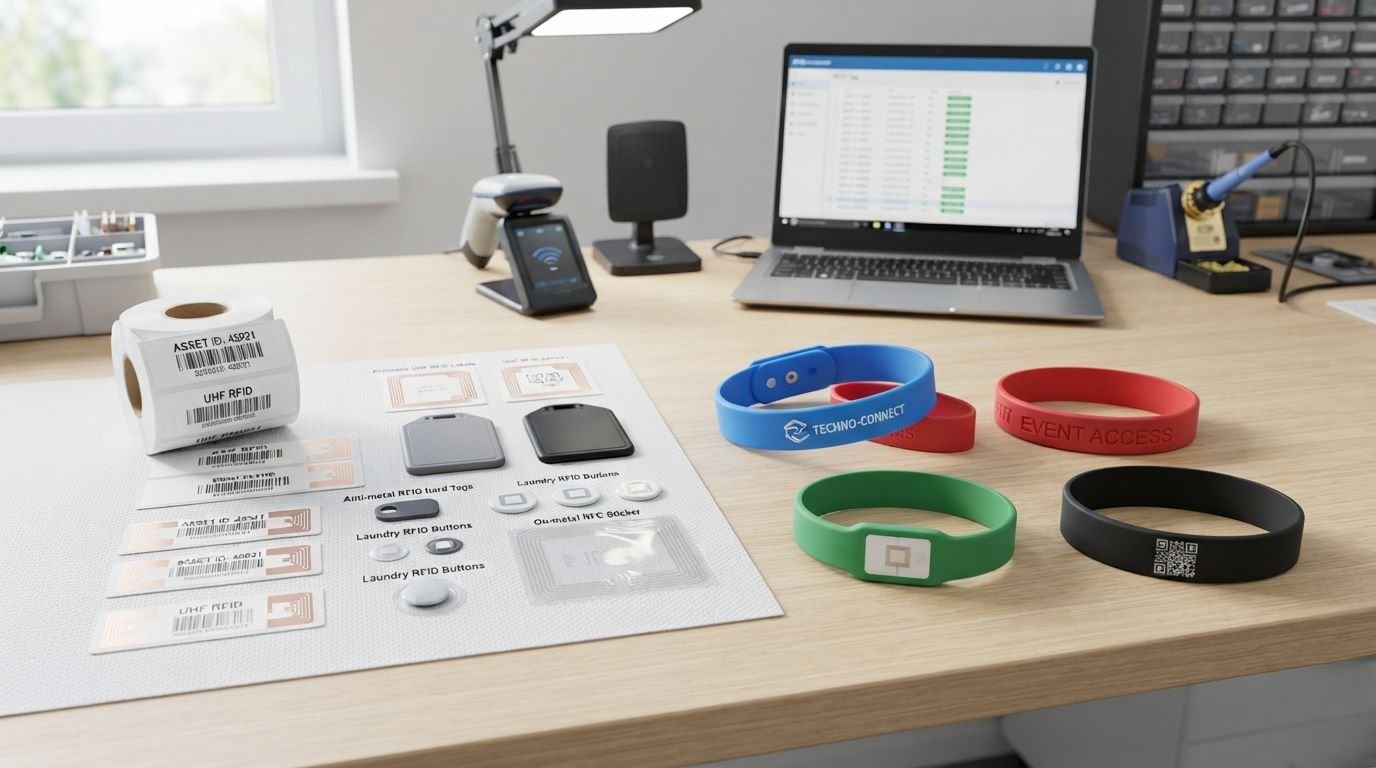
Imagine a warehouse where thousands of products can be identified without manually scanning every box. Now imagine a festival where a visitor can wear a single wristband that acts as a digital credential. These are practical examples of how RFID labels and RFID silicone wristbands are changing identification and tracking.
RFID is not a new concept, but its applications continue to expand. Better hardware, improved software, automation, cloud connectivity, and demand for real-time information are giving RFID a larger role across retail, logistics, manufacturing, hospitality, entertainment, healthcare, and access management.
What Exactly Is RFID?
RFID stands for Radio Frequency Identification. It allows compatible electronic tags to communicate with readers through radio-frequency signals.
A basic RFID ecosystem includes:
- RFID tag or inlay
- RFID reader
- Antenna
- Software
- Database or cloud platform
An RFID tag generally contains a microchip and antenna. Depending on the technology, it can be passive, active, or battery-assisted.
Passive RFID products are particularly popular because they can operate without an internal battery. The reader supplies the energy required for communication.
This wireless identification capability is what makes RFID different from traditional printed identification methods.
The Past: How RFID Replaced Repetitive Identification Tasks
Before RFID became widely accessible, businesses depended heavily on paper records, manual counting, printed labels, and barcode scanning.
Barcodes represented a major improvement because they allowed electronic data collection. However, a barcode normally needs to be visually scanned.
RFID introduced another possibility. A compatible reader can communicate with a tag wirelessly, potentially allowing multiple tagged items to be identified within the reader’s operating area.
As RFID chips became smaller and manufacturing became more efficient, the technology moved into mainstream commercial applications.
How RFID Labels Changed Inventory Management
One of the most important developments was the introduction of RFID labels.
An RFID label combines an electronic RFID inlay with a conventional label format. This allows businesses to retain printed information while adding electronic identification.
For example, a company can place an RFID label on a carton while printing a product code, barcode, serial number, or branding on the same surface.
This combination has made RFID labels useful for:
- Warehouse inventory
- Retail products
- Shipping cartons
- Manufacturing parts
- Asset tracking
- Healthcare supplies
- Logistics
- Document management
Why Businesses Like RFID Labels
The real attraction is visibility.
Instead of relying entirely on employees to locate and scan products individually, businesses can use RFID infrastructure to automate parts of the identification process.
Potential benefits include:
- Faster inventory checks
- Better stock visibility
- Reduced manual data entry
- Improved asset tracking
- More efficient receiving
- Better shipment verification
The actual results depend on the quality of the RFID system and how well it is integrated into business workflows.
The Rise of RFID Silicone Wristbands
RFID technology eventually moved beyond products and assets.
Businesses also needed convenient ways to identify people. This encouraged the development of RFID silicone wristbands.
The concept is straightforward: an RFID component is incorporated into a wearable silicone band. The user carries the credential on their wrist rather than in a pocket or bag.
Silicone is a practical material because it is flexible, lightweight, and comfortable. Suitable designs can also be made for environments involving moisture and frequent handling.
Where RFID Silicone Wristbands Are Useful
Wearable RFID has become particularly interesting for events and hospitality.
Potential applications include:
- Concerts
- Music festivals
- Sporting events
- Waterparks
- Resorts
- Hotels
- Gyms
- Conferences
- Membership programs
At a large event, a wristband can provide a simple wearable credential for suitable access-control systems.
For a resort, the same concept can support guest identification and selected services when connected to compatible software.
RFID Labels vs RFID Silicone Wristbands
Although both use RFID technology, they solve different problems.
| Feature | RFID Labels | RFID Silicone Wristbands |
| Primary purpose | Product and asset identification | Human identification |
| Physical format | Adhesive label | Wearable band |
| Main applications | Retail, warehouse, logistics | Events, resorts, fitness |
| Customization | Printed information | Colors, logos, graphics |
| Durability | Application dependent | Designed for wearable use |
| Reusability | Depends on application | Possible with suitable designs |
The important point is that there is no universal “best” RFID product. The correct format depends on what needs to be identified and where the system will operate.
Why RFID Frequency Matters
One topic businesses should understand before selecting an RFID product is frequency.
Different RFID technologies operate at different frequency ranges, including LF, HF, UHF, and NFC-related implementations.
Each has different characteristics relating to:
- Reading distance
- Data communication
- Tag size
- Environmental behavior
- Reader requirements
- Application suitability
For example, a short-range credential and a warehouse inventory system may require completely different RFID configurations.
Selecting the frequency based only on price can create performance problems later.
What Can Affect RFID Performance?
RFID is a wireless technology, so the surrounding environment matters.
Factors that can influence performance include:
- Metal
- Liquids
- Tag orientation
- Reader placement
- Antenna configuration
- Reading distance
- Interference
- Product packaging
- Environmental conditions
A label that performs well on cardboard may behave differently when attached to metal equipment.
This is why real-world testing is essential before large-scale deployment.
The Present: RFID Is Becoming Part of Connected Systems
Today, RFID is increasingly integrated with digital platforms.
Businesses can connect RFID data with:
- Warehouse-management systems
- Enterprise resource planning software
- Inventory platforms
- Access-control systems
- Event-management software
- Cloud databases
- Analytics tools
This integration creates a valuable link between physical objects and digital information.
A product carrying an RFID label can become digitally visible. A visitor wearing an RFID silicone wristband can become a recognized credential within an authorized system.
The Future of RFID Labels
The future of RFID labels is moving toward greater automation and intelligence.
As businesses adopt artificial intelligence, robotics, cloud computing, and advanced analytics, RFID data can become an important source of operational information.
Future developments may include:
- Smaller RFID inlays
- Improved antenna designs
- Better performance near challenging materials
- Sustainable label materials
- Sensor-enabled RFID
- Automated inventory reconciliation
- AI-supported inventory analysis
The goal is no longer simply to identify an item.
The bigger opportunity is understanding what is happening to that item throughout its journey.
The Future of RFID Silicone Wristbands
The next generation of RFID silicone wristbands may become increasingly connected to digital customer experiences.
Future designs could focus on:
- Improved comfort
- Reusable construction
- Enhanced security
- Better personalization
- Mobile integration
- Cloud connectivity
- More detailed event analytics
For entertainment venues, hotels, and resorts, the wristband could evolve from a simple access credential into a central part of the visitor experience.
Sustainability Is Becoming Part of the Conversation
As RFID adoption grows, environmental considerations are also becoming important.
Disposable identification products can generate significant material consumption at large events and high-volume operations.
This is encouraging interest in:
- Reusable wristbands
- Lower-material label designs
- Recyclable substrates
- Efficient manufacturing
- Longer-lasting products
RFID silicone wristbands may be particularly useful for recurring programs where the same wearable credential can be used repeatedly.
However, sustainability should be evaluated across the complete product lifecycle rather than based on one material alone.
How to Choose the Right RFID Product
Before purchasing RFID labels or RFID silicone wristbands, businesses should answer several questions.
- What exactly needs to be identified?
- What reading distance is required?
- Which RFID frequency is appropriate?
- What materials surround the tag?
- Will the product be exposed to water, heat, or chemicals?
- How long should it last?
- Is customization required?
- What readers and software will be used?
- Will the product be reusable?
- Can the system scale in the future?
Testing samples in the actual operating environment can help identify problems before full implementation.
FAQ About RFID Labels and RFID Silicone Wristbands
What are RFID labels used for?
RFID labels are commonly used for inventory, retail products, logistics, assets, manufacturing components, and document identification.
What are RFID silicone wristbands used for?
They are used for wearable identification, access control, events, hospitality, memberships, and visitor management.
Are RFID labels the same as barcode labels?
No. Barcodes rely on optical scanning, while RFID communicates wirelessly with compatible readers.
Do passive RFID labels need batteries?
Generally, passive RFID labels do not contain internal batteries and receive operating energy from the reader.
Can RFID wristbands be customized?
Yes. Depending on the manufacturer, customization may include colors, logos, graphics, numbering, shapes, and RFID encoding.
Are RFID wristbands waterproof?
Some are designed for water-related environments, but the exact resistance depends on the product specifications and construction.
Can RFID labels be placed on metal?
Specialized RFID labels can be designed for metal applications, but metal can affect RFID performance, making testing important.
Are silicone RFID wristbands reusable?
Some designs can be reused, depending on the application, construction, cleaning requirements, and closure system.
Can RFID integrate with business software?
Yes. RFID systems can connect with appropriate inventory, warehouse, access-control, event, and enterprise platforms.
What is the future of RFID?
RFID is expected to become increasingly connected with artificial intelligence, automation, cloud computing, IoT systems, analytics, and sustainable manufacturing.
Read more – https://newsgrow.blogspot.com/2026/08/building-smarter-entry-systems-what.html
https://bhoomijanatural.info/rfid-cards-and-keyfobs-move-to-the-center-of-modern-access-security/