
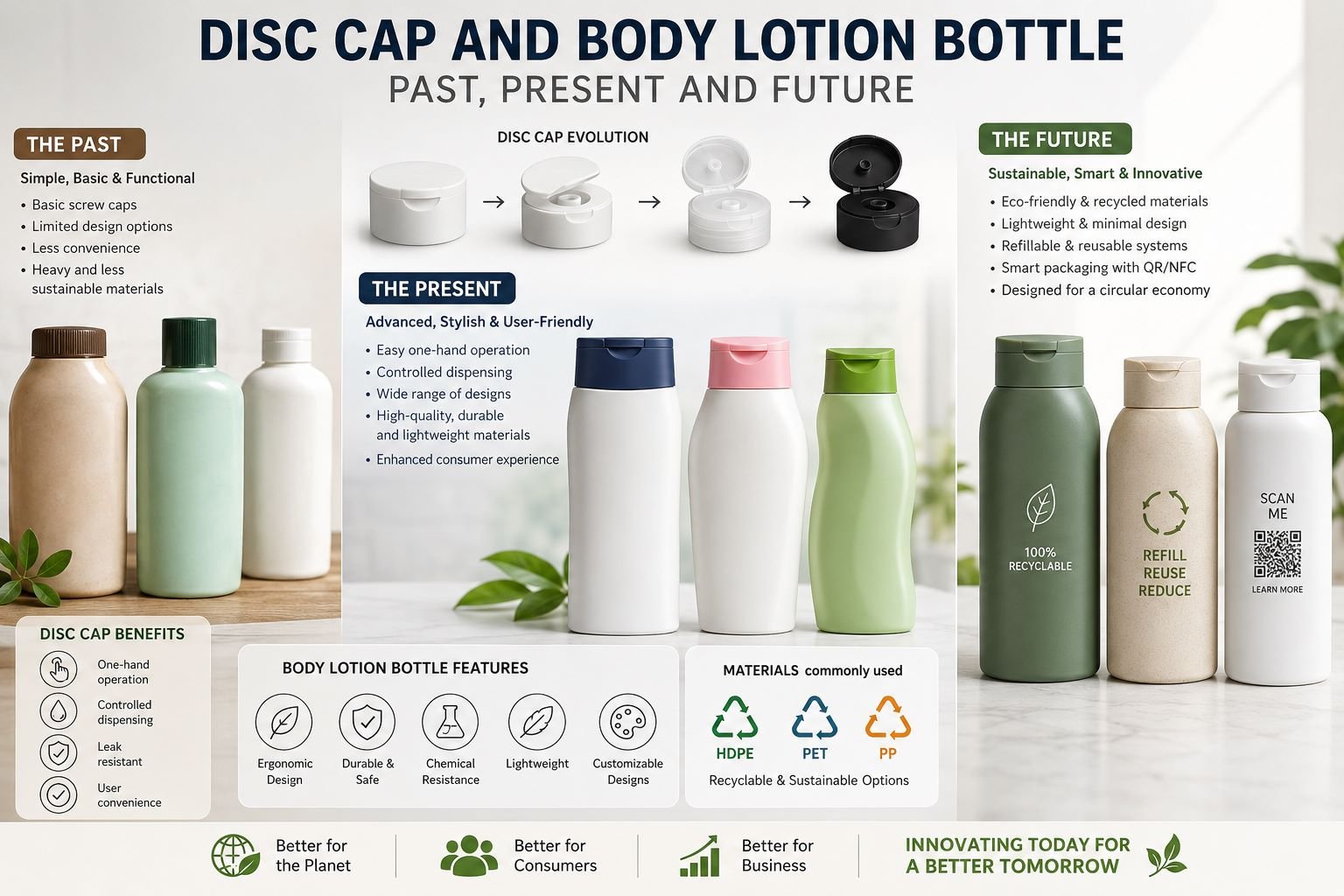
The beauty packaging sector is witnessing a new wave of development as established formats such as the disc cap and body lotion bottle are being reconsidered for a changing personal care market.
For decades, lotion packaging was largely judged by its ability to safely contain a formulation and prevent leakage. That standard is no longer enough. Modern brands increasingly want packaging that is easy to use, visually distinctive, efficient to manufacture and better aligned with sustainability objectives.
The transformation marks an important moment for personal care packaging. Instead of replacing familiar formats completely, manufacturers are improving them through better engineering, recycled-material opportunities, lightweight construction and refill concepts.
Personal Care Packaging Was Once Built Around Simplicity
Earlier lotion packaging focused heavily on practical containment.
A conventional bottle combined with a removable screw closure provided an affordable way to package skincare formulations. Consumers simply unscrewed the cap, poured or squeezed out the product and replaced the closure.
However, convenience became more important as lotions, shampoos and other personal care products moved deeper into everyday routines.
Managing a separate closure was not always practical, particularly with wet hands. Larger openings could also make controlling the amount dispensed more difficult.
These limitations encouraged the packaging industry to explore closures capable of delivering faster access without requiring complete removal.
Disc Cap Emerged as an Everyday Dispensing Solution
The disc cap helped address those usability concerns through a relatively simple mechanical design.
Pressing one side of the closure causes the opposite section to rise, exposing the dispensing opening. Consumers can then dispense the formulation and press the raised section down to close it.
The concept proved valuable because it did not require consumers to learn a complicated dispensing system.
Its key characteristics included:
- Simple press-to-open operation
- Convenient one-handed use
- Controlled dispensing
- Compact closure construction
- Quick opening and closing
- No detachable cap during application
The disc cap subsequently became familiar across personal care categories ranging from body lotion and shampoo to cleanser, conditioner and shower products.
The Body Lotion Bottle Became Part of the Beauty Experience
While closure technology improved convenience, bottle design increasingly influenced how consumers perceived products.
A basic body lotion bottle was once primarily a protective container. Growing competition within beauty and skincare changed that role dramatically.
Packaging became an important part of brand storytelling.
Different bottle shapes and finishes could communicate different messages. Sleek minimalist packaging might suggest modern skincare, while transparent containers could highlight product color or texture.
Manufacturers responded by expanding design possibilities across shape, size, color, finish and decoration.
The bottle had effectively become part of the product itself.
Brands Increasingly View Bottle and Closure as One System
One important change in modern packaging development is the growing emphasis on component integration.
Rather than choosing a bottle first and adding a closure later, brands can evaluate the disc cap and body lotion bottle together.
This matters because dispensing performance depends on several connected factors.
Bottle flexibility influences squeezing pressure. Formulation viscosity determines flow. The opening controls the amount released, while neck compatibility affects sealing.
A well-matched system can therefore provide a noticeably better customer experience than components selected primarily for appearance.
Plastic Materials Enabled Greater Design Flexibility
The growth of plastic packaging allowed manufacturers to develop lighter and more adaptable personal care containers.
Several materials became particularly important.
| Material | Common Packaging Role | Notable Feature |
| HDPE | Lotion containers | Strength and flexibility |
| PET | Transparent containers | Clarity and lightweight construction |
| PP | Dispensing closures | Durability and flexibility |
| PCR Resin | Selected packaging | Uses recovered plastic material |
Polypropylene is widely considered for the disc cap, while PET and HDPE remain common options for a body lotion bottle.
Packaging developers must nevertheless evaluate each material against the actual formulation and expected conditions of use.
Consumer Expectations Are Forcing Packaging to Improve
Modern customers expect packaging to perform almost invisibly.
They do not want to struggle with a closure, clean product from around the bottle opening or discover leakage inside a travel bag.
This places greater pressure on packaging designers to focus on usability.
Important requirements now include:
- Easy opening
- Controlled flow
- Secure closing
- Comfortable handling
- Travel convenience
- Attractive presentation
- Product protection
- Responsible material selection
This consumer-focused approach is expected to influence future packaging innovation significantly.
Sustainability Moves From Trend to Design Requirement
Perhaps the most important transformation is happening around material use.
The traditional assumption that more packaging automatically provides greater value is being challenged.
Brands are increasingly exploring ways to deliver required performance while reducing unnecessary material.
Major development areas include:
- Lightweight bottle construction
- Reduced virgin resin consumption
- Post-consumer recycled materials
- Design for recyclability
- Refillable packaging models
- Simplified components
- Reduced secondary decoration
These changes could reshape both the disc cap and body lotion bottle over the coming years.
Next-Generation Disc Cap May Look Familiar but Perform Differently
Consumers may not notice dramatic visual changes in future closures.
The biggest improvements could happen inside the structure.
Manufacturers Explore Lightweight Engineering
Future disc cap development may involve optimizing wall thickness, internal geometry and material distribution.
The objective is straightforward: use material efficiently while maintaining dependable opening, closing and sealing performance.
This approach can become particularly meaningful at high production volumes.
Dispensing Openings Could Become More Precise
Another area of development involves product flow.
Thick and thin formulations behave differently. Future closure designs could be more closely matched to individual viscosity requirements.
Better dispensing control can improve application while potentially reducing unnecessary product release.
Future Body Lotion Bottle Could Contain Less Virgin Plastic
Recycled-content packaging is expected to remain an important area of innovation.
A future body lotion bottle could incorporate post-consumer recycled resin where suitable for the intended application.
Using PCR material can help reduce reliance on virgin resources, although manufacturers still need to consider quality, appearance, processing, formulation compatibility and applicable regulatory requirements.
Lightweighting provides another opportunity.
Through structural optimization, bottle manufacturers can seek to reduce material without compromising necessary strength.
Refill Models Could Change How Lotion Is Purchased
The future of skincare packaging may also involve separating the product from the primary container.
Instead of purchasing a new body lotion bottle with every refill, customers could keep a durable main bottle and replenish the formulation separately.
Refill Packaging Must Be Easy to Use
The success of such systems will depend heavily on convenience.
Consumers are more likely to participate when refilling is clean, quick, hygienic and economically attractive.
A refill model that creates additional inconvenience may struggle regardless of its sustainability advantages.
For manufacturers, designing the refill experience could therefore become just as important as designing the bottle.
Digital Features Could Give Packaging a Second Function
A physical package can now act as a bridge to digital content.
QR codes and other connected technologies can provide additional information without requiring a larger label.
A digitally enabled body lotion bottle could connect consumers with:
- Ingredient details
- Application recommendations
- Recycling instructions
- Product authenticity verification
- Production information
- Refill availability
- Brand sustainability programs
This could become particularly important as consumers seek greater product transparency.
Past and Future Packaging Tell Two Different Stories
| Earlier Packaging | Emerging Packaging |
| Designed mainly for containment | Designed around total experience |
| Removable closures | Convenient dispensing |
| Material-heavy construction | Lightweight engineering |
| Virgin plastic dependence | Recycled-content opportunities |
| Dispose after use | Refill and reuse concepts |
| Decoration-driven differentiation | Purpose-driven minimalism |
| Information printed on label | Connected digital information |
The comparison shows that packaging innovation is increasingly about efficiency rather than complexity.
Frequently Asked Questions
What does a disc cap do?
A disc cap provides a press-operated opening for controlled dispensing without requiring complete closure removal.
Why did disc caps become popular?
They combined convenient operation, compact design and controlled dispensing in a relatively simple closure.
Where can disc closures be used?
They are commonly associated with lotions, shampoos, conditioners, cleansers and other personal care formulations.
What is a body lotion bottle usually made from?
PET and HDPE are common choices depending on appearance, flexibility and formulation requirements.
Why is PP commonly used for closures?
Polypropylene offers useful flexibility, durability and molding characteristics for many closure applications.
What is PCR packaging?
PCR packaging uses post-consumer recycled material recovered after previous consumer use.
Can lotion bottles become lighter?
Yes. Structural optimization can potentially reduce material while retaining required packaging performance.
Why are refill systems gaining attention?
They can reduce repeated consumption of primary containers by allowing customers to retain and replenish a durable bottle.
Can packaging provide digital information?
Yes. QR codes and related technologies can connect consumers with detailed online product information.
What is expected from future beauty packaging?
Greater emphasis is expected on convenience, recyclability, lightweighting, recycled materials, refillability and digital transparency.
https://newsgrow.blogspot.com/2026/08/cream-jar-and-cosmetic-jar.html
https://gosarkarijobs.com/disc-cap-and-cosmetic-pump-a-deep-guide-to-modern-cosmetic-packaging/
https://newsgrow.blogspot.com/2026/08/disc-cap-and-cosmetic-pump-essential.html
https://tandtlawassociates.com/past-and-future-of-disc-cap-and-body-lotion-bottle-packaging/