
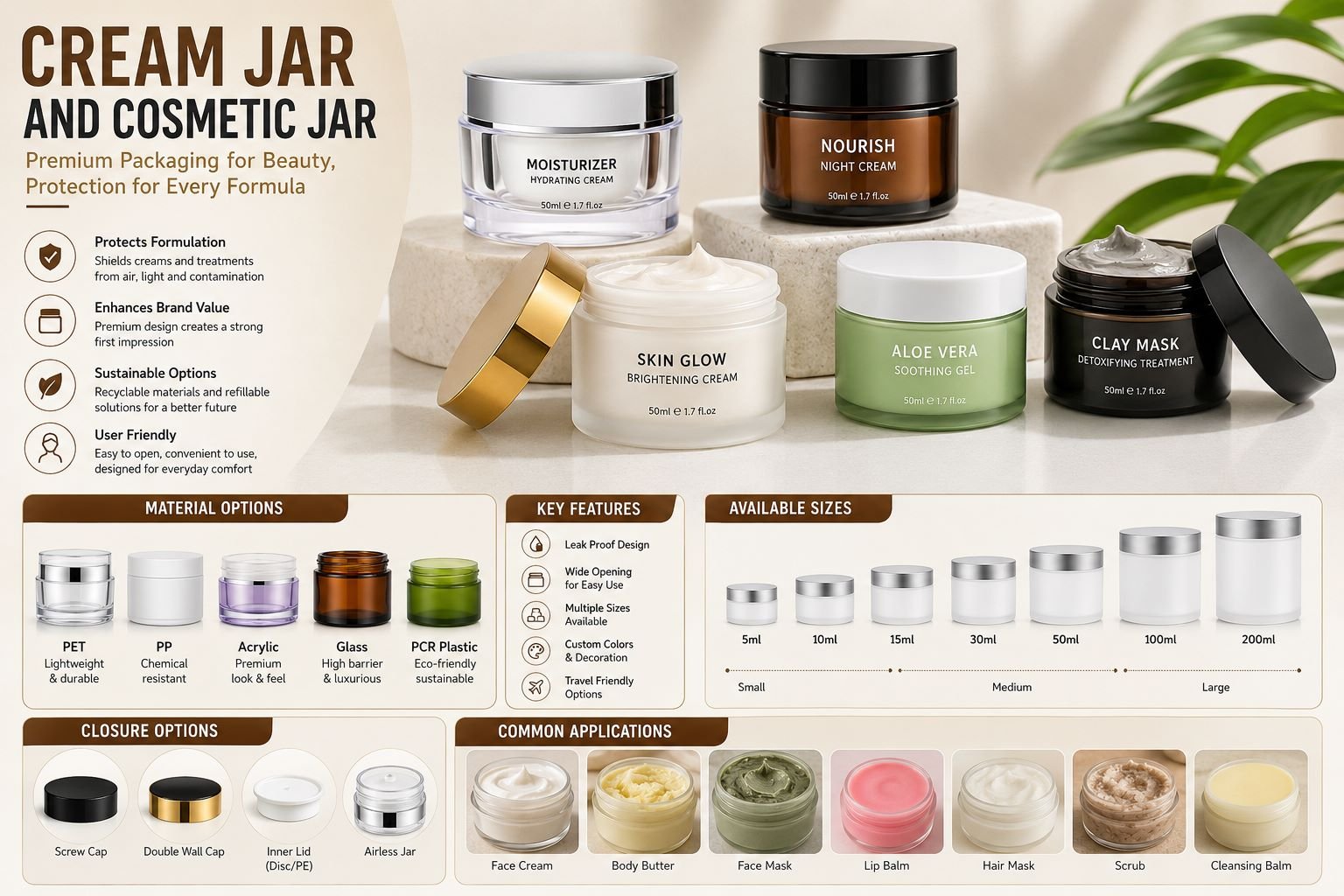
Beauty and skincare companies are rethinking how products are packaged as consumer expectations move toward a combination of premium appearance, practical functionality, responsible material choices, and convenient application. At the center of this development, the cream jar and cosmetic jar continue to provide versatile packaging solutions for a broad range of personal care formulations.
From daily moisturizers and anti-aging products to body butter, facial masks, cleansing balms, and hair treatments, jar packaging has established a strong presence across the beauty sector. Today, however, brands are looking beyond conventional packaging and evaluating how jar design can contribute to product protection, brand recognition, logistics, and the overall customer experience.
Beauty Brands Redefine the Role of Jar Packaging
Packaging is often the first physical connection between a consumer and a beauty product.
Customers notice the shape, weight, finish, color, cap, and labeling before they experience the formulation itself. As a result, a cream jar can influence expectations about quality and value from the first interaction.
Modern packaging development therefore involves several priorities:
- Product protection
- Easy application
- Reliable closure
- Strong visual identity
- Transportation durability
- Efficient material use
- Consistent manufacturing
The challenge for brands is finding a solution that addresses these requirements without making packaging unnecessarily complicated.
Expanding Skincare Categories Increase Demand for Versatile Jars
Beauty routines have become more specialized, resulting in a wider range of formulations and textures.
Traditional facial moisturizers now share the market with sleeping masks, barrier creams, cleansing balms, scalp treatments, body butter, and specialized cosmetic products.
The wide opening of a cosmetic jar makes it particularly suitable for high-viscosity formulations that consumers need to scoop or apply directly.
Popular Jar-Based Cosmetic Categories
Common applications include:
- Face creams
- Body creams
- Facial masks
- Hair masks
- Cleansing balms
- Exfoliating scrubs
- Styling waxes
- Hand treatments
- Lip care
- Professional spa products
This versatility enables brands to create coordinated packaging families covering multiple product categories.
Packaging Material Becomes Part of Product Strategy
Material selection can influence almost every aspect of a finished cosmetic product, including its appearance, transportation weight, durability, barrier characteristics, and cost.
Manufacturers currently provide several options for cream jar production.
| Material | Primary Benefit | Typical Positioning |
| Glass | Substantial, premium feel | Prestige skincare |
| PET | Lightweight and clear | Mainstream beauty |
| PP | Durable and versatile | Skincare and body care |
| Acrylic | Luxury visual effect | High-end cosmetics |
| PCR Plastic | Recycled content | Sustainability-focused products |
Rather than choosing a material solely because it looks attractive, brands are increasingly considering how it performs throughout the complete product lifecycle.
Product and Packaging Compatibility Remains Essential
A sophisticated design cannot compensate for packaging that is incompatible with the formulation.
Cosmetics may contain fragrances, oils, botanical ingredients, acids, vitamins, and active compounds. Depending on their composition, these ingredients can interact differently with packaging materials.
Testing Can Identify Potential Problems
Compatibility evaluation can help detect issues such as:
- Leakage
- Cracking
- Swelling
- Discoloration
- Closure changes
- Surface deterioration
- Decoration damage
- Unexpected product loss
Testing the actual formulation with the intended cosmetic jar provides valuable information before mass production begins.
Time Can Reveal Hidden Packaging Problems
Some packaging issues may appear only after extended storage or exposure to different environmental conditions.
Brands should therefore establish appropriate testing protocols based on the formulation, intended shelf life, transportation route, and target market.
Premium Packaging Is Becoming More Personalized
Beauty companies are increasingly using packaging customization to create recognizable identities.
A cream jar can communicate clinical simplicity, botanical positioning, youthful energy, or luxury depending on its proportions and decorative treatment.
Popular customization possibilities include:
- Custom molding
- Screen printing
- Hot stamping
- Frosted finishes
- Soft-touch coatings
- Metallization
- Embossed logos
- Decorative labels
- Custom-colored caps
- Matte or glossy surfaces
Digital Presentation Matters Too
Cosmetic packaging is no longer designed exclusively for physical shelves.
A modern cosmetic jar must also remain visually distinctive in website listings, social media campaigns, online advertisements, and marketplace thumbnails.
This has increased the value of simple, recognizable shapes and strong visual branding.
Packaging Capacity Shifts Toward Practicality
Brands are also reconsidering how much packaging is genuinely necessary for each product.
Using an oversized container can increase material consumption, secondary packaging dimensions, storage requirements, and shipping volume.
More practical sizing can create a better balance.
| Capacity | Common Product Type |
| 5–15 ml | Samples, eye cream and lip care |
| 20–30 ml | Targeted facial treatments |
| 50 ml | Daily facial moisturizers |
| 100–200 ml | Body creams, scrubs and masks |
| 250 ml+ | Professional and salon products |
Choosing an appropriately sized cream jar can improve usability while supporting packaging efficiency.
Refillable Designs Bring New Thinking to Luxury Cosmetics
Refill systems are creating another direction for beauty packaging.
A refillable cosmetic jar can feature a durable decorative outer container and a replaceable inner unit. Instead of purchasing the complete package repeatedly, customers replace the product-containing component.
The concept can be particularly attractive for prestige beauty, where the outer packaging may incorporate substantial decorative materials.
Refill Systems Must Remain Convenient
A successful refill solution should be:
- Easy to understand
- Simple to install
- Hygienic
- Secure during use
- Convenient to repurchase
Complex refill procedures can discourage customers from adopting the system.
Airless Cream Jars Introduce Controlled Dispensing
Premium skincare brands are also exploring jar-style airless packaging.
These packages generally use dispensing mechanisms that release a controlled quantity without requiring consumers to access the entire product surface directly.
Potential advantages can include cleaner application and more controlled dispensing.
An airless cream jar can therefore provide a different experience from traditional wide-mouth packaging.
However, compatibility with product viscosity, filling equipment, dispensing performance, material composition, and cost should be evaluated before selection.
Sustainability Pushes Brands Beyond Basic Recyclability
Environmental packaging discussions are becoming more detailed.
Instead of focusing only on whether a cosmetic jar can theoretically be recycled, companies are beginning to consider the quantity of material used, recycled content, transportation requirements, component separation, and reuse opportunities.
Strategies Being Explored Include
- Lightweight container construction
- PCR materials
- Refillable formats
- Reduced secondary packaging
- Fewer mixed materials
- More efficient shipping configurations
- Clear disposal instructions
The objective is to reduce unnecessary packaging impact while continuing to protect the cosmetic formulation effectively.
E-Commerce Makes Durability a Business Priority
Online beauty retail creates packaging challenges that may not be obvious during initial design.
Products can experience repeated movement, vibration, stacking, impact, and temperature changes before delivery.
A cream jar intended for e-commerce should therefore be assessed for more than appearance.
Brands may evaluate:
- Cap security
- Leakage resistance
- Breakage risk
- Surface scratching
- Label adhesion
- Printing durability
- Secondary packaging protection
Products that arrive clean and undamaged create a stronger first impression and can reduce avoidable returns.
Quality Control Becomes Critical at Scale
A sample package may look excellent, but maintaining the same quality across thousands of units requires consistent manufacturing.
Variations in dimensions, color, printing, closure fit, or surface quality can affect the finished product.
Beauty brands are therefore placing greater importance on supplier quality management.
Key Quality Areas
Manufacturers may inspect:
- Jar dimensions
- Thread consistency
- Closure fit
- Surface defects
- Color variation
- Decoration alignment
- Leakage performance
- Batch-to-batch consistency
Quality control becomes particularly important when customized packaging involves multiple manufacturing and decoration processes.
Frequently Asked Questions
1. What is a cream jar commonly used for?
A cream jar is commonly used for moisturizers, masks, balms, body butter, hair treatments, and other thick formulations.
2. What is a cosmetic jar?
A cosmetic jar is a packaging container designed for various skincare, haircare, body care, and beauty products.
3. Why is jar packaging popular?
Wide openings, convenient product access, design flexibility, and compatibility with thick formulations contribute to its popularity.
4. Should brands choose glass or plastic?
The decision should consider formulation compatibility, branding, weight, durability, transportation, cost, and environmental objectives.
5. Can cream jars be customized?
Yes. Colors, closures, printing, coatings, labels, shapes, and decorative treatments can often be customized.
6. What does PCR mean?
PCR refers to post-consumer recycled material recovered from previously used products and processed for suitable new applications.
7. Why should cosmetic jars undergo testing?
Testing can identify potential compatibility, leakage, closure, transportation, and decoration problems before commercial distribution.
8. What is a refillable cosmetic jar?
It generally combines a reusable external container with a replaceable product-containing refill.
9. What is airless jar packaging?
Airless jar packaging uses a dispensing mechanism intended to reduce direct access to the bulk formulation during application.
10. Which jar capacity is common for face cream?
A 50 ml cream jar is frequently used, although appropriate capacity depends on formulation and intended product usage.