
The performance of a plastic product often begins long before it reaches the mould, cooling unit, or finishing line. It starts with how effectively the raw material is melted, mixed, homogenized, and transported. This makes extrusion technology a critical part of modern polymer manufacturing.
Among the available systems, the twin extruder and single extruder are widely used for different processing requirements. A single-screw machine is known for straightforward and stable extrusion, while twin-screw equipment is frequently chosen for intensive mixing and material modification.
Understanding where each system creates value can help manufacturers improve product consistency, control operating costs, and avoid investing in equipment that does not match their actual production needs.
Why the Extrusion Process Matters
Extrusion converts solid raw materials into a continuous melt or finished shape. Polymer pellets, powders, additives, or recycled materials enter the machine through a feeding system and travel through a heated barrel.
During this journey, the material may undergo several operations:
- Conveying
- Compression
- Melting
- Mixing
- Homogenization
- Venting
- Filtration
- Pressure development
The processed material eventually leaves the extruder for pelletizing, shaping, cooling, cutting, or another downstream operation.
The way these stages occur depends heavily on screw configuration.
Single Extruder Focuses on Efficient Continuous Processing
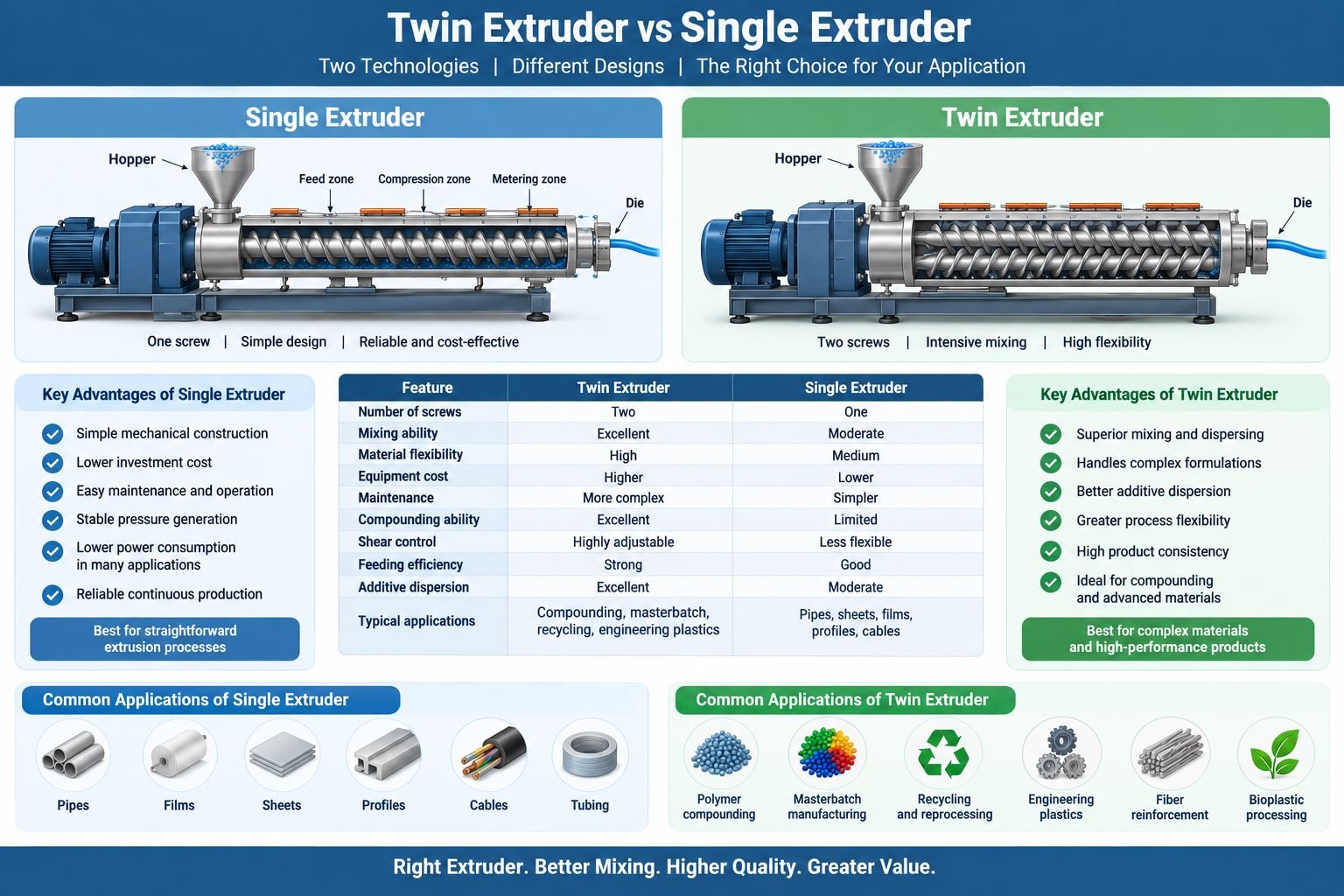
A single extruder contains one rotating screw positioned inside a barrel. The screw transports material forward while heat from the barrel and mechanical energy generated during processing contribute to melting.
Different sections of the screw perform different functions.
The feed section accepts and transports solid material. The compression area increases pressure and supports melting, while the metering section helps stabilize the melt before discharge.
This relatively direct material path makes single-screw extrusion a dependable solution for many standardized manufacturing processes.
Why Manufacturers Choose Single-Screw Technology
Not every polymer application requires aggressive mixing or complex screw configurations.
When a manufacturer receives material that has already been formulated correctly, the production objective may simply be to melt it consistently and form it into the required product.
The single extruder offers important advantages in this situation:
- Straightforward mechanical design
- Stable material throughput
- Reliable pressure generation
- Easier machine operation
- Lower maintenance complexity
- Competitive investment cost
- Efficient continuous processing
Its simplicity can be an advantage rather than a limitation when the application is appropriate.
Major Applications of Single Extrusion
Single-screw technology is widely used in downstream product manufacturing.
Common applications include:
- PE pipes
- PP pipes
- Plastic profiles
- Blown films
- Plastic sheets
- Tubing
- Wire insulation
- Cable sheathing
A single extruder is especially effective when manufacturers need consistent melt delivery over long production runs.
Twin Extruder Adds a Different Level of Processing
A twin extruder uses two screws inside the barrel instead of one.
This changes how material travels through the processing chamber. The screws can create repeated material division, recombination, compression, and redistribution.
As a result, the machine can do considerably more than melt a polymer.
Twin-screw processing can support:
- Polymer blending
- Additive incorporation
- Pigment dispersion
- Filler mixing
- Fiber reinforcement
- Devolatilization
- Reactive processing
- Compound production
This makes the technology particularly useful when the extruder itself plays an active role in creating the material formulation.
Why Mixing Quality Matters in Polymer Production
Consider a compound containing polymer, color pigment, calcium carbonate, and several functional additives.
If these ingredients are not properly mixed, the final material may appear acceptable in one batch but perform differently in another.
Poor mixing can potentially contribute to:
- Uneven coloration
- Inconsistent properties
- Surface defects
- Processing difficulties
- Variable downstream performance
The twin extruder addresses this challenge through controlled distributive and dispersive mixing.
Understanding the Two Types of Mixing
Mixing performance is not defined by one action.
Distributive Mixing
Distributive mixing spreads ingredients across the available polymer volume.
For example, if a formulation contains a small percentage of UV stabilizer, that stabilizer needs to be distributed consistently throughout the material.
The objective is uniformity.
Dispersive Mixing
Dispersive mixing deals with particle clusters.
Pigments, fillers, and certain additives may enter the system as agglomerates. Mechanical forces are required to break these clusters and achieve finer dispersion.
A properly configured twin extruder can generate controlled shear for this purpose.
Twin Extruder and Single Extruder Compared
| Factor | Twin Extruder | Single Extruder |
| Screw count | Two | One |
| Primary strength | Mixing and compounding | Stable extrusion |
| Mixing intensity | High | Moderate |
| Filler incorporation | Excellent | Limited to moderate |
| Process flexibility | High | Moderate |
| Mechanical complexity | Higher | Lower |
| Maintenance | More specialized | Simpler |
| Initial investment | Higher | Lower |
| Pressure stability | Good | Excellent |
| Standard product extrusion | Good | Excellent |
The comparison highlights why selecting equipment purely according to output capacity can be misleading.
Masterbatch Shows the Value of Twin-Screw Mixing
Masterbatch manufacturing is an excellent example of a process where mixing quality is essential.
Color masterbatch contains a concentrated amount of pigment dispersed in a polymer carrier. Additive masterbatch follows a similar principle but incorporates functional ingredients.
The concentration means dispersion must be carefully controlled.
A twin extruder can provide the necessary combination of material distribution and mechanical shear to create more homogeneous masterbatch formulations.
Filled Polymers Require Controlled Processing
Mineral fillers are commonly introduced into polymers to achieve particular performance or economic objectives.
Examples include:
- Calcium carbonate
- Talc
- Silica
- Glass fibers
- Natural fibers
- Other functional minerals
As filler concentration increases, material flow can become more challenging.
Twin-screw systems can use dedicated feeding points and mixing sections, allowing processors to introduce fillers after the base polymer has reached an appropriate condition.
This flexibility is one reason twin extrusion is widely used for filled compounds.
Screw Configuration Can Transform Extrusion Performance
The screw is effectively the working heart of an extrusion machine.
A single extruder typically uses a continuous screw designed around feeding, compression, melting, and metering.
Many twin-screw machines use modular elements.
Engineers can arrange different elements along the shaft according to the material and processing objective.
Possible elements include:
- Forward conveying sections
- Kneading blocks
- Mixing elements
- Reverse elements
- Specialized shear zones
The configuration influences residence time, material temperature, mixing, pressure, and throughput.
Twin Extrusion Supports Flexible Ingredient Feeding
Complex compounds may contain materials with very different physical forms.
Base resin may arrive as pellets, fillers as powder, reinforcement as fibers, and certain additives as liquids.
Introducing everything through one hopper is not always ideal.
A twin extruder can support multiple feeding points. Side feeders can introduce fillers or fibers at selected barrel sections, while liquid dosing systems can add other ingredients separately.
This allows greater control over how long sensitive materials experience heat and shear.
Recycling Makes Extrusion Selection More Important
Recycled plastic processing introduces different challenges because feedstock quality may vary.
Depending on the recycling stream, incoming material can contain moisture, inks, additives, mixed grades, or volatile contaminants.
A single extruder may be sufficient for relatively homogeneous recycled material.
More demanding recycling operations may require advanced blending and devolatilization, areas where twin-screw systems can provide additional processing flexibility.
The correct choice depends on feedstock quality and the specifications required from the recycled output.
Degassing Can Improve Processing Stability
Moisture and volatile materials can create problems when trapped in molten polymer.
Potential consequences include bubbles, odor, poor surface appearance, and unstable processing.
Extruders can include atmospheric vents or vacuum degassing systems to remove these unwanted substances.
The modular processing zones available in a twin extruder can make it possible to melt material, create a suitable pressure profile, release volatiles, and continue processing within one line.
Energy Efficiency Is About More Than Motor Size
Manufacturers naturally want to control electricity costs, but comparing installed motor power alone provides limited information.
A single extruder can deliver excellent energy efficiency in conventional applications.
A twin-screw machine may require greater power when intensive mixing is performed. However, the system may simultaneously replace multiple separate processing steps.
A more useful calculation considers:
Energy consumption ÷ acceptable finished output
This provides a better indication of actual production efficiency.
What Should Manufacturers Check Before Buying?
Machine selection should begin with a detailed processing assessment.
Manufacturers should evaluate:
- Polymer characteristics
- Material bulk density
- Additive concentration
- Filler requirements
- Required mixing quality
- Temperature sensitivity
- Target throughput
- Degassing requirements
- Product specifications
- Future formulation changes
If the application mainly involves melting and shaping a stable polymer, a single extruder can offer an efficient solution.
If the process involves creating or significantly modifying a formulation, a twin extruder may be more suitable.
Frequently Asked Questions
What is the biggest difference between single and twin extruders?
The single extruder has one screw, while twin-screw equipment uses two screws that enable more intensive material mixing.
Which machine is better for standard plastic extrusion?
A single extruder is highly suitable for many conventional pipe, film, sheet, profile, and tubing applications.
Which technology is preferred for compounding?
A twin extruder is commonly preferred because it provides greater mixing and ingredient-distribution flexibility.
Why is twin extrusion suitable for masterbatch?
Masterbatch requires effective dispersion of concentrated pigments or additives, making controlled twin-screw mixing particularly valuable.
Can single extruders process fillers?
Yes, depending on formulation and machine design, although complex or highly filled compounds may require more intensive mixing.
Can both machines process recycled polymers?
Yes. The appropriate system depends on material consistency, contamination, moisture, formulation requirements, and desired output quality.
Which extruder is easier to operate?
A single extruder generally offers simpler operation because its mechanical and processing configuration is less complex.
Why are side feeders used?
Side feeders allow fillers, fibers, or additives to enter at selected stages rather than introducing all ingredients through the main hopper.
Does twin extrusion improve final product quality?
It can improve consistency where the formulation requires strong mixing, homogenization, additive dispersion, or controlled material modification.
Which extruder offers better value?
Value depends on the application. The best machine is the one that achieves required quality and capacity at an economical total production cost.
Read more – https://tandtlawassociates.com/twin-extruder-vs-single-extruder-deep-guide-to-extrusion-technology/