
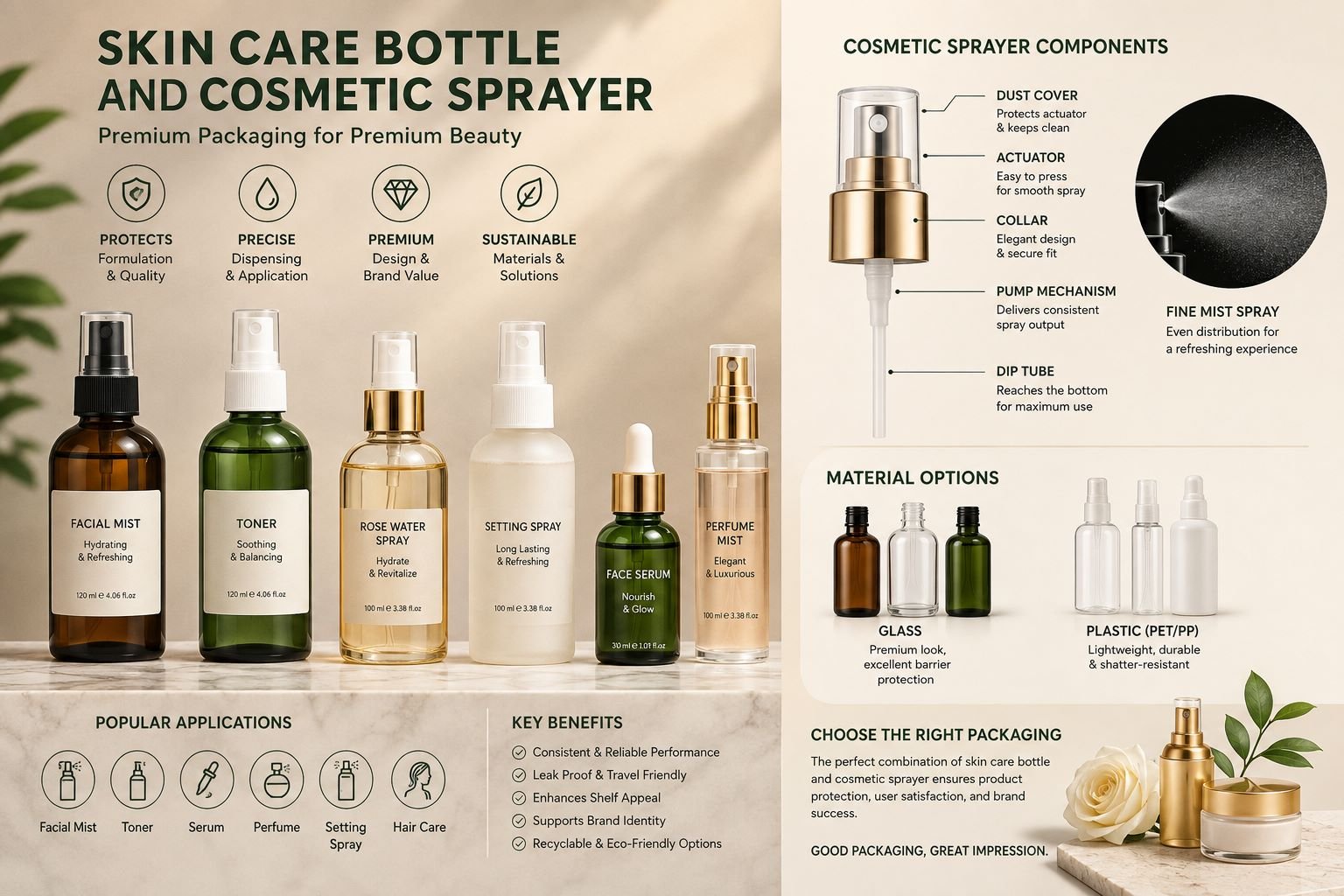
Think about the last skincare product that impressed you. The formula probably mattered, but chances are the packaging contributed to the experience too. A bottle that feels comfortable in your hand, a mist that spreads evenly, or a closure that never leaks can make daily skincare feel effortless.
That is exactly why the skin care bottle and cosmetic sprayer have become more than ordinary packaging components. They influence product stability, application, brand identity, portability, sustainability, and customer satisfaction.
For beauty businesses developing new products, understanding what happens between filling the bottle and the customer’s final application can lead to smarter packaging decisions.
Your Formula and Packaging Need to Work Together
Packaging development should ideally begin with one question: what does the formula need?
Different cosmetic formulations behave differently inside containers. A watery facial toner does not have the same packaging requirements as an oil-based treatment, alcohol-containing mist, or active serum.
Before choosing a skin care bottle, brands should understand:
- Product viscosity
- Chemical composition
- Sensitivity to light
- Sensitivity to oxygen
- Storage temperature
- Application requirements
- Intended shelf life
- Distribution conditions
This information helps narrow down suitable materials and dispensing systems.
Glass or Plastic: Which One Should You Choose?
There is no simple answer because both materials offer advantages.
When Glass Makes Sense
Glass is often chosen for high-end serums, facial oils, concentrates, and treatment products.
Its weight can create a premium feeling, while amber or colored varieties may offer additional light protection.
However, glass increases shipping weight and requires careful handling because it can break.
When Plastic Makes Sense
Plastic provides greater flexibility for many everyday cosmetic applications.
PET, PETG, PE, PP, and HDPE are among the commonly considered materials.
A plastic skin care bottle can offer lightweight construction, durability, various shapes, and convenient portability.
Don’t Judge Material by Appearance Alone
Two bottles that look almost identical can behave very differently when filled with the same formulation.
Chemical compatibility, barrier properties, wall thickness, and closure design all matter.
Testing should therefore be part of material selection.
Why the Sprayer Deserves Equal Attention
Consumers might never think about the engineering inside a cosmetic sprayer, but they immediately notice when it performs poorly.
A typical sprayer contains several working parts, including an actuator, nozzle, pump, gasket, closure, and dip tube.
Pressing the actuator creates the mechanical action needed to move liquid upward and through the nozzle.
The result may be a fine mist, conventional spray, or larger droplets depending on the system and formulation.
The Perfect Mist Is Not Accidental
Consider a facial mist designed to refresh the skin throughout the day.
If one press covers only a tiny area with large droplets, users may need several applications. If the sprayer releases excessive product, the face can become unnecessarily wet.
A properly matched cosmetic sprayer aims to provide a balanced application.
Important performance characteristics include:
- Appropriate output per actuation
- Consistent droplet distribution
- Comfortable pressing force
- Fast initial priming
- Minimal residual dripping
- Reliable spray pattern
- Secure closure
The formula’s viscosity also affects how effectively the sprayer operates.
One Small Neck Dimension Can Cause a Big Problem
Bottle and closure compatibility is easy to underestimate.
The neck of a skin care bottle must correspond correctly with the dimensions and closure system of the selected sprayer.
Even small inconsistencies can affect sealing.
| Packaging Detail | Why It Matters | Possible Issue |
| Neck finish | Connects bottle and closure | Leakage |
| Gasket | Supports sealing | Formula escape |
| Dip tube | Reaches the product | Incomplete dispensing |
| Pump | Moves formulation | Irregular output |
| Nozzle | Controls spray | Large droplets |
| Cap | Protects actuator | Accidental activation |
Brands should therefore evaluate packaging as one complete system.
Your Packaging Must Survive More Than a Bathroom Shelf
A cosmetic package may look perfect when standing upright in a showroom.
The real challenge begins during distribution.
Products can be exposed to vibration, temperature changes, horizontal storage, impact, pressure, and repeated handling.
Tests Worth Considering Before Launch
Depending on the product, packaging evaluations may include:
- Leakage testing
- Drop testing
- Temperature cycling
- Pump endurance
- Closure torque testing
- Spray-pattern assessment
- Formula compatibility
- Transportation simulation
- Decoration adhesion testing
Testing a skin care bottle with the actual formulation provides more meaningful information than evaluating an empty sample.
Packaging Can Protect Sensitive Formulas
Modern skincare frequently contains ingredients that require careful handling.
Depending on formulation stability, exposure to light, air, heat, or moisture may affect product quality.
Packaging strategies may include tinted bottles, opaque containers, UV-protective finishes, specialized barrier materials, or airless dispensing.
The correct approach depends on formulation testing rather than assumptions.
The Closure Is Part of Product Protection
Protection does not stop at the bottle wall.
A reliable cosmetic sprayer and gasket system also contribute to sealing. If the closure performs poorly, even an excellent bottle material may not provide the intended protection.
Good Packaging Makes Branding Easier
A consumer browsing dozens of cosmetic products may have only seconds to notice a brand.
Packaging helps create that recognition.
A skin care bottle with minimalist typography and frosted glass may communicate premium simplicity. A brightly colored lightweight container can create a completely different personality.
Popular customization techniques include:
- Custom color matching
- Silk-screen printing
- Hot stamping
- Frosting
- Matte coating
- Metallic decoration
- Label application
- Embossing and debossing
Coordinating the bottle with the cosmetic sprayer, collar, and cap creates a stronger overall identity.
You Don’t Always Need a Custom Mold
New beauty businesses sometimes assume that distinctive packaging requires an expensive proprietary bottle.
That is not always necessary.
Stock packaging can be customized through color, printing, labels, coating, caps, and dispensing components.
This approach can allow growing brands to create attractive packaging while avoiding large initial tooling investments.
A custom mold can be considered later when higher production volumes justify greater design exclusivity.
Sustainability Is About More Than Recyclable Materials
Sustainable packaging is becoming a major discussion across the beauty industry, but simply labeling a package recyclable does not answer every environmental question.
Brands need to consider material quantity, durability, transportation weight, recycled content, refillability, reuse, and end-of-life options.
Potential strategies include:
- PCR plastics
- Refillable packaging
- Lightweight bottles
- Reusable containers
- Reduced secondary packaging
- Simplified material combinations
A sustainable skin care bottle still needs to protect the formula effectively.
If weaker packaging causes products to leak or break, additional waste can be created.
Online Shopping Changes Packaging Priorities
E-commerce has introduced a new test for cosmetic packaging: individual parcel delivery.
A bottle purchased in a physical store may arrive on a shelf inside carefully packed cartons. An online order can travel through multiple fulfillment and courier stages.
The package may be tilted, shaken, stacked, or dropped.
For spray products, locking mechanisms or protective caps may help reduce accidental activation.
This makes leak resistance and closure security increasingly important for digital-first beauty brands.
Frequently Asked Questions
What is a skin care bottle?
A skin care bottle is packaging designed for storing and protecting skincare formulations while supporting convenient application and presentation.
What products can go inside skincare bottles?
Toners, facial oils, liquid serums, cleansers, essences, lotions, mists, and hair treatments are common examples.
What does a cosmetic sprayer do?
A cosmetic sprayer uses a pump and nozzle to distribute suitable liquid formulations as controlled droplets or mist.
How do I choose a bottle material?
Consider formulation chemistry, viscosity, light sensitivity, barrier requirements, transportation, durability, appearance, and sustainability goals.
Why does my cosmetic sprayer release large droplets?
Formula viscosity, nozzle design, pump specifications, blockage, or an unsuitable dispensing system may affect droplet formation.
Can facial oils use a sprayer?
Some formulations may be sprayable, but compatibility and dispensing tests should be completed before production.
Why are skincare bottles sometimes tinted?
Tinted packaging can provide additional protection from light for certain light-sensitive formulations.
What causes packaging leakage?
Incorrect neck dimensions, poor sealing, gasket problems, closure damage, temperature changes, or manufacturing inconsistencies can contribute to leaks.
Can small cosmetic brands customize bottles?
Yes. Stock bottles can often be customized through printing, coating, labeling, colors, closures, and decorative finishes.
What is PCR plastic?
PCR stands for post-consumer recycled plastic, which uses recovered material from previously consumed products.
Should cosmetic packaging undergo testing?
Yes. Compatibility, leakage, dispensing, durability, temperature, transportation, and decoration testing can help identify problems before launch.
https://newsgrow.blogspot.com/2026/08/cream-jar-and-cosmetic-jar.html
https://gosarkarijobs.com/disc-cap-and-cosmetic-pump-a-deep-guide-to-modern-cosmetic-packaging/
https://newsgrow.blogspot.com/2026/08/disc-cap-and-cosmetic-pump-essential.html
https://tandtlawassociates.com/past-and-future-of-disc-cap-and-body-lotion-bottle-packaging/
https://newsgrow.blogspot.com/2026/08/disc-cap-and-body-lotion-bottle-designs.html
https://shopnets.com/why-flip-top-cap-and-cosmetic-sprayer-packaging-matters-more-than-ever/
https://newsgrow.blogspot.com/2026/08/the-packaging-detail-customers-notice.html