
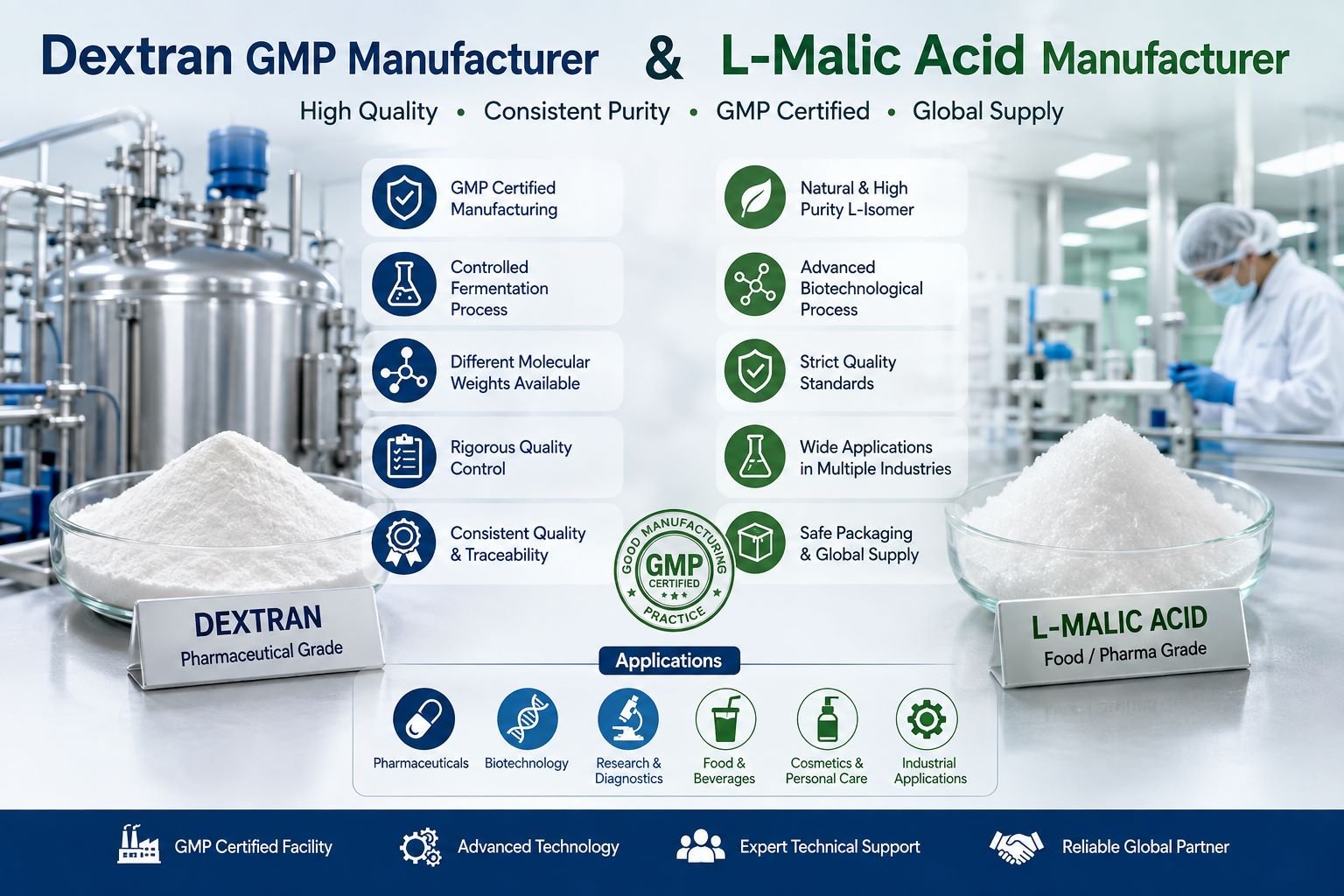
The performance of pharmaceutical, biotechnology, food, and nutraceutical products often depends on something consumers never see: the quality of the raw ingredients used during production. For manufacturers, sourcing these materials is therefore a technical responsibility rather than a simple purchasing exercise.
Dextran and L-malic acid are good examples. Although their chemistry and applications are very different, both require carefully managed production processes. A qualified dextran GMP manufacturer must focus on fermentation control, molecular consistency, purification, and Good Manufacturing Practice. An experienced L-malic acid manufacturer must address purity, stereochemical identity, crystallization, and dependable batch quality.
Understanding these manufacturing requirements can help businesses reduce sourcing risks and establish stronger supplier relationships.
Why Raw Material Consistency Has Become a Business Priority
Industrial formulations are developed around specific ingredient characteristics. When those characteristics change unexpectedly, manufacturing performance can change as well.
An inconsistent specialty ingredient may contribute to processing difficulties, additional laboratory testing, production delays, or formulation adjustments.
For this reason, manufacturers increasingly assess:
- Raw-material traceability
- Production controls
- Process reproducibility
- Analytical capabilities
- Impurity management
- Documentation
- Packaging conditions
- Storage requirements
- Manufacturing capacity
- Supply continuity
A good supplier relationship begins with understanding how consistently the material can be reproduced.
Dextran Manufacturing Combines Biology With Process Engineering
Dextran is a polysaccharide primarily consisting of glucose units. Commercial production commonly uses microbial fermentation, making process control particularly important.
Unlike a simple blending operation, fermentation involves living microorganisms whose activity can be influenced by environmental conditions.
A professional dextran GMP manufacturer therefore needs expertise in microbiology, process engineering, purification, and analytical chemistry.
How Controlled Fermentation Shapes Dextran Quality
Dextran production generally begins by preparing a suitable fermentation medium and introducing selected microorganisms.
The manufacturing environment must then be maintained within defined operating parameters.
Factors That May Influence Fermentation
Important variables can include:
- Temperature
- pH
- Substrate concentration
- Nutrient availability
- Fermentation duration
- Microbial activity
- Process hygiene
Controlling these parameters helps manufacturers achieve predictable production conditions.
However, fermentation produces a complex mixture. The desired dextran must still be separated and purified.
What Happens to Dextran After Fermentation?
Downstream processing is one of the most important parts of dextran production.
Raw fermentation material may contain microorganisms, residual substrates, proteins, salts, and other process-related components.
A Typical Processing Route May Include
- Fermentation broth preparation
- Controlled dextran formation
- Biomass separation
- Product recovery
- Purification
- Fractionation
- Filtration
- Concentration
- Drying
- Final testing and packaging
A capable dextran GMP manufacturer should establish appropriate controls at critical stages instead of relying exclusively on finished-product testing.
Molecular Weight Makes Dextran Application-Specific
One of the most important points for buyers to understand is that dextran is not a single uniform product.
Different molecular-weight grades can demonstrate different properties.
Molecular characteristics can influence viscosity, solubility, diffusion, solution behavior, and processing performance. Consequently, a dextran suitable for one application may not necessarily be suitable for another.
| Quality Characteristic | Practical Relevance |
| Molecular weight | Influences functional behavior |
| Molecular distribution | Indicates consistency |
| Purity | Reflects purification performance |
| Moisture | Affects handling and stability |
| Solubility | Important during formulation |
| Microbial quality | Relevant for sensitive uses |
Clear communication between customer and manufacturer is therefore essential when defining specifications.
Why GMP Adds Value to Dextran Production
Good Manufacturing Practice establishes a systematic approach to production quality.
For a dextran GMP manufacturer, this means manufacturing should operate according to documented procedures and defined responsibilities.
GMP Controls Can Cover
- Employee training
- Raw-material approval
- Equipment qualification
- Cleaning procedures
- Production records
- Laboratory testing
- Deviation handling
- Change control
- Batch traceability
- Product release
The purpose is to reduce uncontrolled variation and create documented evidence that manufacturing procedures have been followed.
This becomes particularly important for customers operating within regulated environments.
L-Malic Acid Requires a Different Manufacturing Strategy
L-malic acid is an organic acid with applications across food, beverages, pharmaceuticals, nutraceuticals, confectionery, cosmetics, and specialty formulations.
Its acidity profile makes it useful for multiple formulation purposes.
A dependable L-malic acid manufacturer must deliver more than acidity. Customers may require defined identity, assay, stereochemical characteristics, impurity limits, moisture levels, and physical properties.
The Science Behind the L-Form
The term L-malic acid refers to a specific stereochemical form of malic acid.
This distinction is important because commercial products can differ in stereochemical composition.
An L-malic acid manufacturer serving customers with defined technical requirements should therefore maintain appropriate controls for product identity and relevant optical characteristics.
Why Purification Is Essential
Producing the target compound does not automatically create a commercial-grade ingredient.
Process-related substances need to be controlled through effective downstream operations.
Manufacturing may involve:
- Primary production
- Separation
- Purification
- Filtration
- Concentration
- Crystallization
- Drying
- Particle preparation
- Quality testing
- Packaging
These steps help transform the initially produced material into a consistent commercial ingredient.
Crystallization Can Determine Processing Performance
Crystallization deserves particular attention in L-malic acid manufacturing because it can influence physical properties.
Chemical purity may meet specifications while inconsistent particle characteristics still create processing challenges.
Physical Properties That Matter
Customers may evaluate:
- Crystal characteristics
- Particle distribution
- Powder flow
- Dissolution behavior
- Moisture characteristics
- Storage stability
For large-scale food or pharmaceutical manufacturers, reliable powder handling can improve production efficiency and reduce operational variability.
A technically capable L-malic acid manufacturer therefore considers physical performance alongside chemical analysis.
How Quality Testing Differs Between the Two Ingredients
Dextran and L-malic acid require different analytical approaches because their critical quality characteristics are different.
| Area | Dextran | L-Malic Acid |
| Chemical family | Polysaccharide | Organic acid |
| Main production approach | Fermentation | Controlled production |
| Key quality attribute | Molecular properties | Purity/stereochemistry |
| Major downstream process | Fractionation | Crystallization |
| Physical concern | Solution behavior | Powder behavior |
| Typical markets | Pharma/biotech | Food/pharma/nutraceutical |
For dextran, testing may emphasize molecular-weight distribution, identity, purity, moisture, solubility, and microbiological parameters.
For L-malic acid, analytical testing may focus on identity, assay, optical characteristics, moisture, related substances, residue, and applicable impurity parameters.
Why a Certificate of Analysis Is Only the Starting Point
A Certificate of Analysis provides valuable information about a particular batch, but professional supplier qualification should go further.
Buyers should understand the systems behind those analytical numbers.
A dextran GMP manufacturer should be able to provide appropriate information concerning product specifications, manufacturing controls, traceability, testing, and quality management.
Likewise, an L-malic acid manufacturer should provide transparent technical specifications and relevant supporting documentation.
Documentation may include:
- Product specifications
- Certificates of Analysis
- Safety information
- Storage guidance
- Quality certifications
- Manufacturing statements
- Packaging information
- Relevant regulatory support
Documentation requirements should be determined by the intended application.
Choosing a Manufacturer Instead of Simply Finding a Supplier
There can be an important difference between purchasing from a manufacturer and purchasing through a trading organization.
Distributors can provide useful commercial and logistical services, but companies with demanding technical requirements may need greater visibility into the actual manufacturing facility.
Before approving a manufacturer, consider these questions:
- Where is the product manufactured?
- What quality system is implemented?
- Which specifications are available?
- How are raw materials controlled?
- What analytical equipment is available?
- How are deviations investigated?
- How is traceability maintained?
- What is the production capacity?
- How are changes communicated?
- What technical support is provided?
Transparent answers can help customers identify stronger long-term partners.
Why Supply Reliability Should Be Evaluated Early
Product quality receives considerable attention during qualification, but supply reliability should not be overlooked.
A perfectly manufactured ingredient cannot support production if it repeatedly arrives late or becomes unavailable.
When evaluating a dextran GMP manufacturer or L-malic acid manufacturer, customers should therefore consider manufacturing capacity, lead times, raw-material sourcing, packaging availability, scalability, inventory planning, and export capabilities.
A reliable supplier should be capable of supporting both present requirements and reasonable future growth.
FAQ
What does a dextran GMP manufacturer specialize in?
A dextran GMP manufacturer specializes in controlled dextran production supported by appropriate GMP, quality, testing, documentation, and traceability systems.
Why is fermentation used for dextran production?
Suitable microorganisms can produce dextran from carbohydrate substrates under carefully controlled fermentation conditions.
Are all dextran grades interchangeable?
No. Molecular weight, distribution, purity, and other characteristics can differ, affecting suitability for particular applications.
Why is dextran purification important?
Purification helps remove unwanted biological and process-related substances generated or introduced during production.
What is an L-malic acid manufacturer?
An L-malic acid manufacturer produces and processes L-malic acid while controlling identity, purity, physical properties, and applicable specifications.
Where is L-malic acid commonly used?
It is commonly used across food, beverages, confectionery, pharmaceutical, nutraceutical, cosmetic, and specialty formulation industries.
Why is the L-form important?
The L designation identifies a specific stereochemical form, making appropriate identity and stereochemical control important.
Why should buyers consider crystallization?
Crystallization can influence particle properties, flow, dissolution, handling, moisture behavior, and industrial processing.
What documentation should a manufacturer provide?
Depending on requirements, documents can include specifications, Certificates of Analysis, safety information, certifications, and storage guidance.
What is the best way to qualify a manufacturer?
Evaluate quality systems, technical expertise, production capability, analytical testing, documentation, traceability, consistency, capacity, and supply reliability.