
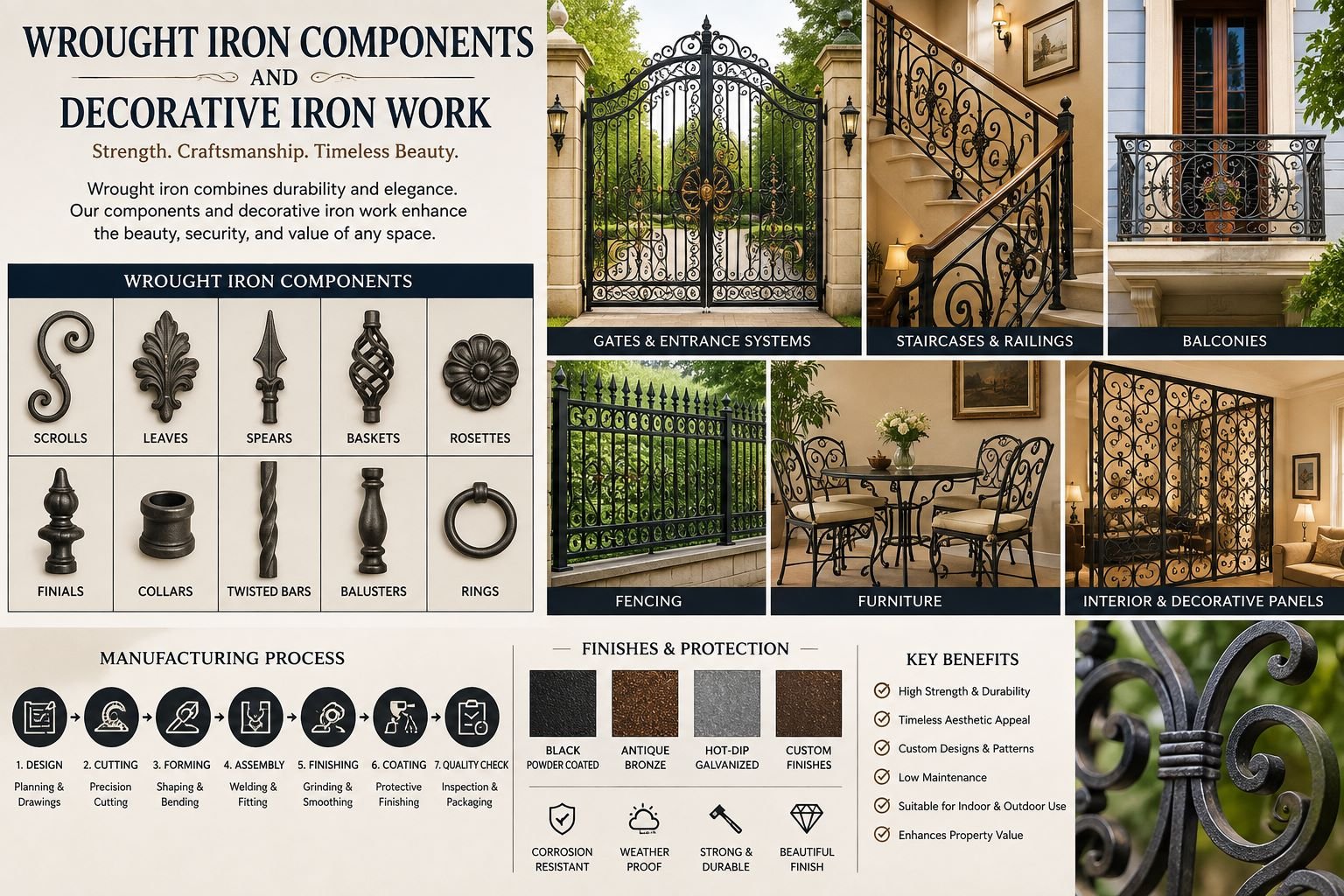
The architectural metalwork industry is entering a new phase as demand grows for distinctive, durable, and customisable design elements. Wrought Iron Components are increasingly being used to create gates, railings, balconies, fencing, staircases, furniture, and interior features that bring together practical functionality and architectural expression.
At the same time, Decorative Iron Work is moving beyond its traditional image. While ornate scrolls, floral motifs, and classical balusters remain popular, architects and fabricators are also embracing geometric patterns, cleaner lines, mixed materials, and contemporary finishes.
This evolution is helping ornamental iron remain relevant across residential, commercial, hospitality, landscape, and luxury development projects.
Architectural Metalwork Enters a More Design-Focused Era
For many years, iron structures were primarily associated with security and structural functionality. Gates controlled entrances, fences protected boundaries, and railings provided safety.
These functions remain important, but expectations have changed.
Modern customers increasingly want functional metal structures to complement the overall architectural identity of a property.
This is creating opportunities for Decorative Iron Work that balances strength, proportion, craftsmanship, and visual detail.
The shift can be seen across everything from large entrance gates to subtle interior partitions.
Small Components Are Creating Major Design Possibilities
At the centre of this transformation are Wrought Iron Components.
These individual elements allow fabricators to build complex patterns from carefully manufactured decorative pieces.
Popular options include:
- C-scrolls and S-scrolls
- Balusters
- Twisted bars
- Rosettes
- Decorative collars
- Rings
- Baskets
- Finials
- Spearheads
- Leaves and flowers
- Medallions
- Decorative panels
Instead of treating each component as an isolated ornament, contemporary designers are considering how multiple elements interact within a complete composition.
From Classical Ornamentation to Contemporary Geometry
One of the strongest developments within Decorative Iron Work is the increasing diversity of design styles.
Traditional ironwork typically features flowing lines, symmetry, floral patterns, and elaborate detailing.
Contemporary metalwork often takes a different direction.
Straight profiles, circles, rectangles, asymmetrical patterns, negative space, and custom-cut panels are increasingly appearing in architectural projects.
| Design Direction | Typical Features | Common Applications |
| Classical | Scrolls, flowers, rosettes | Villas and heritage properties |
| Contemporary | Geometric patterns | Modern residences |
| Minimalist | Straight profiles | Commercial and residential |
| Luxury | Bespoke ornaments | Premium developments |
| Transitional | Mixed traditional-modern details | Renovations and new builds |
This flexibility means Wrought Iron Components can support very different architectural identities.
Entrance Gates Become Architectural Statements
The entrance gate remains one of the most important applications for ornamental metalwork.
A gate occupies a prominent position and often creates the visitor’s first impression of a property.
As a result, designers are paying greater attention to component proportions, pattern density, symmetry, finishes, and integration with surrounding fencing.
Traditional Decorative Iron Work can create elaborate entrances using scrolls, leaves, spearheads, and medallions.
Modern gate designs may instead use a limited number of decorative elements combined with bold geometric forms.
Automated opening systems can also be considered during the design and fabrication process.
Staircase Design Creates New Demand for Decorative Components
Interior staircases are becoming another significant area for architectural ironwork.
Rather than relying entirely on plain balusters, designers can combine different Wrought Iron Components to establish distinctive railing patterns.
Traditional Interiors
Curved balusters, scrolls, collars, and decorative elements can complement carved timber handrails, marble stairs, and classical interiors.
Modern Interiors
Simplified metal profiles and geometric arrangements can create cleaner visual lines.
Mixed-Material Designs
Iron can be paired with timber, stone, marble, or glass to create contrast and architectural depth.
This flexibility makes decorative metal suitable for both new construction and renovation projects.
Balconies Create Visual Rhythm Across Building Façades
Balcony railings can influence an entire elevation because their patterns are often repeated across multiple floors.
Carefully selected Decorative Iron Work can help establish consistency while preventing the façade from appearing flat or repetitive.
For traditional architecture, flowing ornamental patterns may be appropriate.
Contemporary buildings may favour restrained vertical bars or geometric designs.
In every case, structural integrity, railing height, spacing, installation quality, and applicable safety requirements remain fundamental considerations.
Fencing Is Moving Beyond Basic Boundary Protection
Property owners and developers are increasingly viewing fencing as part of the overall exterior design rather than simply a security feature.
Wrought Iron Components allow boundary fencing to coordinate with gates, balconies, and other architectural details.
Finials can complete vertical pickets, while rings, scrolls, or geometric elements can break up large repetitive sections.
This approach can help create a unified visual identity across the property.
Interior Decorative Iron Work Expands into New Areas
Another notable development is the growing presence of metalwork inside buildings.
Designers are incorporating Decorative Iron Work into:
- Room dividers
- Decorative screens
- Wine displays
- Shelving
- Console tables
- Bed frames
- Lighting structures
- Mirror frames
- Fireplace screens
- Feature walls
Metal can provide contrast against softer materials and natural finishes, making it useful for industrial, contemporary, transitional, and luxury interiors.
Manufacturing Technology Changes the Production Landscape
While traditional forging remains an important craft, modern equipment is improving the efficiency and consistency of component manufacturing.
Production technologies can include:
- CNC cutting
- Laser cutting
- Hydraulic bending
- Mechanical twisting
- Press forming
- Precision welding
- Computer-aided design
These processes are particularly useful when manufacturers need to produce large quantities of consistent Wrought Iron Components.
Handcrafted techniques, meanwhile, continue to provide value for specialised designs and bespoke architectural features.
Customisation Becomes a Competitive Advantage
Architecture is becoming increasingly personalised.
Developers and property owners want designs that differentiate their projects rather than relying entirely on standard patterns.
Custom Decorative Iron Work can respond to this requirement through unique dimensions, motifs, patterns, proportions, and finishes.
Standard components still offer considerable advantages.
They can reduce production complexity and make repeated patterns easier to fabricate. Combining standard components with a smaller number of custom pieces can therefore provide an effective balance.
Finishing Technology Supports Long-Term Performance
A decorative structure can only maintain its appearance if the metal surface receives appropriate protection.
Outdoor ironwork may encounter moisture, pollution, temperature changes, and other environmental factors.
Galvanising
Galvanising applies a protective zinc layer and can improve corrosion resistance for suitable applications.
Powder Coating
Powder coating provides a durable decorative surface available in numerous textures and appearances.
Protective Paint Systems
Appropriate primers and compatible finishing coats can also protect metal surfaces while providing aesthetic flexibility.
Maintenance Remains Important
Periodic inspection of Decorative Iron Work can identify coating damage, exposed metal, loose connections, or early corrosion before larger repairs become necessary.
Quality Is Becoming More Important Than Ornamentation
The appearance of an iron component is only one aspect of quality.
Professional buyers increasingly evaluate:
- Material thickness
- Dimensional accuracy
- Shape consistency
- Surface condition
- Welding compatibility
- Pattern repeatability
- Protective treatment
- Installation requirements
- Manufacturing capabilities
- Quality control procedures
For structural or safety-related applications, appropriate engineering specifications and applicable regulations must also be addressed.
Standard and Custom Components Serve Different Needs
| Consideration | Standard Components | Custom Components |
| Lead time | Generally shorter | Usually longer |
| Repeatability | High | Project dependent |
| Design flexibility | Good | Very high |
| Unique identity | Moderate | Excellent |
| Large-volume use | Highly suitable | Depends on complexity |
For many projects, combining both categories can deliver the strongest balance between efficiency and individuality.
FAQ About Wrought Iron Components and Decorative Iron Work
What are wrought iron components?
They are individual ornamental or functional metal elements used to fabricate gates, railings, fences, balconies, staircases, furniture, and architectural structures.
Why is decorative iron work becoming popular again?
Modern fabrication allows ironwork to combine traditional craftsmanship with contemporary patterns, customised designs, and advanced finishes.
What are common wrought iron components?
Scrolls, balusters, finials, spearheads, rings, collars, rosettes, baskets, twisted bars, and floral ornaments are common examples.
Can decorative iron work look contemporary?
Yes. Geometric patterns, clean profiles, open spaces, and restrained detailing are well suited to contemporary architecture.
Can iron components be customised?
Yes. Dimensions, shapes, patterns, motifs, and decorative details can be developed according to specific project requirements.
Where can decorative iron be used?
Applications include gates, railings, balconies, fences, staircases, furniture, screens, partitions, and landscape features.
Is decorative iron suitable for exterior installations?
Yes, when appropriate materials, fabrication, corrosion protection, installation, and maintenance are considered.
How is exterior ironwork protected?
Galvanising, powder coating, protective primers, paint systems, and routine maintenance can help protect exposed metal.
Can decorative iron be used inside buildings?
Yes. Interior applications include furniture, staircases, shelving, partitions, screens, lighting, and feature walls.
Can ironwork be combined with other materials?
Yes. Iron can complement timber, glass, stone, marble, concrete, and other architectural materials.
Are ready-made components useful for fabricators?
Yes. Ready-made components can improve production efficiency and consistency while still supporting customised layouts.
What defines high-quality decorative iron work?
Accurate fabrication, suitable materials, clean connections, balanced design, professional finishing, and secure installation are key indicators.
A New Direction for Decorative Metalwork
The future of Wrought Iron Components is increasingly connected to flexibility. Manufacturers are combining traditional metalworking knowledge with digital design and precision production to support both classical and contemporary requirements.
Meanwhile, Decorative Iron Work is becoming less about adding excessive ornamentation and more about creating purposeful architectural detail.
The result is a broader market where ornamental metalwork can serve heritage restoration, luxury construction, modern residential projects, commercial interiors, hospitality developments, and landscape architecture.
https://gosarkarijobs.com/why-wrought-iron-components-are-redefining-modern-decorative-iron-work/
https://shopnets.com/a-complete-guide-to-wrought-iron-components-for-beautiful-decorative-iron-work/