
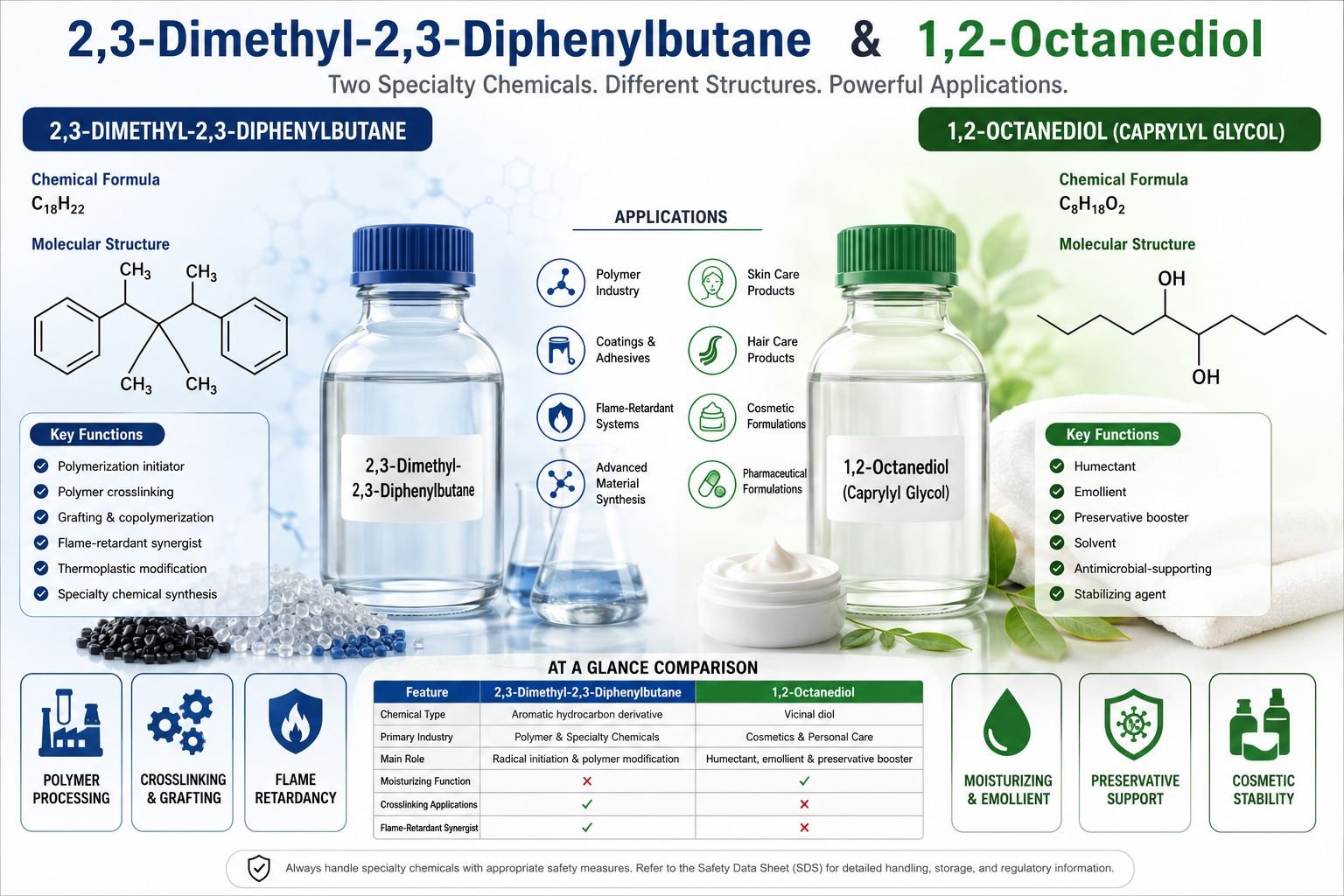
Chemical innovation is often associated with discovering entirely new molecules. In reality, some of the most valuable progress comes from understanding how specialized chemicals can improve existing manufacturing processes and formulations. 2,3-dimethyl-2,3-diphenylbutane and 1,2-octanediol are two good examples.
These compounds have very different chemical structures and serve different markets. 2,3-dimethyl-2,3-diphenylbutane is associated primarily with radical generation and polymer technology. 1,2-octanediol, commonly called caprylyl glycol in personal-care applications, is valued for its moisturizing, emollient, and formulation-supporting properties.
For manufacturers, formulators, procurement professionals, and researchers, understanding these differences is essential when selecting specialty chemicals for specific applications.
A Closer Look at Performance-Driven Chemical Selection
Specialty chemicals are generally selected because they deliver a particular function rather than simply providing bulk material.
For example, polymer engineers may need an additive capable of initiating a reaction at suitable processing temperatures. Cosmetic formulators, meanwhile, may prefer an ingredient capable of supporting moisture retention while contributing to microbial-control strategies.
Chemical selection therefore involves evaluating:
- Molecular structure
- Chemical reactivity
- Processing temperature
- Compatibility
- Required concentration
- Purity
- Storage stability
- Final application
These factors help explain why seemingly small molecular differences can lead to dramatically different industrial uses.
What Is 2,3-Dimethyl-2,3-Diphenylbutane?
2,3-dimethyl-2,3-diphenylbutane is a specialized organic molecule containing two phenyl groups and a highly substituted central carbon framework.
One of its defining technical characteristics is the ability of its central carbon-carbon bond to undergo cleavage under suitable thermal conditions.
This can produce radical species.
Radicals are highly reactive intermediates that can participate in polymerization and polymer-modification reactions. Controlled radical generation is therefore useful in applications where manufacturers want to change polymer structure during processing.
Why Radical Chemistry Matters to Polymer Manufacturers
A finished polymer’s properties depend on the organization of its molecular chains.
Even when two products begin with similar base polymers, differences in molecular weight, branching, grafting, and crosslinking can produce materials with noticeably different characteristics.
This creates several potential roles for 2,3-dimethyl-2,3-diphenylbutane, including:
- Radical generation
- Polymerization initiation
- Crosslinking
- Grafting
- Copolymer modification
- Specialty polymer processing
Its practical effectiveness depends on the chemistry of the polymer and the conditions under which processing occurs.
Understanding the Crosslinking Connection
Crosslinking occurs when connections develop between different polymer chains.
Think of individual polymer molecules as long threads. Connecting these threads at multiple points creates a network rather than leaving them as independent chains.
This structural transformation can affect characteristics such as:
- Heat resistance
- Mechanical performance
- Dimensional stability
- Deformation behavior
- Material durability
Why Controlled Crosslinking Is Essential
Crosslinking must be optimized according to the desired product.
A formulation with insufficient crosslinking may not achieve the targeted properties. Excessive crosslinking, on the other hand, may reduce flexibility or create processing difficulties.
Pilot testing is therefore important before commercial-scale manufacturing.
Where Flame-Retardant Synergy Fits In
Another specialized area involving 2,3-dimethyl-2,3-diphenylbutane is flame-retardant polymer technology.
Certain formulations may use the compound as a synergistic additive.
A synergist is not necessarily responsible for providing the entire flame-retardant effect. Instead, it interacts with the overall additive system to help improve performance.
Manufacturers may explore synergistic formulations to achieve:
- Efficient additive combinations
- Improved flame-retardant performance
- Optimized additive loading
- Better balance of physical properties
- Greater formulation flexibility
Performance should always be confirmed using testing relevant to the final polymer application.
Understanding 1,2-Octanediol from a Formulator’s Perspective
1,2-octanediol belongs to an entirely different chemical category.
It contains an eight-carbon chain with hydroxyl groups attached to the first and second carbon positions. The compound is therefore classified as a vicinal diol.
Within cosmetics and personal care, 1,2-octanediol is commonly known as caprylyl glycol.
Its molecular structure combines a relatively hydrophobic hydrocarbon chain with hydrophilic hydroxyl functionality. This dual character contributes to its usefulness in complex formulations.
Why Multifunctionality Matters in Personal Care
Cosmetic formulations can contain many ingredients, each introduced to perform one or more functions.
Formulators increasingly seek multifunctional ingredients because they can help create efficient formulations without unnecessarily expanding ingredient lists.
1,2-octanediol can potentially contribute to:
- Skin conditioning
- Moisture management
- Emolliency
- Sensory characteristics
- Formulation stability
- Preservation support
It can therefore be found in various skin-care, hair-care, and personal-care formulations.
Where 1,2-Octanediol May Be Used
Potential product categories include:
- Facial moisturizers
- Skin creams
- Body lotions
- Cosmetic serums
- Cleansing products
- Hair-care formulations
- Emulsions
- Specialty personal-care products
The concentration required depends on formulation design, desired functionality, ingredient interactions, and applicable regulations.
The Connection Between Moisturization and Skin Feel
Moisturization is more complex than simply introducing water into a cosmetic formulation.
Formulators often combine ingredients that attract or retain moisture with components that improve softness and surface feel.
1,2-octanediol can contribute humectant and emollient characteristics, making it useful where both moisture management and sensory quality are important.
Consumer Experience Influences Formulation Decisions
A technically stable product can still perform poorly commercially if consumers dislike how it feels.
Important sensory characteristics include:
- Smoothness
- Spreadability
- Absorption
- Softness
- Hydrated feel
- After-application texture
This explains why multifunctional formulation ingredients remain attractive to personal-care developers.
Why Preservation Support Deserves Attention
Cosmetic products containing water can become susceptible to microbial contamination when preservation is inadequate.
Preservation strategies are therefore developed to control microorganisms and maintain product quality throughout the intended period of use.
1,2-octanediol can provide antimicrobial-supporting properties and may enhance a broader preservation system.
Its effectiveness can vary according to:
- Concentration
- Product pH
- Water activity
- Other antimicrobial ingredients
- Packaging
- Production hygiene
- Storage conditions
Preservation Requires Complete Formulation Testing
A common mistake is assuming that the presence of a preservative-supporting ingredient automatically makes a formulation microbiologically secure.
Commercial products should undergo appropriate challenge testing and stability evaluation to verify the effectiveness of the complete system.
Comparing 2,3-Dimethyl-2,3-Diphenylbutane and 1,2-Octanediol
| Consideration | 2,3-Dimethyl-2,3-Diphenylbutane | 1,2-Octanediol |
| Main application | Polymer processing | Personal care |
| Chemical category | Substituted hydrocarbon | Vicinal diol |
| Radical generation | Major relevance | Not typical |
| Crosslinking | Important application | Not primary |
| Polymer grafting | Potential use | Not typical |
| Flame-retardant synergy | Relevant in selected systems | Limited |
| Moisturizing function | Not typical | Relevant |
| Emollient characteristics | Not typical | Relevant |
| Preservation support | Not typical | Relevant |
| Cosmetic use | Limited | Significant |
The table highlights why the chemicals should not be considered substitutes. Each solves a different technical problem.
Why Chemical Purity Matters in Commercial Production
Laboratory performance can be difficult to reproduce commercially when raw-material quality varies.
Impurities, moisture, inconsistent composition, unsuitable storage, or contamination can potentially influence processing and final-product characteristics.
Before purchasing specialty chemicals, businesses should evaluate:
- Product purity
- Grade specification
- Certificate of Analysis
- Safety Data Sheet
- Batch consistency
- Packaging quality
- Storage requirements
- Traceability documentation
Working with suppliers capable of providing technical information can simplify both R&D and commercial manufacturing.
Frequently Asked Questions
What is the primary function of 2,3-dimethyl-2,3-diphenylbutane?
It is primarily relevant to radical chemistry and specialized polymer-processing applications.
Why can this compound generate radicals?
Its molecular structure permits central carbon-carbon bond cleavage under suitable thermal conditions.
Can it be used in polymer crosslinking?
Yes, it can be relevant to selected radical-driven crosslinking processes.
What is its connection with flame retardancy?
It may function as a synergistic component in certain specialized flame-retardant polymer systems.
What is another name for 1,2-octanediol?
In cosmetic applications, it is commonly known as caprylyl glycol.
What products may contain 1,2-octanediol?
It may be found in creams, lotions, serums, cleansers, moisturizers, and hair-care formulations.
Does 1,2-octanediol have moisturizing benefits?
Yes. Its humectant and emollient characteristics can support moisture management and skin conditioning.
Why is it used in preservation systems?
Its antimicrobial-supporting characteristics can complement broader preservation strategies.
Are these two chemicals chemically similar?
No. Their molecular structures, chemical behavior, functions, and principal application areas are substantially different.
What should buyers request from a supplier?
Buyers should request specifications, purity information, a Certificate of Analysis, Safety Data Sheet, storage guidance, and relevant technical documentation.
https://newsgrow.blogspot.com/2026/08/ethylhexylglycerin-emerges-as-key.html
https://newsgrow.blogspot.com/2026/08/inside-modern-formulations-science-and.html