
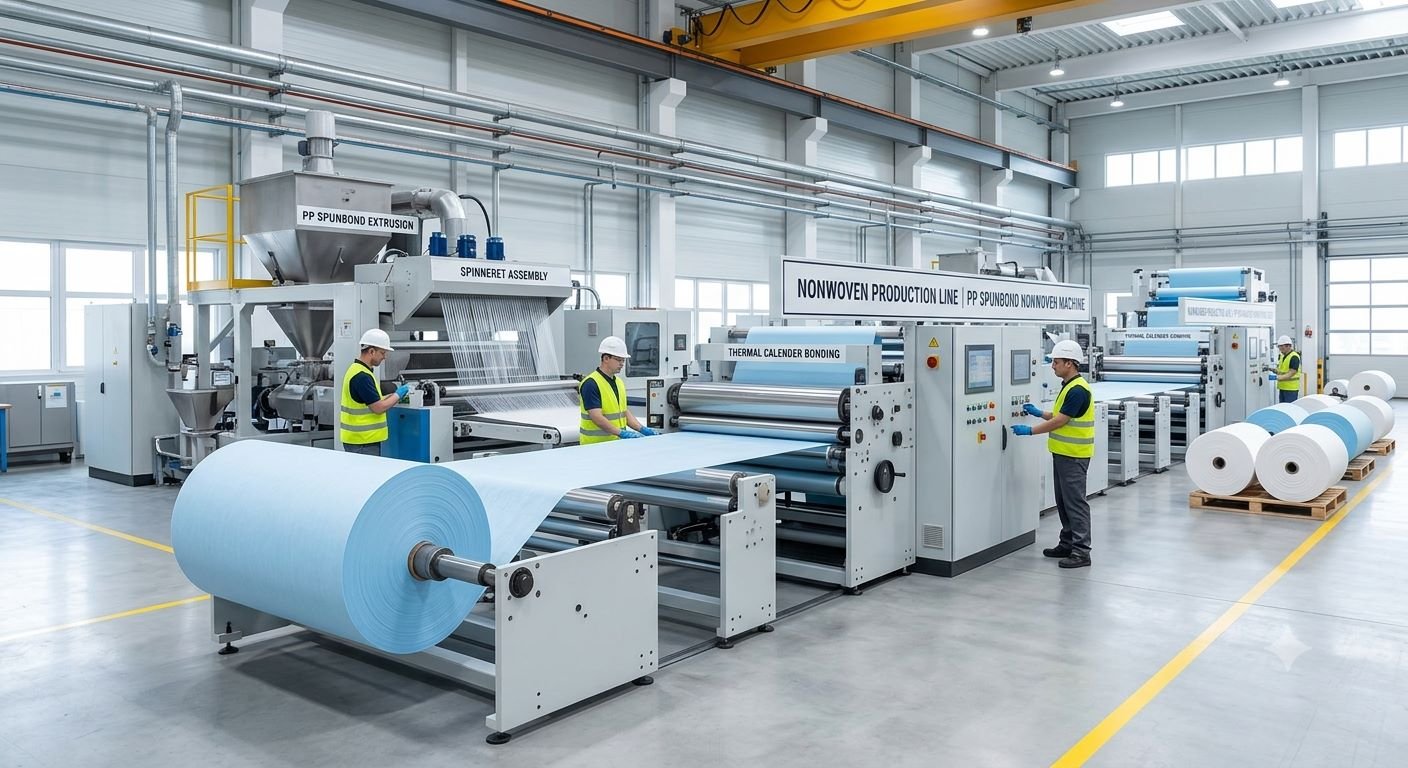
The demand for nonwoven fabrics continues to expand across hygiene products, medical supplies, agriculture, packaging, construction and industrial applications. For manufacturers looking to enter or scale this market, choosing the right Nonwoven Production Line is a significant investment decision.
A modern production line can convert polypropylene (PP) raw material into continuous spunbond nonwoven fabric through a controlled sequence of melting, extrusion, fibre formation, web formation and bonding. However, the right machine configuration depends on factors such as fabric specifications, production capacity, GSM range, end-use applications, automation requirements and available factory infrastructure.
This guide explains how a nonwoven production line works, what equipment it includes, how to evaluate a PP Spunbond Nonwoven Machine, and what manufacturers should consider before purchasing.
What Is a Nonwoven Production Line?
A Nonwoven Production Line is an integrated manufacturing system used to produce fabric-like materials without traditional weaving or knitting.
In a typical PP spunbond process, polypropylene granules are melted and extruded through specially designed spinnerets. The resulting continuous filaments are stretched, laid into a web and bonded to create a strong, lightweight nonwoven fabric.
Unlike woven fabrics, spunbond nonwovens do not require yarn preparation and conventional weaving operations.
In simple terms:
PP granules → melting → extrusion → filament spinning → stretching → web formation → bonding → winding → finished nonwoven fabric
The exact configuration varies according to the required output, fabric width, GSM range and application.
How Does a PP Spunbond Nonwoven Machine Work?
A PP Spunbond Nonwoven Machine uses a continuous process to transform polypropylene into nonwoven fabric.
The main stages generally include:
1. Raw Material Feeding
Polypropylene granules are supplied to the extrusion system. Depending on the production setup, additives, masterbatch or other approved materials may also be incorporated to achieve specific colour or performance characteristics.
Consistent raw-material quality is important because variations can affect extrusion stability, filament formation and final fabric properties.
2. Melting and Extrusion
The polypropylene is heated inside the extruder until it reaches the appropriate molten state.
The extrusion system controls the material flow towards the spinning assembly. Temperature control at different stages is essential for stable processing.
3. Filament Spinning
The molten polymer passes through a spinneret containing numerous small openings.
Continuous polymer filaments emerge from these openings and are subsequently attenuated using controlled airflow.
This stage has a direct influence on filament formation and fabric uniformity.
4. Filament Stretching
High-velocity air helps stretch and cool the filaments.
The stretching process affects characteristics such as:
- Filament diameter
- Fibre orientation
- Tensile properties
- Fabric uniformity
- Overall production stability
5. Web Formation
The continuous filaments are distributed across a moving forming surface to create a web.
Proper airflow and web distribution are important for maintaining consistent fabric weight and appearance across the machine width.
6. Bonding
The loose filament web needs to be bonded to develop the required mechanical properties.
In spunbond production, thermal bonding is commonly used. A calender system applies controlled heat and pressure to bond the filaments at selected points.
7. Fabric Winding
The finished nonwoven material is wound into rolls.
The winding system should maintain suitable tension and roll formation so that the finished rolls can be handled, stored, transported and converted efficiently.
What Are the Main Components of a Nonwoven Production Line?
A complete production system normally consists of several interconnected units.
Depending on the machine design, these may include:
| Component | Main Function |
| Raw material feeding system | Supplies PP granules to the process |
| Extruder | Melts and transports polymer |
| Filtration system | Helps remove unwanted contaminants |
| Metering system | Controls polymer flow |
| Spinning assembly | Produces continuous filaments |
| Quenching/air system | Cools and attenuates filaments |
| Web-forming system | Distributes filaments into a web |
| Calender | Thermally bonds the web |
| Edge trimming system | Controls fabric edges |
| Winder | Produces finished fabric rolls |
| Electrical control system | Controls and monitors production |
| Cooling and auxiliary systems | Support stable operation |
The precise configuration depends on the manufacturer’s engineering approach and the intended production requirements.
Where Is Spunbond Nonwoven Fabric Used?
One reason manufacturers invest in spunbond technology is its versatility.
PP spunbond nonwoven fabric is used in a wide range of products, including:
Hygiene Products
Spunbond material can be used as a component in products such as:
- Disposable nappies
- Sanitary products
- Adult incontinence products
- Hygiene covers
Medical and Healthcare Products
Applications may include:
- Surgical gowns
- Medical protective products
- Disposable caps
- Shoe covers
- Medical packaging components
Product specifications must be selected according to the relevant application and applicable regulatory requirements.
Agriculture
Agricultural nonwovens can be used for:
- Crop covers
- Plant protection
- Nursery applications
- Weed-control products
- Agricultural bags
Construction
Nonwoven materials can form part of:
- Roofing systems
- Building membranes
- Insulation-related products
- Geotextile applications
- Protective construction materials
Packaging and Industrial Products
Spunbond fabrics are also used in:
- Shopping bags
- Packaging materials
- Furniture-related applications
- Filtration products
- Industrial protective materials
The suitability of a particular fabric depends on its GSM, strength, elongation, permeability and other performance requirements.
What GSM Can a Spunbond Production Line Produce?
GSM means grams per square metre and describes the weight of the nonwoven fabric.
A production line may be configured to manufacture different GSM ranges depending on its design and application requirements.
For example, a manufacturer supplying lightweight hygiene materials will have different requirements from a company producing heavier agricultural or construction materials.
Rather than selecting a machine solely on a quoted maximum GSM, buyers should evaluate the usable production range and expected output at the GSM values they actually intend to manufacture.
What Should You Consider When Buying a PP Spunbond Nonwoven Machine?
Purchasing a nonwoven machine is a long-term capital decision. The lowest purchase price is not necessarily the lowest overall production cost.
Consider the following factors before making a decision.
1. Required Production Capacity
Define your expected production volume first.
Consider:
- Target tonnes per day
- Working hours per day
- Number of operating shifts
- Expected utilisation
- Future expansion plans
A machine that is significantly oversized can increase capital and operating costs, while an undersized line may restrict future growth.
2. Fabric Width
Machine width should correspond to your target markets and converting requirements.
A wider line may provide higher production potential, but it can also require greater factory space, infrastructure and investment.
3. GSM Range
Determine the fabric weights you intend to manufacture.
If your business serves several applications, a flexible GSM range can provide greater product diversity.
4. Fabric Quality and Uniformity
Ask prospective suppliers how their system addresses:
- Cross-machine-weight variation
- Filament consistency
- Bonding uniformity
- Roll quality
- Edge control
- Process stability
A production line should be evaluated on the quality of commercially usable output, not simply its theoretical speed.
5. Automation and Controls
Modern control systems can help operators monitor and adjust key production parameters.
Depending on the machine, automation may cover:
- Temperature control
- Extrusion parameters
- Line speed
- Web formation
- Calender conditions
- Winding tension
- Alarm monitoring
The right level of automation depends on your workforce, budget and production requirements.
6. Energy Consumption
Energy costs can have a substantial impact on manufacturing economics.
When comparing suppliers, ask for realistic energy-consumption information under comparable operating conditions rather than relying only on headline specifications.
7. Spare Parts and Technical Support
A production line is only valuable when it can operate reliably.
Before purchasing, clarify:
- Spare-parts availability
- Technical support
- Installation assistance
- Operator training
- Preventive maintenance requirements
- Troubleshooting support
- Warranty terms
Local or regional service availability can be particularly important for manufacturers operating in markets where specialist technicians are not readily available.
How Much Does a Nonwoven Production Line Cost?
There is no single standard price for a Nonwoven Production Line.
The investment depends on factors such as:
- Production capacity
- Machine width
- Number of beams
- Automation level
- GSM range
- Extruder configuration
- Electrical and auxiliary systems
- Installation requirements
- Factory infrastructure
- Supplier and machine specifications
A serious buyer should therefore request a detailed technical and commercial quotation rather than comparing machines using purchase price alone.
A better way to compare suppliers
Ask each supplier to provide comparable information covering:
- Machine configuration
- Rated and expected production capacity
- Fabric width
- GSM range
- Power requirements
- Utility requirements
- Installation scope
- Warranty
- Spare parts
- Training and commissioning
- Production acceptance criteria
- After-sales service
This makes it easier to compare the actual value of different proposals.
What Factory Infrastructure Does a Spunbond Line Need?
Before ordering machinery, manufacturers should assess their facility.
Depending on the equipment configuration, requirements may include:
- Adequate production-floor space
- Electrical power supply
- Cooling systems
- Compressed air
- Ventilation
- Raw-material storage
- Finished-roll storage
- Material-handling equipment
- Fire and workplace safety systems
The supplier should provide the technical utility requirements and installation layout before finalising the factory setup.
New vs Used Nonwoven Production Equipment
A used machine can appear attractive because of its lower initial capital requirement. However, the decision should include a technical inspection.
For used equipment, check:
- Machine age
- Operating history
- Maintenance records
- Extruder condition
- Spinneret condition
- Calender condition
- Electrical components
- Winder performance
- Replacement-part availability
- Actual production capability
A lower purchase price does not necessarily mean a lower total cost if the machine requires extensive refurbishment or frequent downtime.
How to Choose a Reliable Nonwoven Machine Manufacturer
Choosing the manufacturer is as important as choosing the machine.
Look beyond brochures and specifications.
A professional supplier should be able to discuss your intended applications, production targets, raw material, fabric specifications and factory conditions.
Questions worth asking a supplier
Can the machine produce my required GSM range?
Ask for realistic production parameters rather than only maximum specifications.
What output can I expect at my target GSM?
Production rates can vary according to fabric weight and operating conditions.
What is included in the quoted price?
Clarify whether installation, commissioning, training and auxiliary equipment are included.
What technical support is available after installation?
Understand how breakdowns, spare parts and maintenance are handled.
Can the supplier provide test production?
Where possible, evaluating actual fabric samples can provide more useful information than specifications alone.
Nonwoven Production Line: Common Buying Mistakes
Focusing Only on Machine Price
A cheaper machine may have higher energy consumption, more downtime or limited technical support.
Buying for Maximum Capacity Instead of Actual Demand
Higher capacity is not automatically better. Your investment should match your realistic sales and production requirements.
Ignoring Product Specifications
A line designed for one type of nonwoven application may not be ideal for another.
Define your target GSM, width, strength, colour and end-use requirements before selecting the equipment.
Underestimating After-Sales Support
Technical assistance and spare parts can become critical once commercial production begins.
Not Planning Factory Utilities Early
Electrical, cooling, ventilation and space requirements should be considered before the machinery arrives.
How Can Manufacturers Improve Production Efficiency?
Efficiency is not simply about increasing line speed.
Manufacturers can improve overall performance by focusing on:
- Consistent raw materials
- Preventive maintenance
- Correct temperature control
- Stable extrusion
- Proper web formation
- Accurate winding
- Operator training
- Process monitoring
- Planned spare-parts inventory
- Minimising unnecessary downtime
For example, increasing machine speed may increase theoretical output but can be counterproductive if it causes greater fabric variation, rejects or unplanned stoppages.
Frequently Asked Questions
What is a Nonwoven Production Line?
A Nonwoven Production Line is an integrated manufacturing system used to convert polymers such as polypropylene into nonwoven fabric through processes including extrusion, filament spinning, web formation and bonding.
What is a PP Spunbond Nonwoven Machine?
A PP Spunbond Nonwoven Machine is equipment designed to manufacture spunbond nonwoven fabric from polypropylene. It melts the polymer, forms continuous filaments, creates a web and bonds the filaments into fabric.
Is polypropylene suitable for spunbond nonwoven fabric?
Yes. Polypropylene is widely used for spunbond applications because it can be processed into continuous filaments and provides a useful combination of low weight, strength and processability.
What products can be manufactured using spunbond technology?
Depending on fabric specifications, spunbond nonwoven materials can be used in hygiene, healthcare, agriculture, construction, packaging and industrial applications.
How do I select the right nonwoven machine?
Start with your target product specifications, GSM, fabric width, required capacity, raw material, operating hours and budget. Then compare machine configurations, energy requirements, automation, technical support and total ownership costs.
Is a higher-speed machine always better?
No. The appropriate machine should deliver the required quality and commercially usable output consistently. Maximum line speed should be evaluated alongside fabric uniformity, energy consumption, downtime and maintenance requirements.