
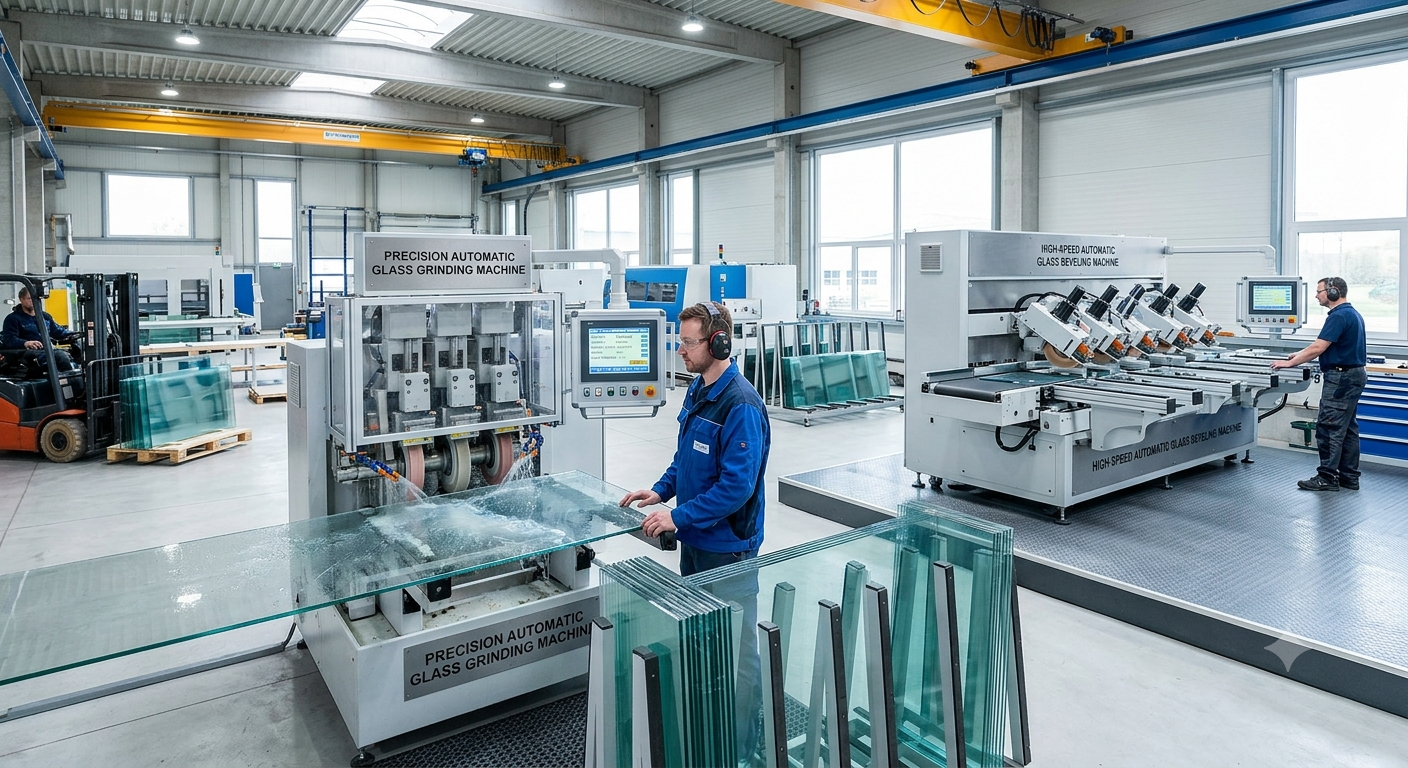
Glass processing demands precision. A small variation in edge quality, thickness, grinding pressure or machine alignment can affect the appearance, safety and usability of a finished glass product. This is why choosing the right glass grinding machine is an important decision for glass processors, fabricators, furniture manufacturers, architectural glass companies and other industrial users.
A modern grinding system can do much more than simply remove sharp edges. Depending on its configuration, it can grind straight edges, shape profiles, prepare surfaces and support processes such as polishing and bevel production.
For businesses comparing equipment, the key is not simply to find a machine with a high processing speed. The right solution should match the glass thickness, dimensions, edge finish, production volume, automation requirements and quality standards of the application.
What Is a Glass Grinding Machine?
A glass grinding machine is industrial equipment designed to remove, shape or refine material from the edge or surface of glass using abrasive grinding wheels or related tooling.
The grinding process can be used to:
- Remove sharp or uneven glass edges
- Produce a consistent edge profile
- Prepare edges for further polishing
- Improve dimensional accuracy
- Create decorative or functional edge shapes
- Support high-volume glass fabrication
- Reduce manual edge-finishing work
Different machines are designed for different edge configurations. A straight-line edging machine, for example, is suited to continuous processing of straight glass edges, while specialised equipment can produce arrissed, flat-polished, pencil or other edge profiles.
The machine configuration, abrasive type, spindle arrangement, coolant system and automation level all influence the final result.
How Does a Glass Grinding Machine Work?
Although machine designs vary, the basic grinding process follows a similar principle.
Glass is positioned and transported through the machine while abrasive wheels remove a controlled amount of material from the edge. Coolant is commonly used during processing to control heat and help manage glass debris.
A typical process includes:
- Glass loading – The workpiece is placed on the machine’s conveyor or support system.
- Positioning – Guides, belts or automated systems keep the glass correctly aligned.
- Grinding – Abrasive wheels gradually remove material from the edge.
- Profile formation – Additional wheels may create the required edge geometry.
- Fine grinding or polishing – Finer abrasives can improve the surface finish where required.
- Cooling and cleaning – Water or coolant systems help control processing conditions and remove particles.
- Inspection – The finished edge is checked for dimensions, consistency, chips and surface quality.
The exact sequence depends on whether the equipment is intended for basic edge grinding, edge polishing, bevel production or a combination of processes.
Types of Glass Grinding Machines
There is no single grinding machine that is ideal for every glass-processing application. Common configurations include the following.
1. Straight-Line Glass Grinding Machine
A straight-line machine is designed to process straight edges efficiently and consistently. It is widely used where large quantities of rectangular or similarly shaped glass panels need repeatable edge treatment.
Typical applications include:
- Architectural glass
- Furniture glass
- Shower enclosures
- Interior glass panels
- Decorative glass
- General flat-glass processing
The number and arrangement of grinding heads can vary according to the desired edge finish and production requirements.
2. Double-Edging Glass Grinding Machine
Double-edging systems process two opposite edges during the same production cycle. This configuration can be valuable for high-volume production because it reduces handling between operations.
It is particularly relevant where manufacturers need consistent dimensions across large production runs.
3. Shape Glass Grinding Machine
Shape grinding equipment is designed for glass with curves, cut-outs or non-rectangular geometries.
Applications may include:
- Automotive glass
- Bespoke architectural glass
- Furniture components
- Decorative panels
- Special-shaped mirrors
For shaped glass, machine flexibility and accurate workpiece positioning are particularly important.
4. CNC Glass Grinding Machine
CNC-controlled systems provide programmable control over movements and processing parameters. They can be useful for manufacturers handling complex shapes or repeat production requirements.
Depending on the machine design, CNC technology can help manage:
- Glass positioning
- Grinding paths
- Edge profiles
- Tool movements
- Repeatability
- Production parameters
For businesses producing a wide variety of designs, CNC capability can make production planning more flexible.
What Is a Glass Beveling Machine?
A glass beveling machine is specialised equipment used to create an angled or sloping edge around the perimeter of a glass piece.
Unlike basic edge grinding, bevel processing intentionally creates a defined angled surface. The bevel may subsequently be polished to achieve the required appearance.
Bevelled glass is commonly found in:
- Decorative mirrors
- Furniture glass
- Interior design products
- Luxury architectural applications
- Decorative panels
- Certain speciality glass products
A beveling machine may use multiple grinding and polishing stages to achieve the required bevel width, angle and surface quality.
Glass Grinding Machine vs Glass Beveling Machine
The two machines are related, but they are not interchangeable in every application.
| Feature | Glass Grinding Machine | Glass Beveling Machine |
| Main purpose | Edge grinding and finishing | Creating an angled bevel |
| Typical output | Finished or prepared glass edge | Defined sloping edge |
| Common applications | Architectural, furniture and general glass processing | Decorative mirrors and speciality glass |
| Edge geometry | Depends on tooling and configuration | Angled/bevelled |
| Polishing capability | Available on some configurations | Commonly integrated into bevel processing |
| Best suited to | General edge treatment | Decorative or functional bevel production |
A manufacturer that primarily produces standard flat glass panels may have different equipment requirements from a business specialising in decorative mirrors.
Key Applications of Glass Grinding Equipment
Glass grinding is used across a broad range of manufacturing environments.
Architectural Glass
Glass processors use edge grinding and polishing equipment for doors, partitions, façades, balustrades and other architectural products.
Consistent edge quality is especially important when glass is visible in the finished installation.
Furniture Glass
Tables, shelves, display units and cabinets often require smooth and visually consistent edges. Grinding can remove sharp edges and prepare the glass for further finishing.
Mirror Manufacturing
Mirror processors may require both edge grinding and bevel production. Decorative bevels can add visual depth to mirrors and are often used in interior applications.
Shower and Bathroom Glass
Glass used in shower enclosures and bathroom installations may require carefully finished edges before assembly and installation.
Decorative Glass
Speciality glass products can require shaped edges, polished surfaces, bevels or other customised profiles. Machine selection should therefore be based on the final product rather than simply the raw glass dimensions.
Important Features to Consider Before Buying
Buying a glass grinding machine is a production decision, not simply an equipment purchase. Several factors should be evaluated before selecting a model.
1. Glass Thickness Range
Check the machine’s supported thickness range and compare it with the glass your business actually processes.
If your production includes multiple thicknesses, choose equipment that can accommodate the required range without compromising edge quality.
2. Maximum Glass Size
Consider both the smallest and largest glass sizes you regularly process.
A machine that works well for standard panels may not be appropriate for oversized architectural glass.
3. Required Edge Profile
Determine whether you need:
- Flat grinding
- Flat polishing
- Arrissed edges
- Pencil edges
- Bevels
- Special profiles
The required profile determines the tooling and machine configuration.
4. Production Volume
A small workshop with occasional glass processing has different requirements from a high-volume factory.
For continuous production, factors such as conveyor design, automatic loading, processing speed, wheel life and maintenance access become increasingly important.
5. Grinding Wheel Configuration
Grinding wheels are critical to machine performance. Different abrasive materials and grit sizes are used for different stages of glass processing.
The correct tooling depends on the glass type, edge profile, desired finish and processing sequence.
6. Coolant and Water Management
Glass grinding generates heat and fine particles. A suitable coolant or water-management system can help control processing conditions and keep the grinding area cleaner.
When comparing machines, examine the design of the water circulation, filtration and drainage system rather than focusing only on the headline machine specifications.
7. Automation and Controls
Modern machines may incorporate digital controls, programmable settings, automatic thickness adjustment and other automation features.
Automation can be particularly valuable when production involves repeat orders or multiple product specifications.
8. Ease of Maintenance
Downtime can affect production schedules and operating costs.
Look for practical maintenance features such as accessible grinding components, straightforward adjustment procedures, readily available consumables and clear machine diagnostics.
9. After-Sales Support
Technical support matters just as much as the machine itself.
Before placing an order, ask the supplier about:
- Installation support
- Operator training
- Spare parts
- Grinding wheel availability
- Maintenance assistance
- Troubleshooting
- Warranty terms
- Remote or on-site technical support
A reliable supplier should be able to explain how the machine will be supported throughout its working life.
How to Choose the Right Glass Grinding Machine
The best approach is to start with your production requirements rather than starting with a particular machine model.
Ask these questions:
What type of glass do we process?
Identify the glass types, thicknesses, sizes and shapes.
What edge finish do we need?
A basic ground edge has different equipment requirements from a highly polished or bevelled edge.
How many pieces do we process each day?
Production volume influences the required machine configuration and automation level.
Are the products mostly standard or customised?
High product variation may make programmable or CNC-controlled equipment more attractive.
How important is automation?
Automation can reduce manual handling and improve process consistency, but it should be justified by production requirements.
What level of technical support is available?
A machine is a long-term production asset. Service, parts and technical expertise should therefore be part of the purchasing decision.
Glass Grinding Machine for Small Workshops vs Industrial Production
A smaller glass workshop may prioritise affordability, compact dimensions, straightforward operation and flexibility.
An industrial glass-processing plant may place greater emphasis on:
- Continuous production
- Higher throughput
- Automated handling
- Multiple grinding stages
- Consistent edge quality
- Integration with upstream and downstream equipment
- Preventive maintenance
- Production monitoring
There is no universal “best” configuration. The right machine is the one that provides the required processing capability without creating unnecessary complexity or capacity.
How to Improve Glass Grinding Results
Even a well-designed machine can produce inconsistent results if the process is poorly controlled.
Practical measures include:
Use the Correct Grinding Parameters
Grinding pressure, wheel selection, feed rate and coolant conditions should be appropriate for the glass and edge profile being processed.
Monitor Grinding Wheels
Worn or incorrectly dressed wheels can affect edge quality and increase the likelihood of inconsistent results.
Keep the Water System Clean
Accumulated glass particles can affect coolant circulation and machine performance. Regular cleaning and filtration should therefore be part of routine maintenance.
Maintain Accurate Alignment
Poor alignment can contribute to uneven edge removal, inconsistent dimensions and premature component wear.
Inspect Finished Edges
Visual inspection and dimensional checks can identify problems before defective products move further through the production process.
Common Problems When Selecting or Operating Grinding Equipment
Some purchasing mistakes can be avoided with a more practical evaluation process.
Choosing Based Only on Price
The lowest initial purchase price does not necessarily represent the lowest overall operating cost.
Consider tooling, consumables, energy, maintenance, downtime, technical support and expected production requirements.
Ignoring the Required Edge Finish
A machine may process glass efficiently but still be unsuitable if it cannot produce the required edge profile or surface quality.
Buying More Capacity Than Necessary
Oversized equipment can increase capital and operating costs without delivering meaningful benefits for a smaller production environment.
Underestimating After-Sales Service
Replacement parts and technical assistance can become important over years of operation. Supplier support should therefore be evaluated before purchase.
Maintenance Tips for a Glass Grinding Machine
Routine maintenance helps protect machine performance and production consistency.
A basic maintenance programme may include:
- Cleaning glass debris from processing areas
- Checking coolant and water systems
- Inspecting grinding wheels
- Checking belts and moving components
- Monitoring abnormal vibration or noise
- Verifying alignment
- Lubricating components according to manufacturer recommendations
- Checking electrical and safety systems
- Replacing worn consumables promptly
Always follow the equipment manufacturer’s maintenance instructions and safety procedures.
Frequently Asked Questions
What is a glass grinding machine used for?
A glass grinding machine is used to grind, shape or finish glass edges. Depending on the machine configuration, it can remove sharp edges, create specific profiles and prepare the edge for polishing or further processing.
What is the difference between grinding and beveling glass?
Grinding generally refers to removing and refining material from the glass edge, while beveling creates a deliberate angled edge around the glass perimeter. A bevel may then be polished for a decorative finish.
Is a glass grinding machine suitable for different glass thicknesses?
Many machines are designed to process a specified range of glass thicknesses. The actual capability depends on the machine model and configuration, so buyers should confirm the manufacturer’s stated working range before purchasing.
Can one machine grind and polish glass?
Yes, some glass edge-processing machines combine grinding and polishing stages. The exact capabilities depend on the machine’s spindle arrangement, tooling and configuration.
What should I consider when buying a glass beveling machine?
Consider the glass thickness and dimensions, bevel angle and width, required surface finish, production volume, automation level, tooling requirements, maintenance needs and after-sales technical support.
Is CNC control necessary for glass grinding?
Not necessarily. CNC control is particularly useful for complex shapes, repeatable customised work and applications requiring programmable movements. Standard straight-edge production may not require the same level of CNC functionality.
How can I choose a reliable glass machine supplier?
Compare technical specifications, machine construction, application suitability, demonstrations or sample processing, warranty terms, spare-parts availability, installation support and after-sales service. Where possible, ask the supplier to process a sample similar to your actual production requirements.