
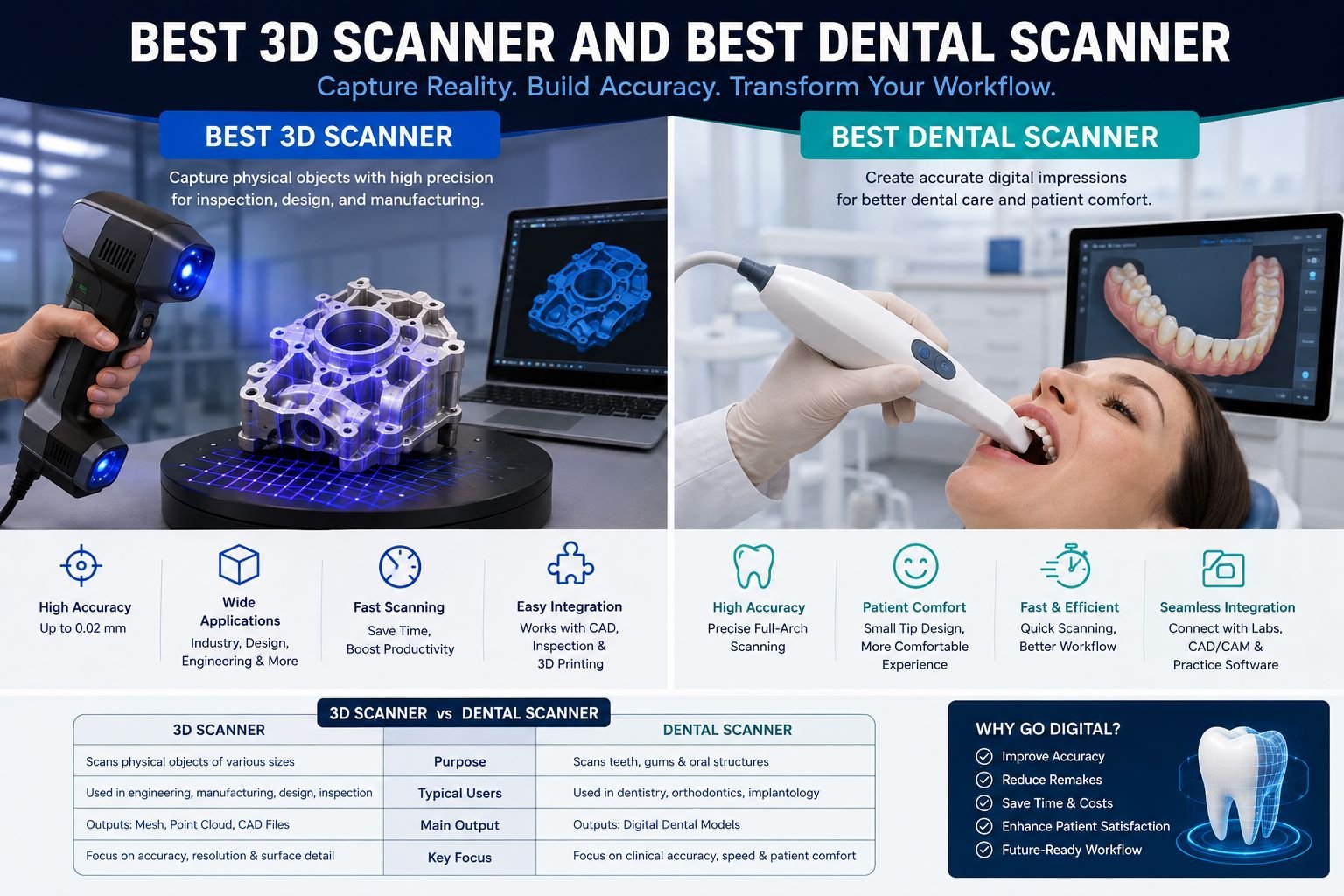
Digital scanning has transformed the way professionals capture, measure, analyse, and reproduce physical objects. From engineering and product development to dentistry and healthcare, modern scanners can convert real-world surfaces into highly detailed digital models within minutes. However, finding the Best 3D Scanner or the Best Dental Scanner requires more than simply comparing prices.
Accuracy, scanning speed, software compatibility, workflow requirements, portability, and long-term operating costs all influence the right purchasing decision. Understanding these factors helps professionals invest in scanning technology that genuinely improves productivity and digital workflows.
What Is a 3D Scanner?
A 3D scanner is a device that captures the shape, dimensions, and surface characteristics of a physical object and converts the collected information into digital three-dimensional data.
How 3D Scanning Technology Works
Different systems use technologies such as structured light, laser triangulation, photogrammetry, or infrared imaging. Thousands or millions of measurement points are collected to form a digital point cloud.
From Point Cloud to Digital Model
Specialised software converts this data into polygon meshes or CAD-compatible models. These files can then be used for reverse engineering, dimensional inspection, product development, 3D printing, quality control, heritage preservation, and digital manufacturing.
How to Choose the Best 3D Scanner
The Best 3D Scanner is not necessarily the model with the highest specification. It should match the objects being scanned and the accuracy required by the application.
Important considerations include:
- Accuracy and resolution: Critical for precision engineering and inspection.
- Scanning volume: Small components need different equipment from vehicles or industrial structures.
- Portability: Handheld scanners provide flexibility for field measurements.
- Scanning speed: Faster data acquisition improves productivity.
- Surface compatibility: Reflective, dark, transparent, or complex surfaces can be challenging.
- Software: Look for reliable processing, mesh editing, measurement, and export capabilities.
- File compatibility: STL, OBJ, PLY, STEP, and other commonly used formats may be required.
- Calibration: Straightforward calibration helps maintain consistent results.
For reverse engineering or dimensional inspection, precision may be the highest priority. For creative design or general 3D modelling, speed and usability can sometimes matter more.
Where Is a 3D Scanner Used?
Professional scanning technology now supports numerous industries.
Manufacturers use scanners to compare finished components against CAD designs. Automotive businesses digitise vehicle components for inspection and reproduction. Designers capture physical prototypes and convert them into editable digital models.
Common applications include product inspection, reverse engineering, additive manufacturing, industrial design, research, architecture, cultural preservation and customised manufacturing.
Choosing the Best 3D Scanner therefore begins with identifying the intended application rather than focusing exclusively on technical specifications.
What Is a Dental Scanner?
A dental scanner is specialised digital imaging equipment designed for dentistry. Intraoral scanners capture the surfaces of teeth, gums, implants, preparations, and surrounding oral structures to produce accurate digital impressions.
Traditional impressions typically require trays and impression materials. Digital scanning can provide a more streamlined workflow by creating three-dimensional patient records that can be reviewed and transferred electronically.
What Makes the Best Dental Scanner?
Choosing the Best Dental Scanner requires consideration of both clinical performance and everyday usability.
Scanning accuracy is especially important when producing restorations, aligners, implant-supported solutions, retainers, and other dental appliances. However, accuracy alone does not determine whether a scanner fits a dental practice.
A suitable system should also provide efficient scanning, intuitive software, comfortable scanner dimensions, dependable tracking, convenient data management, and compatibility with the clinic’s digital ecosystem.
Important Features of a Dental Scanner
When comparing intraoral scanning systems, dental professionals should evaluate practical workflow factors.
Scanner ergonomics matter because clinicians may use the device repeatedly throughout the working day. A lightweight, well-balanced handpiece can make scanning more comfortable.
Software is equally important. Efficient case management, margin identification, scan review, communication, and laboratory export capabilities can significantly influence productivity.
The Best Dental Scanner should therefore balance hardware performance with software quality, support, training, and integration capabilities.
Best 3D Scanner vs Best Dental Scanner
| Feature | 3D Scanner | Dental Scanner |
| Main Purpose | General object digitisation | Digital dental impressions |
| Typical Users | Engineers, designers, manufacturers | Dentists, orthodontists, laboratories |
| Scanning Subjects | Components, products, structures | Teeth, gums and oral anatomy |
| Common Output | Meshes and 3D models | Digital dental models |
| Key Priority | Accuracy and versatility | Clinical accuracy and workflow |
| Typical Applications | Inspection, CAD, reverse engineering | Crowns, aligners, implants, retainers |
Although both systems capture three-dimensional information, dental scanners are specifically designed around oral scanning and clinical workflows.
Benefits of Investing in Professional 3D Scanning
Digital scanning can eliminate many manual measurement steps while improving repeatability. Accurate digital records can also be stored, shared, analysed, modified, and reproduced without repeatedly handling the original object.
For industrial users, the Best 3D Scanner can support faster inspection, design verification and reverse engineering.
For dental professionals, the Best Dental Scanner can improve digital case communication between clinics, laboratories and other treatment partners while reducing dependence on conventional impressions.
How to Select the Right Scanner for Your Business
Before purchasing, define your required accuracy, typical scanning size, daily workload, software environment, available budget, and expected applications.
Request a practical demonstration using objects or clinical cases similar to your real-world workflow. Marketing demonstrations performed under ideal conditions may not reveal how equipment behaves with challenging geometry or surfaces.
Also investigate training, technical support, warranty conditions, software subscription costs, upgrades, accessories and replacement components. The purchase price represents only one part of the total ownership cost.
Frequently Asked Questions About 3D and Dental Scanners
1. What is the Best 3D Scanner for professional use?
The right scanner depends on required accuracy, object size, scanning environment, software compatibility and intended application.
2. Are handheld 3D scanners accurate?
Professional handheld systems can deliver excellent accuracy when properly calibrated and operated according to manufacturer specifications.
3. Can 3D scanners create CAD models?
Scanning typically produces point-cloud or mesh data that can be processed using reverse-engineering software to develop CAD geometry.
4. Can scanned models be 3D printed?
Yes. Properly processed scans can commonly be exported into formats suitable for 3D printing workflows.
5. What is the Best Dental Scanner for a clinic?
The ideal option combines clinical accuracy, fast scanning, ergonomic operation, intuitive software, laboratory connectivity and dependable support.
6. Are dental scanners suitable for crowns?
Digital intraoral scanning is widely used in restorative workflows, including crowns and other prosthetic applications.
7. Can dental scanners be used for orthodontics?
Yes. Digital scans can support orthodontic assessment, aligner workflows, retainers and treatment planning.
8. Is scanner software important?
Absolutely. Software determines how efficiently users process, inspect, manage, export and communicate scanning data.
9. Should price determine which scanner I purchase?
No. Evaluate total ownership cost, including software, support, training, accessories, maintenance and upgrades.
10. How should I compare scanners before buying?
Compare equipment using your own representative scanning requirements and evaluate accuracy, speed, workflow, software and after-sales support.