
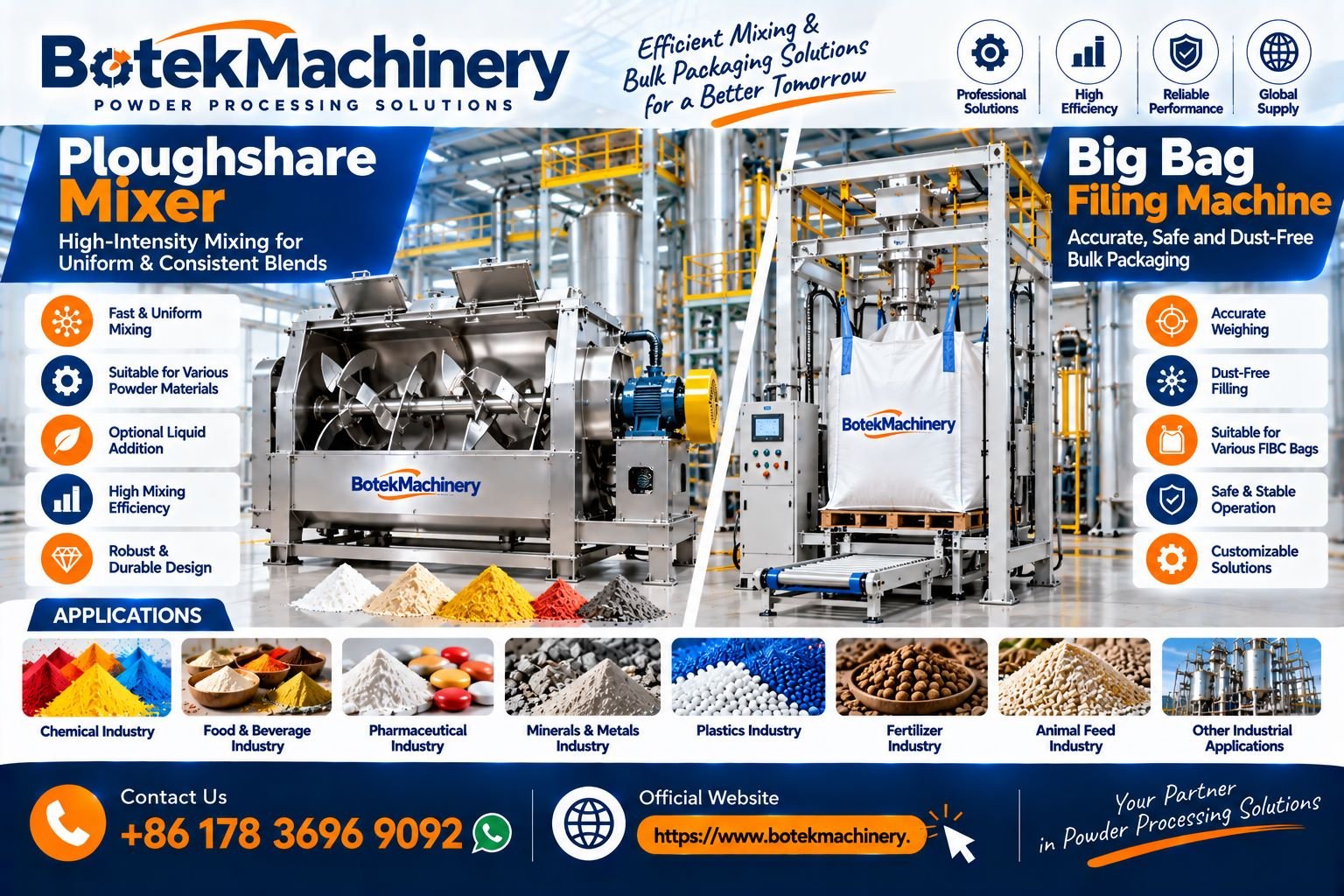
Industrial manufacturers handling powders, granules, minerals, chemicals, food ingredients, pharmaceuticals, fertilizers, and specialty materials are increasingly looking for equipment that improves both product preparation and bulk packaging. Two technologies playing an important role in these operations are the big bag filling machine and ploughshare mixer.
A ploughshare mixer is designed for intensive and rapid blending of dry powders, granules, and selected formulations, while a big bag filling machine enables processed material to be packed efficiently into flexible intermediate bulk containers, commonly known as FIBCs or jumbo bags. When integrated into one production line, these systems can help manufacturers improve consistency, reduce manual handling, control dust, and increase production efficiency.
What Is a Ploughshare Mixer?
A ploughshare mixer is an industrial mixing machine generally built around a horizontal cylindrical chamber containing a high-speed shaft equipped with plough-shaped mixing elements.
As the shaft rotates, the ploughs lift, separate, and redistribute the material throughout the vessel. This creates intensive three-dimensional movement that can produce fast and uniform blending.
Typical materials may include:
- Chemical powders
- Food ingredients
- Minerals
- Fertilizers
- Pharmaceutical ingredients
- Plastic additives
- Pigments
- Detergents
- Specialty powders
The actual suitability depends on particle characteristics, formulation requirements, capacity, and desired mixing performance.
How a Ploughshare Mixer Works
The basic mixing process involves loading the required ingredients into the mixing chamber and operating the rotating shaft at a controlled speed.
The plough-shaped elements continuously move the material through the chamber.
This action can:
- Separate powder particles
- Redistribute ingredients
- Reduce dead zones
- Promote rapid blending
- Improve ingredient dispersion
Some systems can also incorporate high-speed choppers or additional devices when agglomerate reduction or more intensive dispersion is required.
Why Manufacturers Choose Ploughshare Mixing
A ploughshare mixer can offer several advantages in high-throughput processing.
Potential benefits include:
- Short mixing cycles
- High blending intensity
- Good batch uniformity
- Handling of different bulk densities
- Ability to process powders and granules
- Optional liquid addition
- Flexible batch capacities
The equipment may be particularly useful where production efficiency requires faster mixing than gentle tumbling systems can provide.
Material Characteristics Matter
Mixing results depend heavily on the material itself.
Manufacturers should consider:
- Particle size
- Bulk density
- Moisture
- Flowability
- Ingredient concentration
- Cohesiveness
- Abrasiveness
Significant differences in density or particle size can increase the risk of segregation.
For that reason, equipment configuration and operating parameters should be evaluated using the actual formulation whenever possible.
Liquid Addition During Mixing
Some industrial formulations require small quantities of liquids, oils, binders, or other additives to be incorporated into dry powders.
A properly configured ploughshare mixer may support controlled liquid addition through spraying systems.
Successful liquid incorporation depends on:
- Spray location
- Droplet size
- Mixing intensity
- Addition rate
- Material absorption
- Total liquid percentage
Incorrect liquid distribution can create lumps or uneven product quality, making process testing important.
What Is a Big Bag Filling Machine?
A big bag filling machine is an industrial system designed to fill large flexible containers with powders, granules, pellets, and other bulk solids.
These bags are commonly referred to as:
- FIBCs
- Jumbo bags
- Bulk bags
- Super sacks
The filling machine typically supports the bag, connects it to the product discharge point, controls material flow, and may weigh the material during filling.
Why Automated Big Bag Filling Matters
Manual bulk-bag filling can create challenges involving accuracy, dust, bag handling, and production speed.
A big bag filling machine can help improve:
- Filling consistency
- Weight accuracy
- Dust containment
- Operator efficiency
- Bag stability
- Production throughput
- Material handling
Automation can become especially valuable in plants filling many bags during each production shift.
Typical Big Bag Filling Process
A filling cycle may involve several stages.
Bag Placement → Spout Connection → Bag Inflation → Material Filling → Weighing → Compaction → Final Weight → Bag Removal
The exact sequence depends on machine configuration.
Some systems may include conveyors, bag vibration, height adjustment, pallet handling, and automatic weighing.
Accurate Weighing and Filling
Weight accuracy is an important consideration in bulk packaging.
A filling system may use load cells and controlled feeding to regulate the amount of material entering the bag.
A common strategy is to use faster material flow initially and slower filling as the target weight approaches.
This can help balance production speed with weighing accuracy.
Dust Control During Filling
Fine powders may release dust when entering a large bag.
A properly designed big bag filling machine may therefore include:
- Sealed filling connections
- Inflatable spout clamps
- Dust extraction
- Enclosed transfer
- Venting systems
Better dust control can reduce product loss, improve housekeeping, and support a cleaner operating environment.
For hazardous or combustible powders, appropriate engineering and safety assessments are essential.
Connecting Mixing with Big Bag Filling
A common production arrangement places the ploughshare mixer upstream of bulk-bag packaging.
A typical process line may be:
Raw Material Feeding → Mixing → Intermediate Storage → Controlled Feeding → Weighing → Big Bag Filling
This configuration enables the finished blended product to move directly toward bulk packaging with limited manual handling.
It can also reduce opportunities for contamination or product segregation between process stages.
Preventing Segregation After Mixing
Achieving a uniform blend is only useful if that uniformity is maintained until packaging.
Powder mixtures containing particles with different densities or sizes can segregate during long drops, excessive vibration, or uncontrolled transfer.
Manufacturers may reduce segregation by considering:
- Short transfer distances
- Gentle conveying
- Controlled discharge
- Appropriate hopper geometry
- Reduced free-fall height
The process between mixer and packaging machine deserves as much attention as the mixing stage itself.
Automation and Process Integration
Modern plants are increasingly linking mixing and filling equipment through centralized control systems.
Automation can monitor:
- Batch recipes
- Mixing time
- Motor load
- Material levels
- Filling weight
- Bag count
- Production status
Recipe-based control can help manufacturers achieve repeatability between production batches.
Applications Across Different Industries
A ploughshare mixer and big bag filling machine can support a broad range of sectors.
Chemicals
Powders, additives, pigments, and specialty formulations may require intensive blending followed by bulk packaging.
Food Processing
Dry food ingredients, premixes, and powders can be blended before shipment or downstream processing.
Fertilizers
Powdered and granular fertilizer formulations often require high-capacity mixing and bulk-bag handling.
Minerals
Processed mineral powders may be blended and packaged in large bags for industrial customers.
Plastics
Resins, additives, fillers, and pigments can be processed in bulk-material production lines.
Frequently Asked Questions
What is a big bag filling machine?
A big bag filling machine is equipment designed to fill large flexible bulk containers with powders, granules, pellets, or other dry materials.
What is a ploughshare mixer?
A ploughshare mixer is an intensive industrial blender using rotating plough-shaped elements to rapidly distribute powders and granules.
What industries use big bag filling machines?
They are commonly used in chemical, food, mineral, plastics, fertilizer, agricultural, and specialty-material industries.
What materials can be mixed in a ploughshare mixer?
It can process many dry powders, granules, additives, pigments, food ingredients, minerals, and similar materials.
Can liquids be added during mixing?
Depending on machine design, controlled liquid spraying can be integrated into the mixing process.
Can a mixer feed directly into a bulk-bag filling system?
Yes. The equipment can be integrated through hoppers, conveyors, feeders, or other material-transfer systems.
Why are load cells used in big bag filling?
Load cells measure the amount of material being filled and help the system stop at the desired target weight.
How can dust be reduced during bag filling?
Sealed connections, extraction systems, venting, and enclosed transfer equipment can help control dust.
Can bulk bags be compacted while filling?
Some filling systems include vibration or settling devices that help distribute material and improve bag stability.
What information is needed when selecting equipment?
Manufacturers should provide material characteristics, bulk density, required capacity, batch size, target bag weight, bag dimensions, dust behaviour, and process requirements.
Media Contact
Sales & Media Enquiries
Contact: +86 178 3696 9092
Official Website: https://www.botekmachinery.