
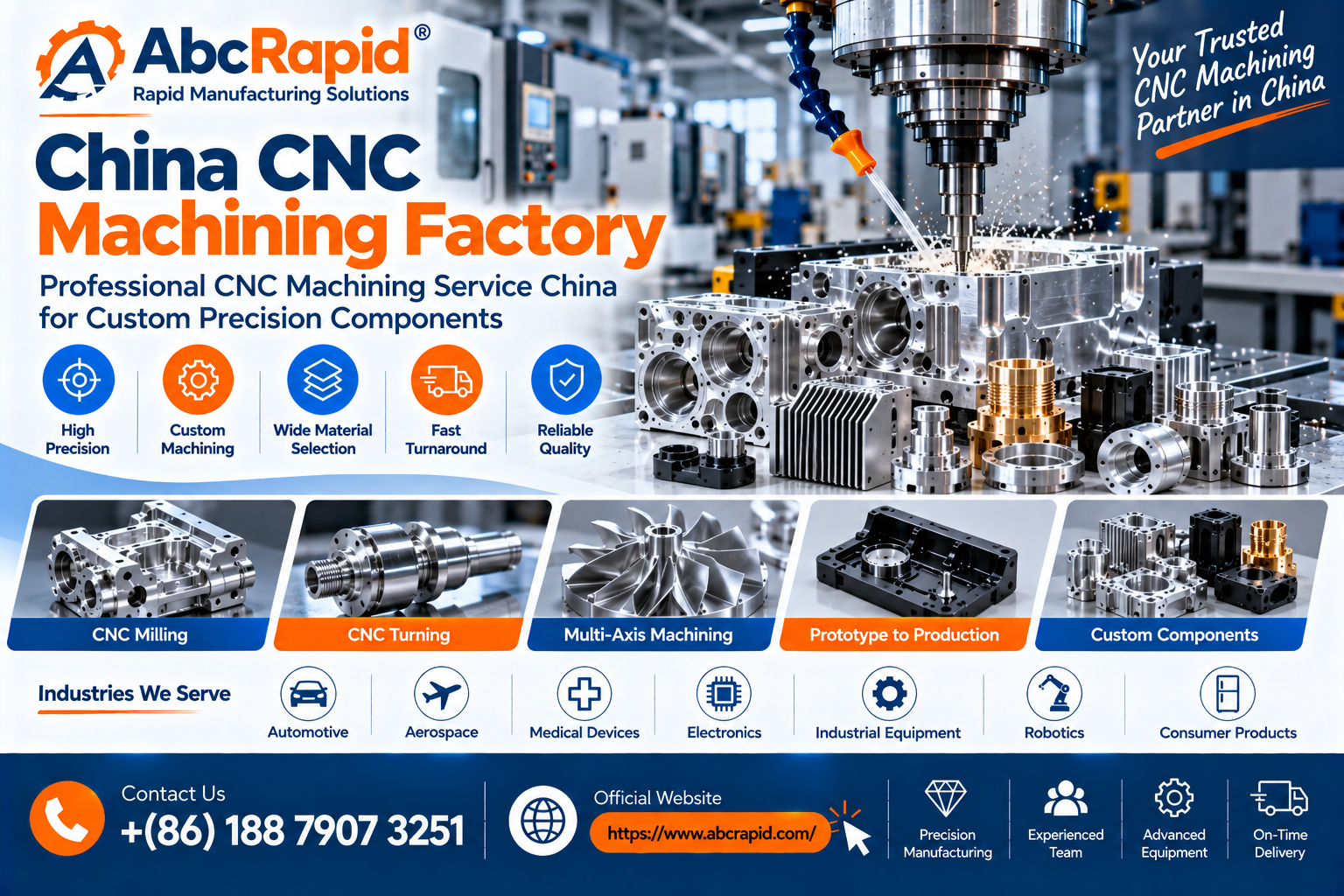
Global product developers are placing greater emphasis on shorter lead times, flexible production quantities, dimensional consistency, and responsive engineering support. This shift is increasing demand for an experienced china cnc machining factory capable of supporting prototype development, custom components, pilot batches, and ongoing production. At the same time, choosing the right china cnc machining manufacturer has become an important sourcing decision for businesses in automotive, aerospace, robotics, electronics, medical equipment, and industrial machinery.
Modern CNC manufacturing combines digital CAD data, advanced machine tools, experienced programming, inspection systems, and secondary finishing to convert engineering designs into production-ready components.
What Is a China CNC Machining Factory?
A china cnc machining factory is a manufacturing facility that uses computer-controlled equipment to produce customized metal and plastic components according to engineering drawings and 3D CAD files.
Typical capabilities may include:
- CNC milling
- CNC turning
- Multi-axis machining
- Drilling and tapping
- Prototype machining
- Low-volume production
- Surface finishing
- Dimensional inspection
Unlike tooling-intensive manufacturing methods, CNC machining can often begin without dedicated molds or dies.
This makes the technology suitable for projects where designs are still evolving or production quantities are limited.
What Does a China CNC Machining Manufacturer Provide?
A professional china cnc machining manufacturer typically manages a complete workflow rather than simply operating machines.
A project may involve:
- Reviewing CAD files and drawings
- Confirming materials and quantities
- Evaluating manufacturability
- Developing machining strategies
- Programming CNC equipment
- Producing the components
- Completing secondary finishing
- Inspecting critical dimensions
- Preparing completed parts for delivery
Careful coordination between these stages helps maintain consistency across both prototype and production orders.
CNC Milling for Complex Components
CNC milling is widely used for components with pockets, holes, slots, contours, and multiple machined surfaces.
Three-axis milling can handle many conventional geometries, while four-axis and five-axis equipment can provide greater flexibility for more complex parts.
Multi-axis machining can be particularly useful for:
- Multi-sided components
- Complex curved surfaces
- Angled holes
- Precision housings
- Aerospace-style brackets
Reducing the number of times a part must be repositioned can also improve dimensional relationships between features.
CNC Turning for Rotational Parts
CNC turning is commonly used for cylindrical components.
Typical products include:
- Shafts
- Bushings
- Pins
- Sleeves
- Spacers
- Connectors
- Threaded components
The workpiece rotates while cutting tools remove material.
Some turning centers also include milling and drilling capabilities, enabling more complex parts to be completed in fewer manufacturing operations.
Material Selection Influences Performance
Material choice affects strength, weight, corrosion resistance, machinability, and cost.
A china cnc machining factory may work with materials such as:
Aluminum
Suitable for lightweight housings, brackets, electronic components, and structural parts.
Stainless Steel
Used for components requiring mechanical strength and corrosion resistance.
Carbon and Alloy Steel
Common in industrial machinery, tooling, fixtures, and mechanical assemblies.
Brass
Often selected for fittings, connectors, and precision components.
Copper
Useful for parts requiring good electrical or thermal conductivity.
Engineering Plastics
POM, nylon, PTFE, ABS, and polycarbonate can also be machined for suitable applications.
The most appropriate material should be selected according to operating conditions rather than cost alone.
Why Design for Manufacturability Matters
An engineering design may function well digitally but still contain features that make CNC production unnecessarily complicated.
Design-for-manufacturability analysis can identify potential issues before machining starts.
Important factors include:
Internal Corner Geometry
Because CNC cutting tools are round, perfectly sharp internal corners can require additional processing.
Deep Cavities
Deep pockets may require long tools and slower cutting conditions.
Thin Walls
Thin sections can vibrate or distort during material removal.
Tool Access
Difficult-to-reach features can increase setup and machining time.
A capable china cnc machining manufacturer can provide manufacturability feedback before full production begins.
Practical Tolerances Help Control Cost
CNC machining can achieve high precision, but tighter tolerances generally require more machining and inspection effort.
Critical dimensions may include:
- Bearing locations
- Precision bores
- Alignment holes
- Mating faces
- Threaded interfaces
However, non-critical cosmetic or clearance features may not require the same level of precision.
Clearly identifying important dimensions helps manufacturers focus production and inspection resources where they matter most.
CNC Machining for Rapid Prototyping
One of the major advantages of working with a china cnc machining factory is the ability to produce functional prototypes directly from production-grade materials.
Machined prototypes can be used to evaluate:
- Fit and assembly
- Fastener access
- Mechanical movement
- Structural behavior
- Heat transfer
- Surface quality
- Product weight
Physical testing may reveal issues that are difficult to detect in a digital model.
Once changes are identified, CAD files can be updated and another prototype produced without creating new hard tooling.
Low-Volume and Bridge Production
CNC machining is also well suited to low-volume production.
After prototype approval, the same manufacturing process can often support:
- Pilot batches
- Engineering validation runs
- Customer evaluation units
- Specialized commercial parts
- Bridge manufacturing
Bridge production is particularly useful when a product is ready but injection molds, casting tools, or other mass-production systems are still being prepared.
This approach can help businesses enter the market sooner.
Surface Finishing Adds Value
Machined components may require secondary treatments for appearance, protection, or performance.
Common finishing options include:
- Anodizing
- Powder coating
- Sandblasting
- Polishing
- Painting
- Plating
- Passivation
Finishing requirements should be defined early because some coatings can affect final dimensions.
A professional china cnc machining manufacturer should consider machining allowances and finishing requirements as part of the complete production plan.
Quality Inspection Is Essential
Precision machining must be supported by reliable inspection.
Common measurement equipment may include:
- Calipers
- Micrometers
- Thread gauges
- Height gauges
- Coordinate Measuring Machines
- Optical measurement systems
For critical projects, buyers may also request dimensional reports or first-article inspection documentation.
Complete engineering drawings help eliminate uncertainty by clearly defining tolerances, threads, finishes, and critical features.
How to Evaluate a CNC Machining Factory
Selecting a supplier based only on the lowest quotation can create additional risks later.
Buyers should consider:
- Machine capabilities
- Multi-axis machining availability
- Material experience
- Quality-control systems
- Finishing capabilities
- Engineering communication
- Production flexibility
- Delivery management
A suitable china cnc machining factory should understand the functional intent of the component as well as the dimensions shown on the drawing.
Applications Across Major Industries
CNC machining supports many sectors.
Automotive
Applications may include sensor housings, mounting brackets, test fixtures, and specialty vehicle parts.
Aerospace
Projects may involve structural brackets, precision housings, and development hardware.
Robotics
Common parts include motor mounts, actuator housings, sensor brackets, and structural components.
Electronics
CNC machining can produce enclosures, heat sinks, internal frames, and connector housings.
Industrial Equipment
Manufacturers may require fixtures, machine components, replacement parts, and custom mechanical assemblies.
Frequently Asked Questions
What is a china cnc machining factory?
A china cnc machining factory is a manufacturing facility that produces custom parts using CNC milling, turning, and related machining technologies.
What is a china cnc machining manufacturer?
A china cnc machining manufacturer is a company that manages CNC production, material processing, inspection, finishing, and related manufacturing services.
Can CNC machining be used for prototypes?
Yes. CNC machining is widely used for functional prototypes and engineering validation parts.
Can CNC machining support low-volume production?
Yes. It is suitable for prototypes, pilot runs, bridge manufacturing, and specialized production quantities.
Which materials can be CNC machined?
Common options include aluminum, stainless steel, carbon steel, brass, copper, and engineering plastics.
Can complex components be produced?
Yes. Multi-axis CNC machining can manufacture many complex shapes and multi-sided parts.
Are surface finishes available?
Yes. Common options include anodizing, painting, polishing, powder coating, plating, and sandblasting.
What information is needed for a quotation?
Typical requirements include 3D CAD files, 2D drawings, quantity, material, tolerances, and finishing specifications.
Why is dimensional inspection important?
Inspection verifies that critical dimensions meet the requirements specified in the engineering drawings.
How should buyers select a CNC supplier?
Evaluate machining capability, materials, quality control, technical communication, finishing, lead time, and production flexibility.
Media Contact
CNC Machining & Manufacturing Enquiries
Contact: +(86) 188 7907 3251
Email: enquiry@abcrapid.com
Official Website: https://www.abcrapid.com/
