
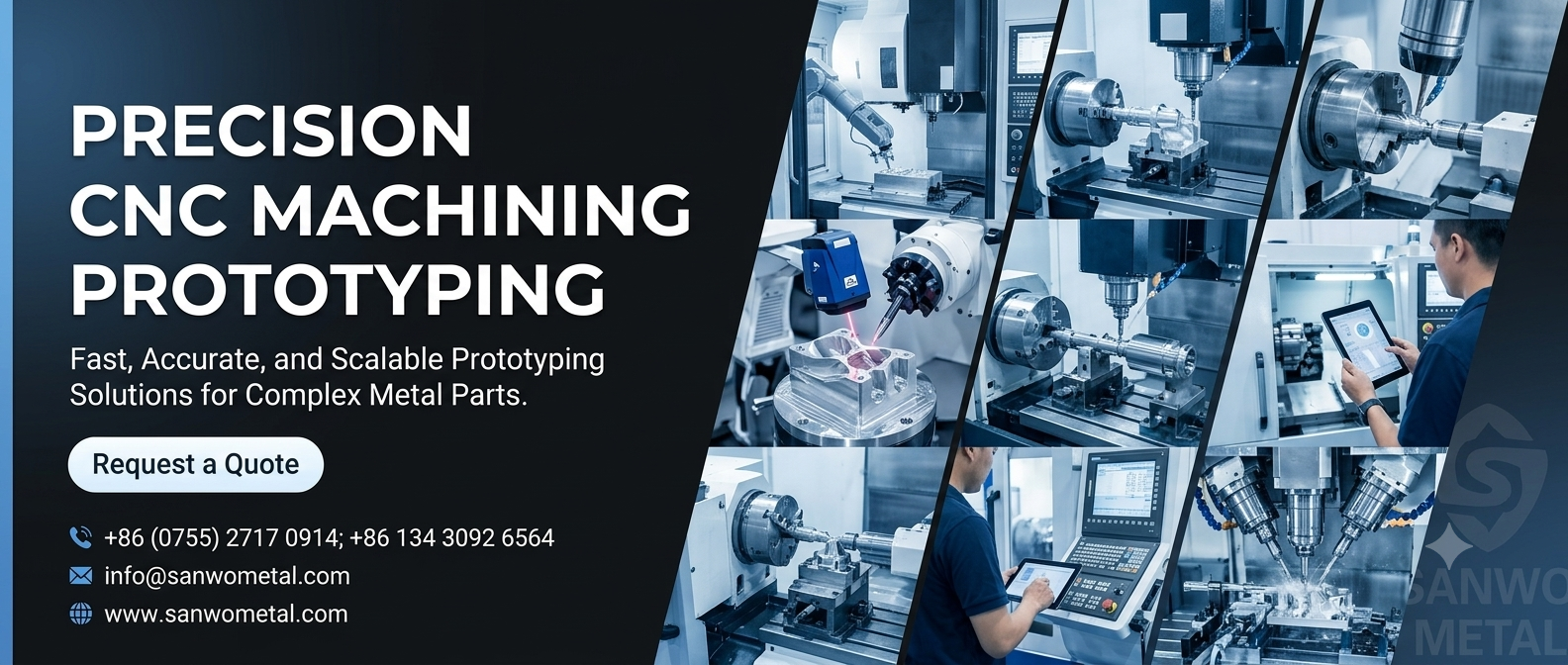
In today’s competitive manufacturing industry, companies need faster, more accurate, and cost-effective solutions to transform ideas into functional products. CNC Machining Prototyping has become one of the most reliable methods for creating high-quality prototypes that help engineers, designers, and manufacturers test concepts before full-scale production. By using advanced computer-controlled machining technology, businesses can achieve exceptional accuracy, repeatability, and flexibility during product development. SanwoMetal provides professional CNC machining solutions that support startups, engineers, and industries in developing precise prototypes and production-ready components.
What Is CNC Machining Prototyping?
CNC Machining Prototyping is the process of manufacturing prototype parts using Computer Numerical Control (CNC) machines. Unlike traditional manual machining methods, CNC machines operate through programmed instructions created from CAD (Computer-Aided Design) models. This allows manufacturers to produce complex geometries, tight tolerances, and detailed components with consistent quality.
The main purpose of prototype machining is to evaluate product designs, identify potential issues, test functionality, and make improvements before investing in mass production. Industries such as aerospace, automotive, medical devices, electronics, and industrial equipment rely heavily on CNC prototypes to reduce development risks and improve time-to-market.
Why CNC Machining Prototyping Is Important for Product Development
Developing a new product involves multiple stages, including design, testing, modification, and final manufacturing. A physical prototype allows engineers to analyze real-world performance instead of relying only on digital simulations.
Key advantages of CNC machining prototyping include:
- High Precision and Accuracy: CNC machines can achieve tight tolerances, making them suitable for complex and demanding applications.
- Fast Production Time: Rapid machining processes help companies create functional prototypes quickly.
- Material Flexibility: CNC machining supports various materials, including aluminum, stainless steel, titanium, brass, plastics, and engineering composites.
- Design Validation: Physical prototypes help identify design flaws before large-scale production.
- Cost Reduction: Early testing minimizes expensive mistakes during final manufacturing.
By using CNC prototype machining, businesses can improve product reliability while reducing overall development expenses.
How CNC Machining Prototyping Works
The CNC prototyping process involves several important steps:
1. CAD Design Preparation
The process begins with a digital 3D model created using CAD software. Engineers define dimensions, shapes, and technical requirements according to product specifications.
2. CNC Programming
The CAD model is converted into CNC machine instructions using CAM software. These instructions control cutting paths, tool movements, speed, and machining operations.
3. Material Selection
Selecting the right material is essential for prototype performance. Aluminum is commonly used because it provides excellent strength, lightweight properties, and easy machinability.
4. Machining Process
The CNC machine removes material from a workpiece through milling, turning, drilling, or other machining operations. Advanced machines can create highly detailed components with consistent accuracy.
5. Quality Inspection
After machining, prototypes undergo inspection processes to verify dimensions, surface finish, and overall functionality.
CNC Machining Prototyping vs Traditional Prototyping
| Feature | CNC Machining Prototyping | Traditional Prototyping |
| Accuracy | Extremely high precision | Limited accuracy |
| Material Options | Wide range of metals and plastics | Often restricted |
| Production Speed | Faster for functional parts | Can require more time |
| Surface Quality | Professional-grade finish | May require additional processing |
| Functional Testing | Suitable for real-world testing | Often limited |
CNC machining provides a production-like prototype that closely represents the final manufactured product.
Applications of CNC Machining Prototyping
CNC prototypes are used across many industries because of their reliability and versatility.
Aerospace Industry
Aerospace manufacturers require lightweight and highly precise components. CNC machining helps create prototype parts for testing aircraft systems and structural components.
Automotive Manufacturing
Automotive companies use CNC prototypes to test engine components, interior parts, and performance-related designs before production.
Medical Equipment
Medical device manufacturers depend on precision machining to develop surgical tools, implants, and diagnostic equipment with strict quality requirements.
Electronics Industry
CNC machining supports the development of enclosures, heat sinks, connectors, and other electronic components.
Benefits of Choosing SanwoMetal for CNC Prototype Manufacturing
Choosing the right manufacturing partner plays a major role in prototype success. SanwoMetal focuses on delivering reliable CNC machining services with advanced technology, professional expertise, and strict quality control.
Benefits include:
- Advanced CNC machining capabilities
- Support for complex prototype designs
- High-quality material options
- Accurate dimensional inspection
- Fast turnaround times
- Professional engineering support
With experience in precision manufacturing, SanwoMetal helps businesses move from concept development to successful production efficiently.
CNC Machining Prototyping and Low Volume Production
Many companies require more than just a single prototype. After successful testing, they often move toward small-batch manufacturing. CNC machining is ideal for this transition because the same equipment and processes can support both prototype development and low volume production.
This approach allows businesses to maintain quality consistency while producing limited quantities for market testing, customer feedback, or specialized applications. It reduces the need for expensive tooling investments and provides greater flexibility compared with traditional manufacturing methods.
Future Trends in CNC Machining Prototyping
The future of CNC prototyping is being shaped by automation, artificial intelligence, and smart manufacturing technologies. Modern CNC systems are becoming faster, more intelligent, and easier to integrate with digital production environments.
Important trends include:
- AI-assisted machining optimization
- Automated quality inspection systems
- Cloud-based manufacturing platforms
- Advanced multi-axis machining capabilities
- Sustainable manufacturing practices
These developments will continue improving efficiency and precision in prototype manufacturing.
Frequently Asked Questions About CNC Machining Prototyping
1. What is CNC Machining Prototyping?
CNC Machining Prototyping is a manufacturing method that uses computer-controlled machines to create accurate prototype parts from digital designs.
2. How long does CNC prototype machining take?
The production time depends on part complexity, material, design requirements, and quantity. Simple prototypes can often be completed quickly, while complex parts require more processing time.
3. What materials can be used for CNC prototypes?
Common materials include aluminum, stainless steel, titanium, brass, copper, plastics, and various engineering-grade materials.
4. Why is CNC machining better for prototypes?
CNC machining provides high accuracy, excellent surface finishes, material flexibility, and functional prototypes suitable for real-world testing.
5. Can CNC machining produce complex designs?
Yes. Advanced CNC machines can manufacture complicated geometries, detailed features, and precision components.
6. Is CNC prototyping suitable for small businesses?
Yes. CNC prototyping allows startups and small companies to test designs without investing in expensive production tooling.
7. What industries use CNC prototypes?
Industries including aerospace, automotive, medical, electronics, robotics, and industrial manufacturing use CNC prototypes.
8. What is the difference between CNC prototyping and 3D printing?
CNC machining removes material from a solid block, while 3D printing builds parts layer by layer. CNC usually provides stronger and more production-like parts.
9. Can CNC prototypes be used as final products?
In many cases, CNC-machined prototypes can also serve as end-use parts, especially for low-volume applications.
10. How does CNC machining reduce manufacturing costs?
CNC machining reduces costs by identifying design problems early, minimizing tooling requirements, and improving production efficiency.
Contact – +86 (0755) 2717 0914,+86 134 3092 6564
Email ID – info@sanwometal.com
Official Website – https://www.sanwometal.com/