
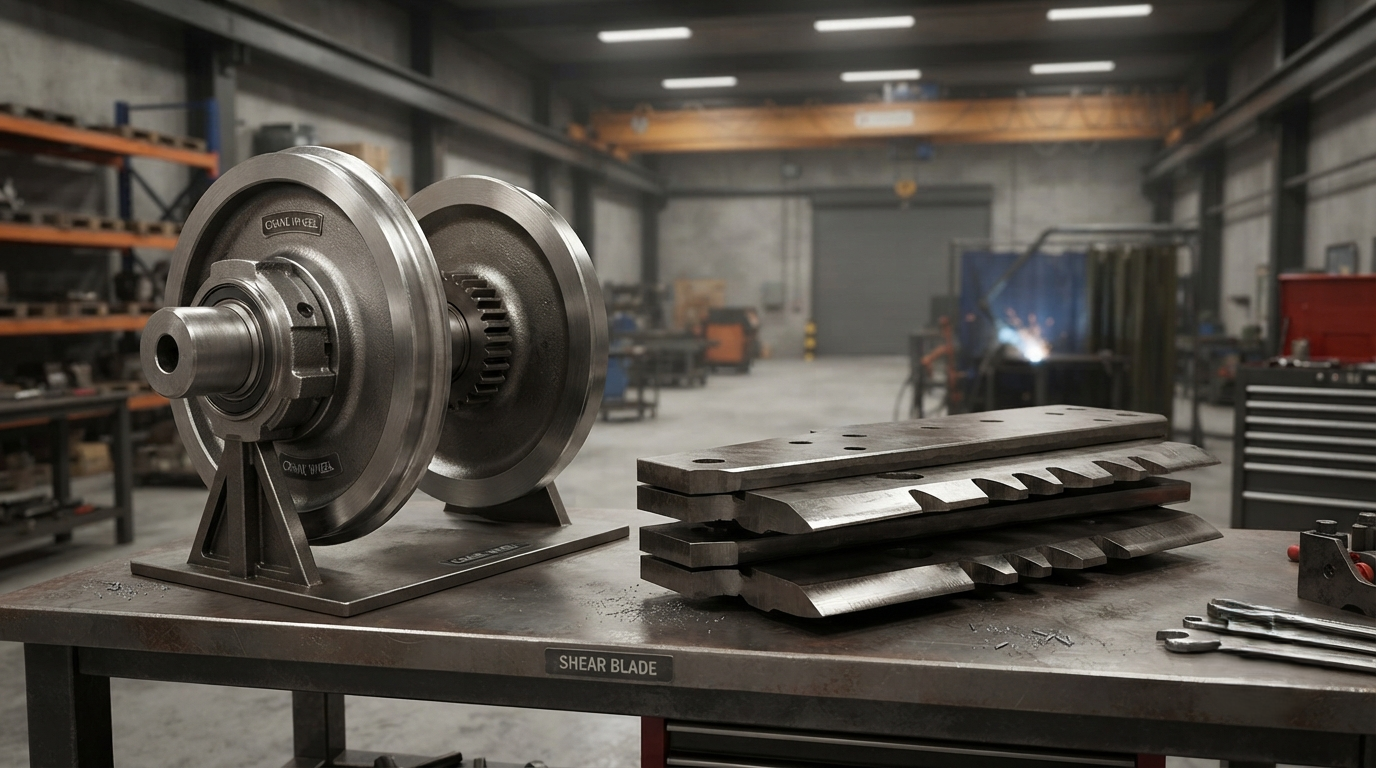
A Crane Wheel supports and guides cranes as they travel along rails, while a Shear Blade performs precision cutting of metal sheets, plates, bars, and other materials. Choosing the correct specification for each component can improve machine efficiency, minimize downtime, and extend equipment service life.
Understanding the Function of a Crane Wheel
A Crane Wheel is a heavy-duty mechanical component used in overhead cranes, gantry cranes, EOT cranes, transfer cars, and other rail-mounted equipment. Its main function is to carry the crane load while allowing smooth movement along a fixed rail.
Crane wheels operate under substantial pressure because they support the combined weight of the crane structure, lifting equipment, and transported material.
Important Crane Wheel Features
A reliable crane wheel normally offers:
- High load-bearing capacity
- Excellent wear resistance
- Accurate dimensional tolerances
- Smooth rolling performance
- Strong resistance to impact and fatigue
- Proper flange geometry
- High surface hardness
- Long operational life
Why Wheel Material Matters
Material selection directly affects wheel durability. Forged alloy steel and carbon steel are commonly preferred because they provide strength and resistance against repeated loading.
Heat treatment can further increase surface hardness while maintaining sufficient toughness inside the wheel.
Common Types of Crane Wheels
Different crane systems require different wheel configurations. Selecting the correct design depends on load capacity, rail dimensions, crane speed, operating conditions, and application.
Common varieties include:
- Single-flange crane wheels
- Double-flange crane wheels
- Flangeless wheels
- Forged crane wheels
- Cast crane wheels
- Heat-treated wheels
- Customized rail wheels
A properly engineered Crane Wheel reduces unnecessary vibration, rail wear, misalignment, and maintenance requirements.
What Is a Shear Blade?
A Shear Blade is an industrial cutting tool designed to cut metal and other materials through shearing action. These blades are widely installed in hydraulic shearing machines, guillotine machines, sheet metal processing equipment, rolling mills, fabrication plants, and steel service centers.
Unlike traditional cutting processes that remove material, shearing separates material through concentrated force between opposing cutting edges.
Key Characteristics of a Quality Shear Blade
An effective shear blade should provide:
- High cutting-edge hardness
- Good impact toughness
- Superior wear resistance
- Precise straightness
- Accurate blade geometry
- Resistance to chipping
- Stable performance during repeated cutting
Blade Hardness and Toughness
Hardness helps the cutting edge remain sharp, while toughness prevents cracking or premature failure. Manufacturers must maintain the correct balance between these characteristics through material selection and controlled heat treatment.
Materials Used for Shear Blades
The required Shear Blade material depends on the material being cut, production volume, sheet thickness, and machine operating conditions.
Common blade materials include:
| Material Type | Key Benefit | Typical Application |
| Carbon Tool Steel | Economical and easy to process | Light-duty cutting |
| Alloy Tool Steel | Better strength and wear resistance | General fabrication |
| D2 Tool Steel | Excellent hardness retention | High-volume sheet cutting |
| HSS | Superior cutting performance | demanding applications |
| Specialized Alloys | Customized durability | Heavy industrial processing |
Selecting a blade only according to hardness can be a mistake. Cutting conditions and impact loads must also be considered.
Crane Wheel vs Shear Blade
Although both products are used in industrial environments, their operating purposes are completely different.
| Feature | Crane Wheel | Shear Blade |
| Main Function | Supports crane movement | Cuts materials |
| Primary Stress | Rolling and compressive load | Cutting and impact load |
| Common Material | Forged or alloy steel | Tool and alloy steel |
| Major Concern | Wear and flange damage | Edge wear and chipping |
| Accuracy Requirement | Diameter and profile | Straightness and edge geometry |
Both components require precision engineering because even minor dimensional errors can affect equipment performance.
How to Select the Right Crane Wheel
Choosing an appropriate Crane Wheel requires more than matching its diameter.
Consider:
- Maximum crane load
- Wheel diameter
- Rail profile
- Wheel tread width
- Flange dimensions
- Shaft or bore dimensions
- Crane travel speed
- Operating temperature
- Duty cycle
- Material hardness
For heavy-duty applications, custom-engineered wheels may offer better reliability than standard designs.
How to Choose the Correct Shear Blade
Before purchasing a Shear Blade, understand the actual cutting application.
Important factors include:
- Type of material being cut
- Material thickness
- Required cutting accuracy
- Machine model
- Blade dimensions
- Cutting frequency
- Blade hardness
- Required surface finish
For continuous production, a higher-quality blade may reduce sharpening frequency and machine downtime.
Maintenance for Longer Service Life
Proper maintenance protects industrial components and reduces unexpected production interruptions.
For crane wheels, regularly inspect the tread, flange, bearings, rail alignment, and wheel diameter. Uneven flange wear may indicate crane skewing or rail alignment problems.
For shear blades, monitor cutting-edge condition and blade clearance. Incorrect clearance can increase burr formation, cutting force, blade wear, and material deformation.
Avoid continuing production with badly worn components because secondary machine damage can become significantly more expensive.
Benefits of Precision-Manufactured Components
Investing in accurately manufactured crane wheels and shear blades can provide:
- Improved equipment efficiency
- Reduced vibration
- Consistent production
- Lower maintenance expenses
- Better workplace reliability
- Longer component life
- Improved cutting quality
- Reduced unplanned downtime
Precision manufacturing becomes especially important in industries where equipment operates continuously under high loads.
Applications Across Different Industries
A Crane Wheel is commonly found in steel plants, warehouses, ports, manufacturing facilities, power plants, shipyards, foundries, construction facilities, and heavy engineering industries.
A Shear Blade is widely used in metal fabrication, automotive manufacturing, steel processing, machinery manufacturing, recycling, sheet metal workshops, and industrial production lines.
Their versatility makes both components important parts of modern manufacturing infrastructure.
Frequently Asked Questions
1. What is a Crane Wheel used for?
A Crane Wheel carries the crane load and enables controlled movement along crane rails.
2. Which material is best for crane wheels?
Forged carbon and alloy steels are commonly selected because of their strength, toughness, and wear resistance.
3. Why do crane wheel flanges wear?
Flange wear can result from rail misalignment, crane skewing, incorrect wheel alignment, or excessive side forces.
4. Can crane wheels be customized?
Yes. Diameter, flange profile, tread width, bore, hardness, and material can be manufactured according to equipment requirements.
5. What is a Shear Blade?
A Shear Blade is a precision cutting component used in machines that separate sheet metal or other materials through shearing force.
6. How long does a shear blade last?
Blade life depends on material grade, cutting material, thickness, machine settings, production frequency, and maintenance.
7. When should shear blades be sharpened?
Sharpening should be considered when cutting quality decreases, burrs increase, or greater cutting force becomes necessary.
8. Why is blade clearance important?
Correct clearance helps produce cleaner cuts while reducing blade stress, deformation, and premature wear.
9. Can shear blades cut stainless steel?
Yes, provided that the blade material, hardness, machine capacity, and clearance are suitable for stainless steel.
10. Are harder shear blades always better?
No. Excessive hardness without sufficient toughness may make blades vulnerable to cracking or chipping.
11. Why is heat treatment important?
Heat treatment improves hardness, wear resistance, strength, and fatigue performance when performed correctly.
12. Should industrial components be manufactured from drawings?
For specialized equipment, manufacturing according to technical drawings or verified samples helps ensure dimensional compatibility.