
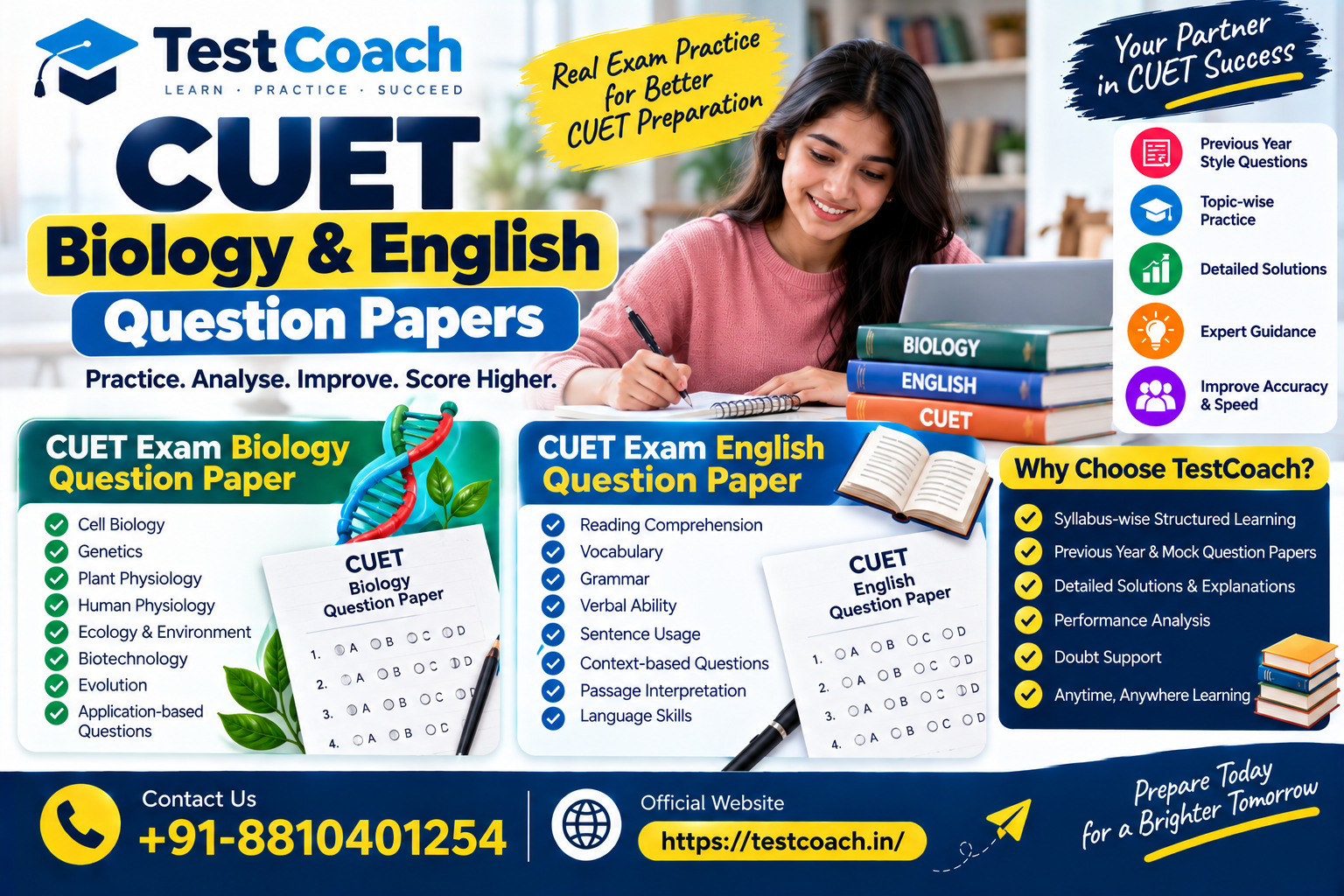
CUET preparation becoming more structured each year, students are increasingly turning to previous-style practice papers and mock questions to understand the nature of the examination. Two frequently searched resources are the cuet exam biology question paper and the cuet exam english question paper, both of which can help students evaluate their preparation, improve speed, and identify weak areas before the actual test.
Biology and English require very different preparation strategies. Biology demands conceptual clarity, accurate recall, and application of scientific knowledge, while English tests comprehension, vocabulary, grammar, and verbal ability. Students who combine syllabus-based study with question-paper practice can build a more balanced and exam-focused approach.
Why Practice with CUET Question Papers Matters
Practising exam-style questions can help students understand how well they are able to apply what they have studied.
A cuet exam biology question paper can reveal whether a student remembers key concepts accurately and can interpret application-based biology questions under time pressure.
Similarly, a cuet exam english question paper can show whether a candidate can read passages efficiently, understand vocabulary in context, and answer grammar or verbal-ability questions accurately.
Question-paper practice can help students improve:
- Speed
- Accuracy
- Time management
- Question selection
- Confidence
- Error recognition
Students should, however, ensure that their preparation remains aligned with the current official syllabus and test structure for their admission cycle.
Understanding the CUET Exam Biology Question Paper
Students preparing for biology should focus on concepts rather than memorising isolated facts.
A cuet exam biology question paper may test a candidate’s understanding of topics through objective questions that require quick recall and accurate interpretation.
Preparation can involve reviewing areas related to:
- Cell biology
- Genetics
- Human physiology
- Reproduction
- Ecology
- Evolution
- Biotechnology
- Plant physiology
- Biological processes
The exact syllabus and weight of topics can change, so candidates should verify the current official requirements before preparing a final study plan.
How to Prepare Biology Effectively
Biology preparation becomes more manageable when students divide the syllabus into smaller units.
A practical method is:
Concept learning → Short notes → Question practice → Revision → Mock testing
Students can create diagrams, tables, and comparison charts for complicated topics.
Biology also contains many terms that can be confused easily. Regular revision is therefore essential.
When solving a cuet exam biology question paper, students should mark every question they answer incorrectly and classify the mistake.
Was it caused by weak knowledge? Confusing terminology? Careless reading? Lack of revision?
The answer determines what needs to be fixed.
Focus on Accuracy in Biology
Biology often appears easy because many questions are factual, but similar-looking options can create confusion.
Students should avoid rushing.
Careful reading is particularly important for questions involving:
- Scientific terminology
- Biological processes
- Sequence-based concepts
- Genetics
- Classification
- Diagrams and interpretation
A strong biology score usually comes from combining recall with careful question analysis.
Understanding the CUET Exam English Question Paper
English preparation requires a different approach.
A cuet exam english question paper may assess how well students understand and use language rather than how much theory they can memorise.
Preparation may include:
- Reading comprehension
- Vocabulary
- Grammar
- Verbal ability
- Sentence usage
- Context-based meaning
- Language interpretation
Students should practise reading quickly without sacrificing understanding.
Reading Comprehension Strategy
Reading comprehension can consume significant time if students do not practise regularly.
Candidates should learn to identify:
- Main idea
- Supporting information
- Tone
- Context
- Inference
- Meaning of words
While solving a cuet exam english question paper, students should avoid repeatedly reading the entire passage for every question.
Instead, they can identify the relevant part of the passage and refer back strategically.
Regular timed reading practice can help improve efficiency.
Build Vocabulary Through Daily Practice
Vocabulary improves through repeated exposure.
Students can create a short vocabulary notebook containing:
- New words
- Meanings
- Synonyms
- Antonyms
- Example sentences
Reading newspapers, essays, editorials, and quality academic material can also strengthen vocabulary naturally.
Rather than memorising hundreds of words at once, students should revise smaller sets frequently.
Grammar Preparation for CUET English
Grammar should be understood as a system of language rules rather than a set of isolated tricks.
Candidates can revise common areas relevant to the current syllabus and practise them through objective questions.
If the same grammar mistake occurs several times in a cuet exam english question paper, students should return to the underlying rule before attempting more tests.
This prevents repeated errors.
How Biology and English Preparation Differ
Biology relies heavily on subject knowledge, while English depends more on language application.
For biology, students should focus on:
- Concept accuracy
- Revision
- Scientific terminology
- Application-based questions
For English, students should focus on:
- Reading speed
- Vocabulary
- Grammar
- Interpretation
This means students should not use the same preparation method for both papers.
Why Mock Testing Should Be Regular
Full-length mock tests can help students simulate exam pressure.
Students can use practice papers to monitor:
- Time spent
- Accuracy
- Number of attempted questions
- Careless mistakes
- Weak chapters
- Weak language areas
A cuet exam biology question paper can be used to test subject mastery, while a cuet exam english question paper can be used to measure reading and language efficiency.
The key is to review the test afterward.
Create an Error Analysis Sheet
After each practice test, students can create a simple error table with four columns:
- Question/topic
- Type of mistake
- Correct concept
- Revision needed
This allows preparation to become more targeted.
Students can also track whether the same mistakes are appearing repeatedly.
If they are, the problem is not lack of practice but incomplete understanding.
Time Management During the Exam
Time pressure can reduce performance even when preparation is strong.
Students should practise making quick decisions about whether to attempt, skip, or return to a question.
For biology, questions involving detailed recall may require careful reading.
For English, long passages can consume time if not approached strategically.
Timed practice helps students develop a more realistic exam rhythm.
Frequently Asked Questions
What is a CUET exam biology question paper?
A cuet exam biology question paper refers to a Biology practice or examination-style paper used to help students prepare for CUET-related biology testing.
What is a CUET exam English question paper?
A cuet exam english question paper contains English-language questions that may involve comprehension, vocabulary, grammar, verbal ability, and language usage.
Are previous-style question papers useful?
Yes. They can help students understand question patterns, identify weak areas, and improve time management.
How should I prepare for CUET Biology?
Study the official syllabus, revise concepts regularly, practise objective questions, and analyse mistakes after each test.
How should I prepare for CUET English?
Focus on reading comprehension, vocabulary, grammar, verbal ability, and timed practice.
Should I solve Biology questions daily?
Regular practice can be useful, especially when combined with revision and concept review.
How can I improve English comprehension speed?
Read regularly, practise timed passages, and learn to identify the main idea and supporting information quickly.
Are mock tests enough for preparation?
No. Mock tests should supplement concept learning, syllabus completion, revision, and topic-wise practice.
How should I analyse a question paper?
Review incorrect, skipped, and time-consuming questions and identify the reason behind each mistake.
Should students check the latest syllabus before practising?
Yes. Students should always verify current official syllabus and examination requirements because structures can change.
Common Mistakes Students Should Avoid
Students often solve multiple question papers without reviewing their errors.
Other common mistakes include:
- Depending only on memorisation
- Ignoring weak chapters
- Avoiding difficult English passages
- Practising without time limits
- Skipping revision
- Using outdated syllabus information
A smaller number of well-analysed practice tests can often be more valuable than many tests attempted without review.
A Better Preparation Strategy
Students can follow a simple four-stage cycle:
Study → Practise → Analyse → Improve
For biology, the focus should remain on conceptual accuracy and revision.
For English, the focus should remain on reading, vocabulary, grammar, and interpretation.
Using a cuet exam biology question paper and a cuet exam english question paper as part of this cycle can help students measure whether their preparation is actually improving.
Media Contact
Student & Media Enquiries
Contact: +91-8810401254
Official Website: https://testcoach.in/