
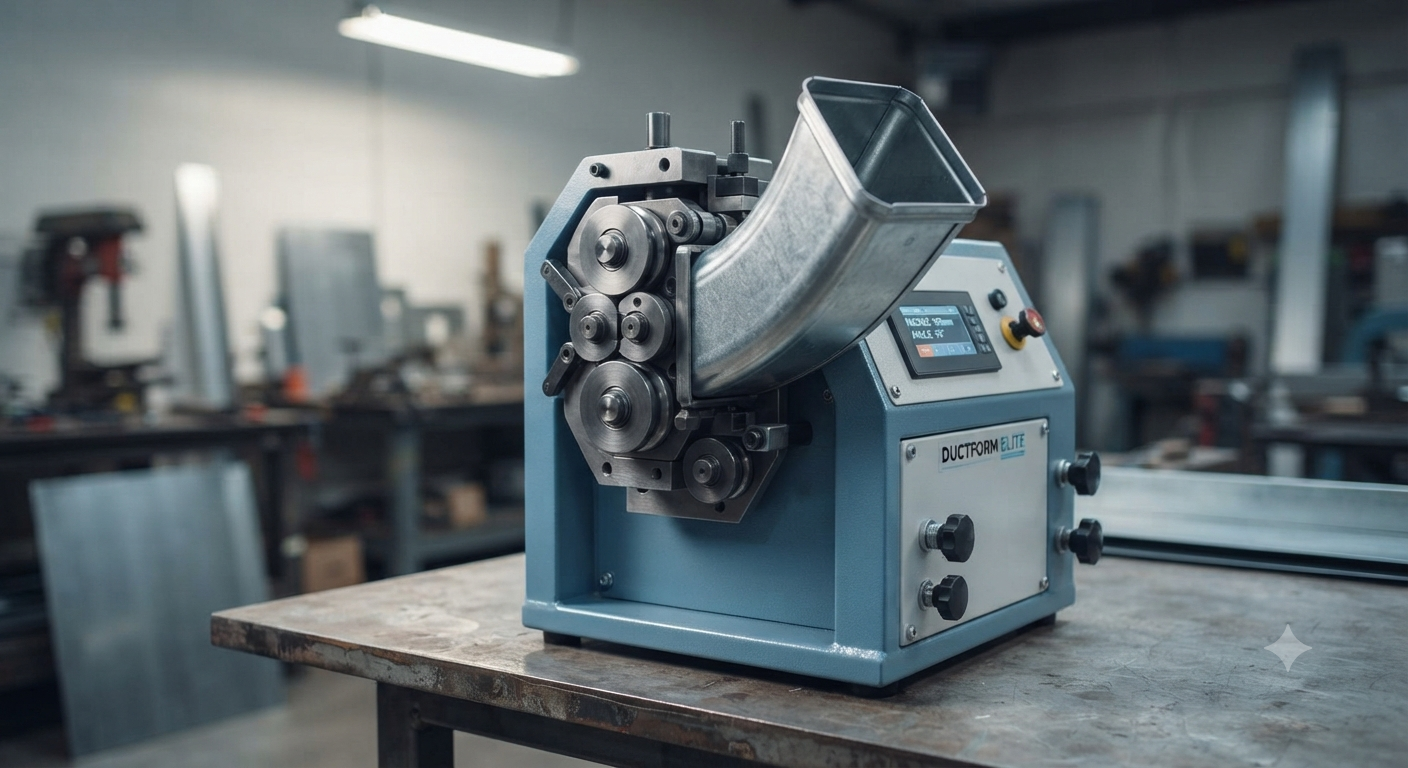
A duct elbow machine is a specialized piece of HVAC sheet metal equipment used to manufacture elbow sections for rectangular or round air ducts. These elbows change the direction of airflow in ventilation systems and are essential in commercial buildings, factories, hospitals, and large residential projects.
Modern duct fabrication shops use automated duct elbow machines to improve accuracy, reduce labor costs, and increase production speed.
Why Is a Duct Elbow Machine Important?
Elbows must be precisely formed to maintain smooth airflow and minimize pressure loss. Manual fabrication is time-consuming and often leads to inconsistent dimensions. A duct elbow machine solves these problems by producing uniform elbow segments with repeatable accuracy.
Main benefits
- Faster production of duct elbows
- Consistent quality and dimensions
- Reduced material waste
- Lower labor requirements
- Better airflow performance
- Compatibility with galvanized steel, stainless steel, and aluminum sheets
Types of Duct Elbow Machines
1. Rectangular duct elbow machine
Used for fabricating segmented elbows for rectangular ducts commonly found in commercial HVAC systems.
2. Round duct elbow machine
Designed for spiral and round duct fittings used in industrial ventilation and dust collection systems.
3. CNC automatic elbow machine
Advanced systems use CNC controls for automatic cutting, forming, and locking operations, making them ideal for high-volume production.
How Does It Work?
The machine typically performs the following steps:
- Sheet feeding – Metal sheet is loaded into the machine.
- Cutting – The sheet is cut according to the required elbow size.
- Forming – The machine bends and shapes the elbow segments.
- Lock forming – Pittsburgh or snap locks are created for assembly.
- Output – Finished elbow pieces are ready for installation or further assembly.
Key Technical Specifications
| Feature | Typical Range |
| Sheet thickness | 0.5–1.2 mm |
| Material type | GI, SS, Aluminum |
| Production speed | 200–800 pcs/hour |
| Control system | PLC / CNC |
| Power requirement | 3–15 kW |
Manual vs Automatic Duct Elbow Machine
| Feature | Manual | Automatic |
| Initial cost | Low | High |
| Production speed | Slow | Fast |
| Labor requirement | High | Low |
| Accuracy | Moderate | High |
| Best for | Small workshops | Large factories |
Industries That Use Duct Elbow Machines
- HVAC contractors
- Industrial ventilation manufacturers
- Dust collection system suppliers
- Pharmaceutical plants
- Food processing facilities
- Commercial construction companies
Maintenance Tips
To ensure long service life:
- Lubricate moving parts regularly
- Keep rollers and forming dies clean
- Inspect electrical connections
- Calibrate the machine periodically
- Replace worn cutting blades on time
Frequently Asked Questions
1. What is a duct elbow machine used for?
It is used to manufacture elbow fittings that change the direction of airflow in duct systems.
2. Can it work with stainless steel?
Yes, most modern machines support stainless steel sheets.
3. What thickness can it handle?
Typically 0.5 mm to 1.2 mm, depending on the model.
4. Is CNC control necessary?
CNC is recommended for high-volume and precision production.
5. How much labor can it save?
Automatic machines can reduce manual labor by 50–70%.
6. What is the average production speed?
Around 200–800 pieces per hour.
7. Can it produce custom elbow angles?
Yes, many machines can produce 30°, 45°, 60°, and 90° elbows.
8. What materials are commonly used?
Galvanized steel, stainless steel, and aluminum.
9. Is training required?
Basic operator training is usually sufficient for PLC models.
10. How long does a duct elbow machine last?
With proper maintenance, it can operate efficiently for 10–15 years or more.