
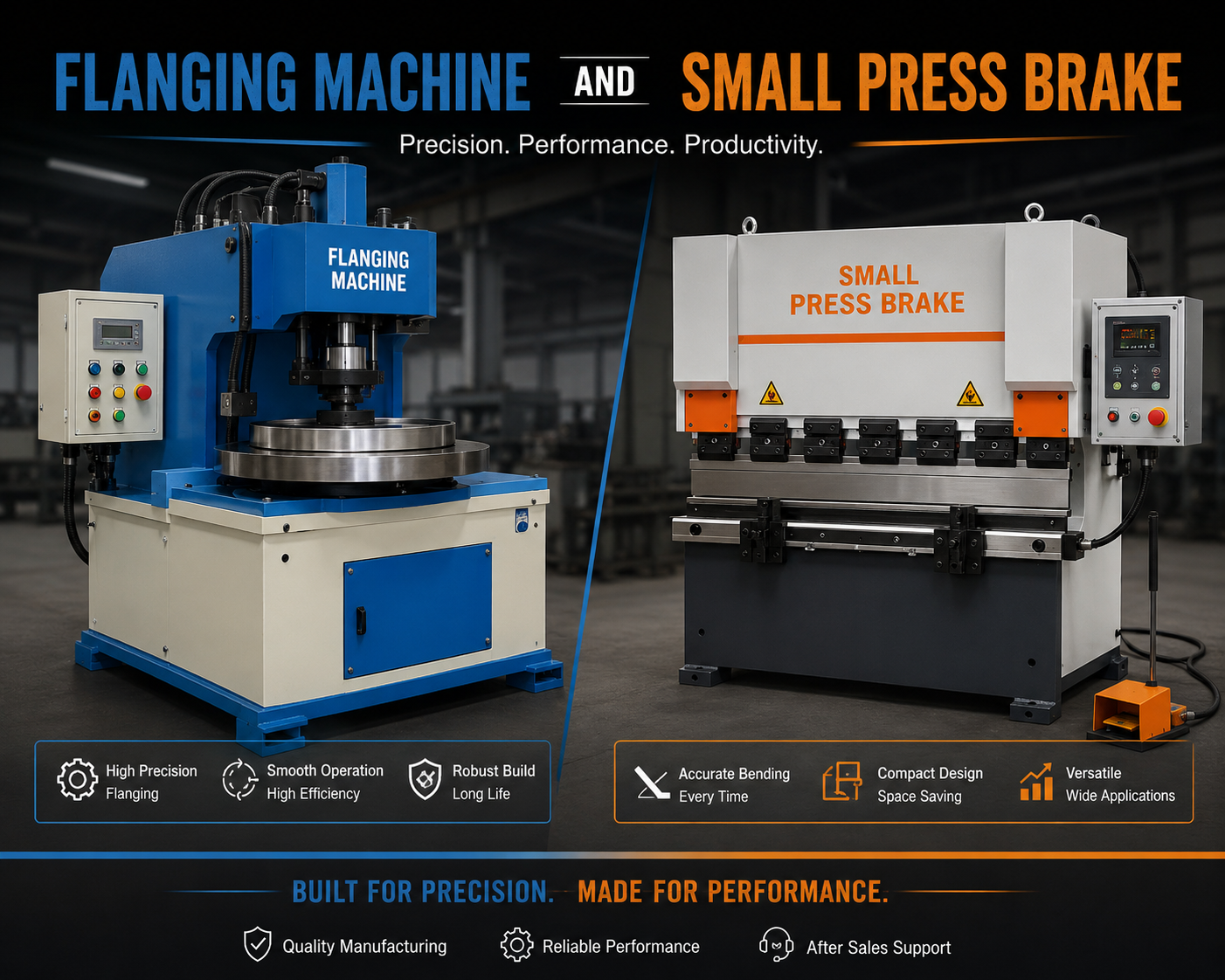
The modern manufacturing industry relies heavily on precision sheet metal fabrication to produce durable, accurate, and high-quality components. Among the most important machines used in this process are the Flanging machine and the small press brake. These machines help manufacturers create bends, flanges, edges, and complex metal profiles used in industries such as automotive, construction, aerospace, electrical equipment, HVAC systems, furniture manufacturing, and industrial engineering.
As production demands continue to grow, businesses are investing in efficient, compact, and high-performance machinery that delivers consistent results while minimizing production costs. Both a Flanging machine and a small press brake play an essential role in improving productivity, reducing material waste, and ensuring dimensional accuracy.
What Is a Flanging Machine?
A Flanging machine is a specialized metalworking machine designed to create flanges or raised edges on metal sheets, tubes, and cylindrical components. Flanging improves the strength, rigidity, and assembly capability of metal parts while also providing smooth edges for welding or fastening.
Flanging is widely used in manufacturing processes where precision and structural integrity are critical.
Primary Applications
- Sheet metal fabrication
- Pressure vessel manufacturing
- HVAC duct production
- Automotive body components
- Stainless steel tanks
- Industrial enclosures
- Electrical cabinets
- Aerospace components
Understanding a Small Press Brake
A small press brake is a compact bending machine used to accurately bend sheet metal into various shapes and angles. It operates using precision tooling and controlled force to create consistent bends without damaging the material.
Unlike larger industrial press brakes, compact models are ideal for workshops, prototype development, educational institutions, and small manufacturing businesses where space and flexibility are important.
Common Applications
- Metal brackets
- Electrical panels
- Control boxes
- Furniture frames
- Kitchen equipment
- Signage fabrication
- Precision engineering parts
- Custom metal products
How a Flanging Machine Works
The flanging process involves forming a raised edge along the metal surface using specially designed rollers or dies.
Basic Working Process
- Position the metal workpiece.
- Secure it using clamps or fixtures.
- Apply controlled forming pressure.
- Roll or press the flange to the desired angle.
- Inspect the finished flange for dimensional accuracy.
This process produces clean, uniform edges suitable for welding, assembly, or structural reinforcement.
Working Principle of a Small Press Brake
A small press brake bends metal by pressing the workpiece between a punch and die.
Typical Operating Steps
- Select the appropriate punch and die.
- Place the sheet metal accurately.
- Program or adjust the bending angle.
- Apply controlled pressure.
- Remove and inspect the finished component.
Modern machines provide excellent repeatability for both simple and complex bends.
Advantages of Using a Flanging Machine
Manufacturers choose a Flanging machine because it improves production quality while reducing manual labor.
Major Benefits
- High dimensional accuracy
- Strong and consistent flange formation
- Faster production cycles
- Reduced material waste
- Improved product durability
- Better welding preparation
- Suitable for mass production
- Minimal operator fatigue
Benefits of a Small Press Brake
A small press brake offers versatility and precision for businesses with limited production space.
Key Advantages
- Compact footprint
- Easy installation
- Lower operating costs
- High bending accuracy
- User-friendly operation
- Ideal for custom fabrication
- Energy-efficient performance
- Suitable for prototype production
Flanging Machine vs Small Press Brake
| Feature | Flanging Machine | Small Press Brake |
| Primary Function | Forms flanges and raised edges | Bends sheet metal |
| Typical Products | Cylindrical parts, ducts, tanks | Brackets, cabinets, frames |
| Precision | High | Very High |
| Material Handling | Sheets, tubes, cylinders | Mainly flat sheet metal |
| Production Speed | Fast | Moderate to Fast |
| Best For | Edge strengthening | Precision bending |
Industries That Use These Machines
Both machines are widely adopted across multiple manufacturing sectors.
Major Industries
- Automotive manufacturing
- Aerospace engineering
- Construction equipment
- HVAC manufacturing
- Electrical enclosure production
- Metal furniture manufacturing
- Shipbuilding
- Industrial machinery
- Agricultural equipment
- Renewable energy systems
Factors to Consider Before Buying
Selecting the right equipment depends on production requirements and long-term business goals.
Important Buying Factors
- Material thickness capacity
- Machine size
- Production volume
- Automation features
- Power consumption
- Tooling compatibility
- Maintenance requirements
- Safety features
- Manufacturer support
- Warranty availability
Maintenance Tips for Long-Term Performance
Proper maintenance ensures consistent productivity and extends machine lifespan.
Recommended Practices
- Lubricate moving components regularly.
- Inspect hydraulic systems.
- Clean machine surfaces after each shift.
- Replace worn tooling promptly.
- Check alignment periodically.
- Tighten loose fasteners.
- Follow manufacturer maintenance schedules.
- Train operators on proper usage.
Latest Trends in Sheet Metal Fabrication
The fabrication industry is rapidly embracing advanced manufacturing technologies.
Emerging Developments
- CNC-controlled flanging systems
- Servo-electric press brakes
- Automated tooling changes
- AI-assisted production monitoring
- Energy-efficient hydraulic systems
- Smart manufacturing integration
- Industry 4.0 connectivity
- Digital quality inspection systems
Frequently Asked Questions (FAQs)
1. What is a Flanging machine used for?
A Flanging machine forms raised edges or flanges on metal sheets and cylindrical components to improve strength and facilitate assembly.
2. What is a small press brake?
A small press brake is a compact machine used for precision bending of sheet metal.
3. Which industries commonly use these machines?
Automotive, aerospace, HVAC, construction, furniture, and electrical manufacturing industries.
4. Can a small press brake handle stainless steel?
Yes, provided the material thickness is within the machine’s rated capacity.
5. Is a Flanging machine suitable for mass production?
Yes. It is widely used in high-volume manufacturing operations.
6. Are compact press brakes accurate?
Modern compact press brakes offer excellent bending precision and repeatability.
7. How often should machines be serviced?
Routine inspections should be performed regularly, with preventive maintenance following the manufacturer’s recommendations.
8. What materials can be processed?
Steel, stainless steel, aluminum, copper, brass, and other sheet metals.
9. Are CNC versions available?
Yes. Many manufacturers offer CNC-controlled flanging machines and small press brakes for enhanced automation.
10. How do I choose the right machine?
Consider production volume, material type, thickness, available workspace, automation needs, and budget before purchasing.