
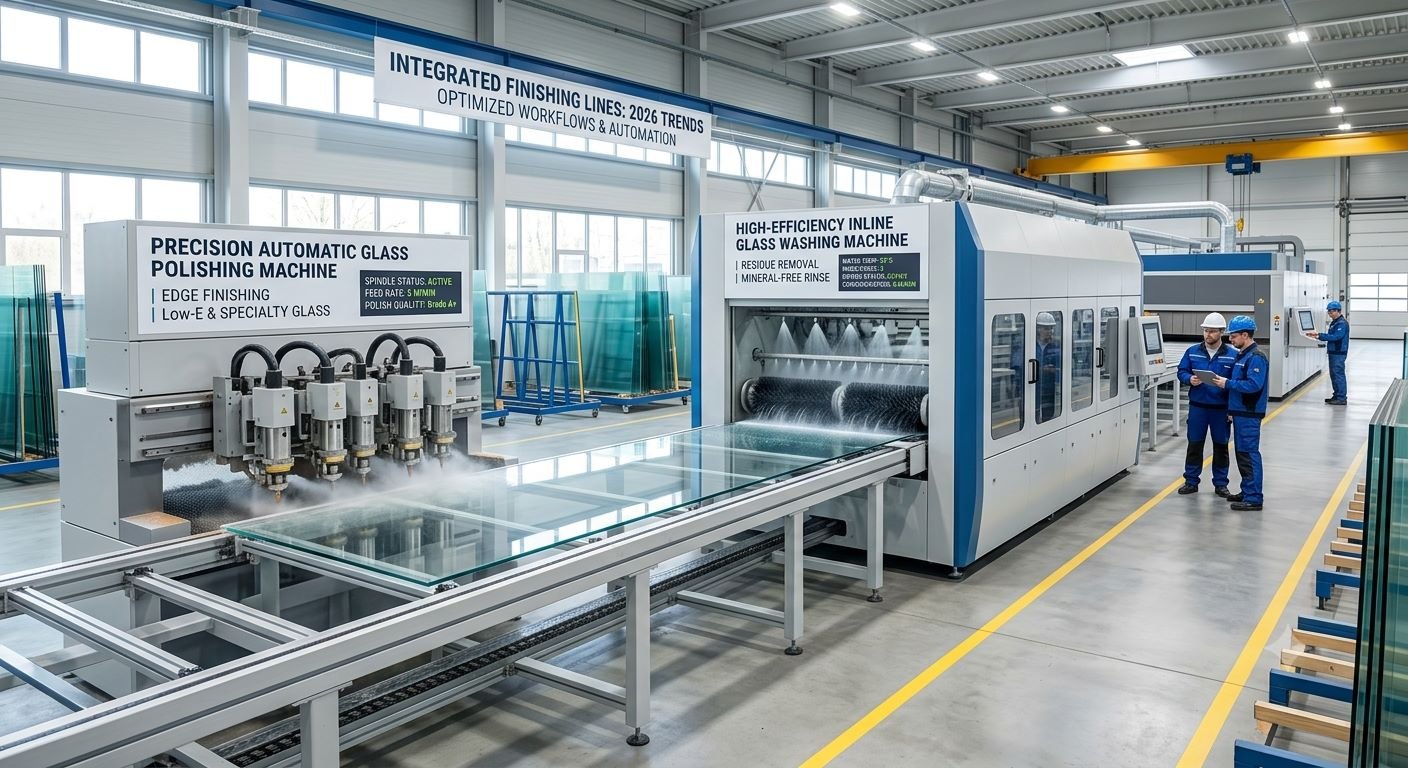
Whether a factory produces architectural glass, mirrors, furniture glass, shower enclosures, automotive panels, or decorative products, the glass polishing machine and glass washing machine are central to finishing. Together, they reduce defects and prepare glass for further processing.
What Is a Glass Polishing Machine?
A glass polishing machine smooths, refines, and finishes glass edges or surfaces after cutting, grinding, drilling, or shaping. Freshly cut glass may have rough edges, chips, scratches, or uneven sections. Polishing removes these imperfections and creates a safer, cleaner finish.
Depending on the application, the machine may process straight, beveled, curved, or shaped edges. Industrial models often combine grinding and polishing stations for a uniform glossy finish.
Benefits include:
- Smooth and uniform edges
- Better appearance
- Reduced sharp-edge risk
- Improved dimensional accuracy
- Higher finished-product value
- Better preparation for further processing
Diamond wheels are commonly used for grinding, while specialized polishing wheels refine the final edge. Water cooling controls heat, removes particles, and protects tools.
How a Glass Polishing Machine Works
Glass enters through a conveyor or feeding section. Coarser grinding wheels remove irregularities first. Finer wheels refine the edge, and polishing wheels create a smooth, bright surface.
Automatic systems can control feed speed, wheel pressure, thickness, and processing sequence, helping factories achieve repeatable quality and higher output.
Typical components include conveyors, spindles, polishing wheels, cooling systems, controls, and safety guards.
What Is a Glass Washing Machine?
A glass washing machine removes dust, cutting oil, fingerprints, grinding residue, polishing compound, and other contaminants from glass surfaces. Clean glass is essential before tempering, laminating, coating, printing, insulating, assembly, or packaging.
Industrial washers clean both sides of the sheet using rinsing, brushes, water sprays, and air drying.
Main advantages include:
- Cleaner, consistent surfaces
- Better coating or lamination adhesion
- Reduced contamination-related rejection
- Faster cleaning than manual methods
- Improved visual inspection
- Reliable preparation for downstream processes
Cleanliness is important in laminated and insulated glass because trapped dust may remain visible.
How a Glass Washing Machine Works
Glass moves into the washer through rollers or a conveyor. Spray nozzles apply water, while rotating brushes loosen dirt from both surfaces. Rinse sections carry away remaining particles. Air knives or blowers then remove moisture before the glass exits.
Advanced machines may use demineralized water, filtration, variable-speed drives, stainless-steel parts, and automated controls.
A glass washing machine usually contains brushes, tanks, pumps, filters, rollers, air knives, blowers, and controls. Cleaning quality depends on water purity, brush condition, and drying efficiency.
Glass Polishing Machine vs Glass Washing Machine
| Feature | Glass Polishing Machine | Glass Washing Machine |
| Primary purpose | Smooths and finishes glass | Cleans and dries glass |
| Main process | Grinding and polishing | Washing and air drying |
| Main tools | Abrasive and polishing wheels | Brushes, spray jets, air knives |
| Removes | Roughness, chips, edge marks | Dust, oil, residue, fingerprints |
| Typical stage | After cutting or edging | Before further processing or packing |
| Final result | Smooth, safe glass | Clean, contamination-free glass |
These machines complement each other. A glass polishing machine improves physical finishing, while a glass washing machine prepares clean surfaces for the next manufacturing step.
How to Choose the Right Machine
Buying decisions should reflect production needs rather than price alone. Evaluate glass dimensions, thickness range, daily volume, automation, energy use, and supplier support.
Important factors include:
- Minimum and maximum glass size
- Supported thickness range
- Processing speed
- Power and water consumption
- Wheel or brush configuration
- Automation functions
- Spare-parts availability
- Maintenance requirements
- Safety features
- Production-line compatibility
High-volume factories may benefit from automatic machines, while smaller workshops may prefer semi-automatic equipment.
Maintenance and Best Practices
Regular maintenance improves machine life and protects glass quality. Inspect wheels, brushes, rollers, filters, pumps, and air systems according to manufacturer recommendations.
On a glass polishing machine, worn or misaligned wheels can cause uneven edges, scratching, vibration, or poor shine. Correct cooling flow is also important.
On a glass washing machine, dirty brushes, contaminated water, blocked nozzles, or weak drying can leave streaks and particles. Tanks and filters should therefore be cleaned regularly.
Correct setup reduces breakage, saves consumables, and improves repeatability.
Frequently Asked Questions
1. What does a glass polishing machine do?
It smooths and finishes glass edges or surfaces after cutting and grinding.
2. Why is glass washing important?
It removes contaminants that may affect coating, laminating, printing, or appearance.
3. Can glass be washed after polishing?
Yes. Washing after polishing removes residue and fine particles.
4. Which industries use these machines?
Architectural, furniture, mirror, automotive, appliance, and decorative glass industries use them.
5. Is automatic washing better than manual cleaning?
For industrial production, automation usually provides faster, more repeatable cleaning.
6. What water is suitable for glass washing?
Filtered or demineralized water is preferred when spot-free cleanliness is important.
7. When should polishing wheels be replaced?
Replace them when wear affects finish quality, accuracy, or safe operation.
8. Why does washed glass have streaks?
Possible causes include dirty brushes, poor water quality, clogged nozzles, or weak drying.
9. Can one machine process different glass thicknesses?
Usually yes, within the range specified by the manufacturer.
10. Are both machines necessary?
Many production lines benefit from both because polishing improves finish and washing ensures cleanliness.