
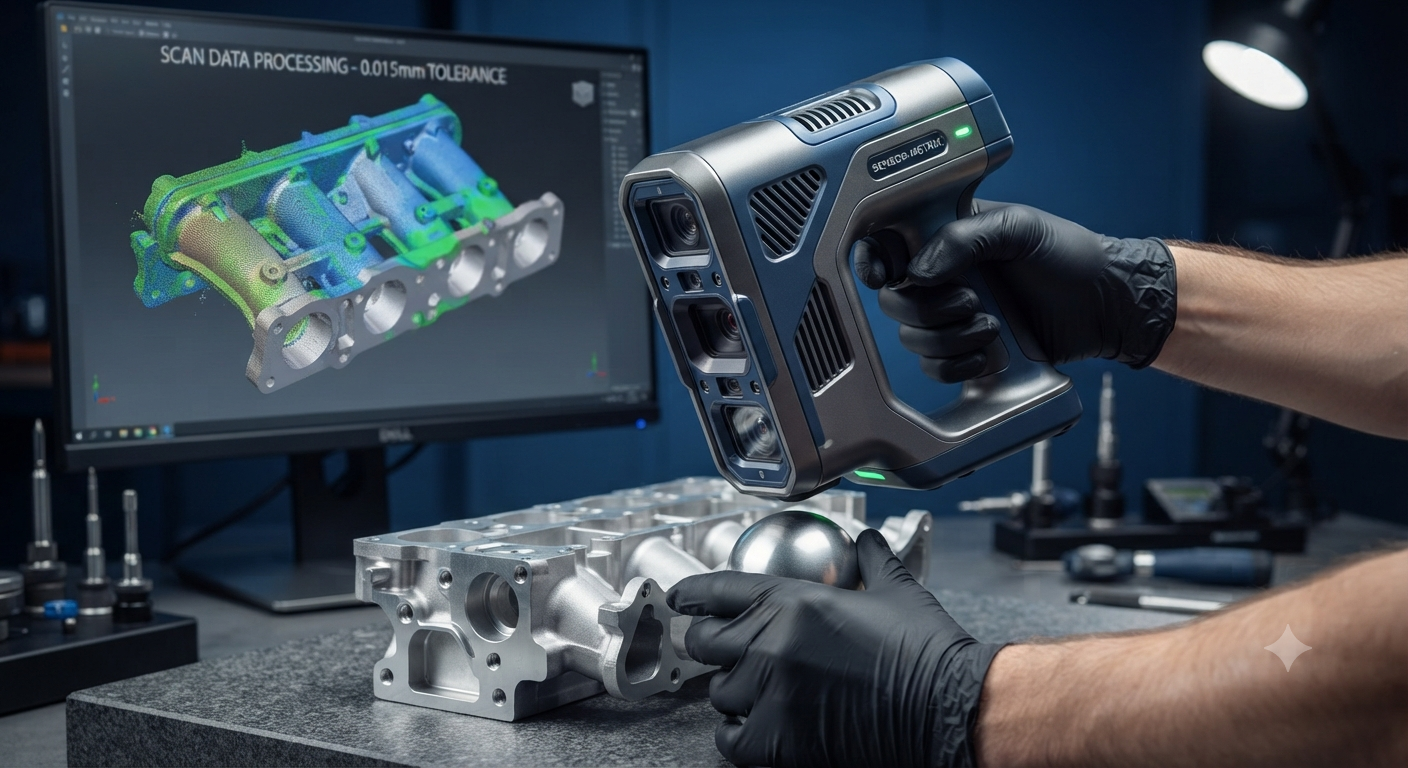
As industries continue to adopt smart manufacturing and Industry 4.0 technologies, the industrial 3d scanner has become an essential tool for capturing accurate measurements, inspecting complex components, and accelerating product development. Modern manufacturers depend on digital scanning solutions to improve production efficiency, reduce errors, and maintain strict quality standards across every stage of the manufacturing process.
Whether used in automotive production, aerospace engineering, medical device manufacturing, electronics, or heavy industry, an industrial 3d scanner delivers the precision and speed required for today’s competitive manufacturing environment.
What Is an Industrial 3D Scanner?
An industrial 3d scanner is a high-precision optical measurement system that creates detailed three-dimensional digital models of physical objects. Using technologies such as structured light, laser scanning, blue light projection, or photogrammetry, the scanner captures millions of surface data points to generate highly accurate digital representations.
These digital models can then be used for inspection, reverse engineering, product development, CAD comparison, dimensional analysis, and quality assurance.
Why Manufacturers Choose an Industrial 3D Scanner
The demand for the industrial 3d scanner continues to increase because manufacturers require faster inspection processes without compromising accuracy.
Key advantages include:
- High-speed digital measurement
- Exceptional dimensional accuracy
- Non-contact inspection
- Reduced manual measurement errors
- Faster product development
- Improved production quality
- Efficient reverse engineering
- Support for automated manufacturing
These benefits enable companies to improve productivity while reducing operational costs.
How an Industrial 3D Scanner Works
A modern industrial 3d scanner uses advanced optical sensors to capture detailed geometric information from an object’s surface.
The scanning process typically includes:
- Positioning the component for inspection.
- Projecting structured light or laser patterns onto the surface.
- Capturing multiple images from different angles.
- Creating a dense digital point cloud.
- Generating a high-resolution 3D mesh.
- Comparing the digital model with CAD files or engineering specifications.
This workflow delivers accurate digital data suitable for engineering, manufacturing, and quality control applications.
Key Features of an Industrial 3D Scanner
Selecting the right industrial 3d scanner requires evaluating performance, flexibility, and software capabilities.
Important features include:
- High measurement accuracy
- Fast scanning performance
- High-resolution image capture
- Portable and stationary options
- Automatic alignment technology
- CAD inspection compatibility
- Reverse engineering software support
- AI-assisted data processing
- Large scanning volume
- Durable industrial design
These features help manufacturers improve efficiency while ensuring reliable inspection results.
Applications of an Industrial 3D Scanner
The industrial 3d scanner supports a wide range of industrial applications.
Common uses include:
- Quality control inspection
- Reverse engineering
- Product design verification
- Prototype validation
- Tool and mold inspection
- Dimensional analysis
- Assembly verification
- Surface wear analysis
- Digital archiving
- Manufacturing process optimization
Its versatility makes it valuable throughout the complete product lifecycle.
Benefits of Using an Industrial 3D Scanner
Superior Measurement Accuracy
An industrial 3d scanner captures detailed surface information with remarkable precision, making it easier to detect dimensional deviations before products reach customers.
Increased Productivity
Automated digital scanning significantly reduces inspection time compared to manual measurement methods, improving production efficiency.
Lower Manufacturing Costs
Early defect detection helps minimize material waste, reduce rework, and prevent expensive production delays.
Improved Digital Collaboration
Digital scan files can be shared instantly with engineering teams, suppliers, and manufacturing partners, supporting faster product development and better communication.
Traditional Inspection vs Industrial 3D Scanner
| Feature | Traditional Inspection | Industrial 3D Scanner |
| Inspection Speed | Moderate | Very Fast |
| Measurement Accuracy | High | Exceptional |
| Contact with Object | Required | Non-Contact |
| Complex Geometry Analysis | Limited | Excellent |
| Digital Output | Basic | Complete 3D Model |
| Automation | Low | High |
| CAD Comparison | Limited | Fully Integrated |
Industries Using an Industrial 3D Scanner
The industrial 3d scanner is widely adopted across numerous industries.
Major users include:
- Automotive manufacturing
- Aerospace engineering
- Medical device production
- Electronics manufacturing
- Heavy machinery
- Plastic injection molding
- Metal fabrication
- Energy and power generation
- Shipbuilding
- Research and development
Its flexibility makes it an important technology for organizations focused on precision manufacturing.
How to Choose the Right Industrial 3D Scanner
Before purchasing an industrial 3d scanner, businesses should consider:
- Required measurement accuracy
- Object size and complexity
- Scanning speed
- Portability requirements
- Software compatibility
- Inspection workflow integration
- Technical support
- Calibration requirements
- Operating environment
- Total cost of ownership
Selecting the right system ensures long-term performance and maximum return on investment.
Future Trends in Industrial 3D Scanner Technology
Innovation continues to shape the future of the industrial 3d scanner.
Emerging developments include:
- Artificial intelligence-powered inspection
- Automated defect detection
- Robotic scanning systems
- Digital twin integration
- Cloud-connected quality management
- Predictive manufacturing analytics
- Higher scanning resolution
- Smart factory automation
These technologies will continue improving manufacturing efficiency, inspection accuracy, and production quality.