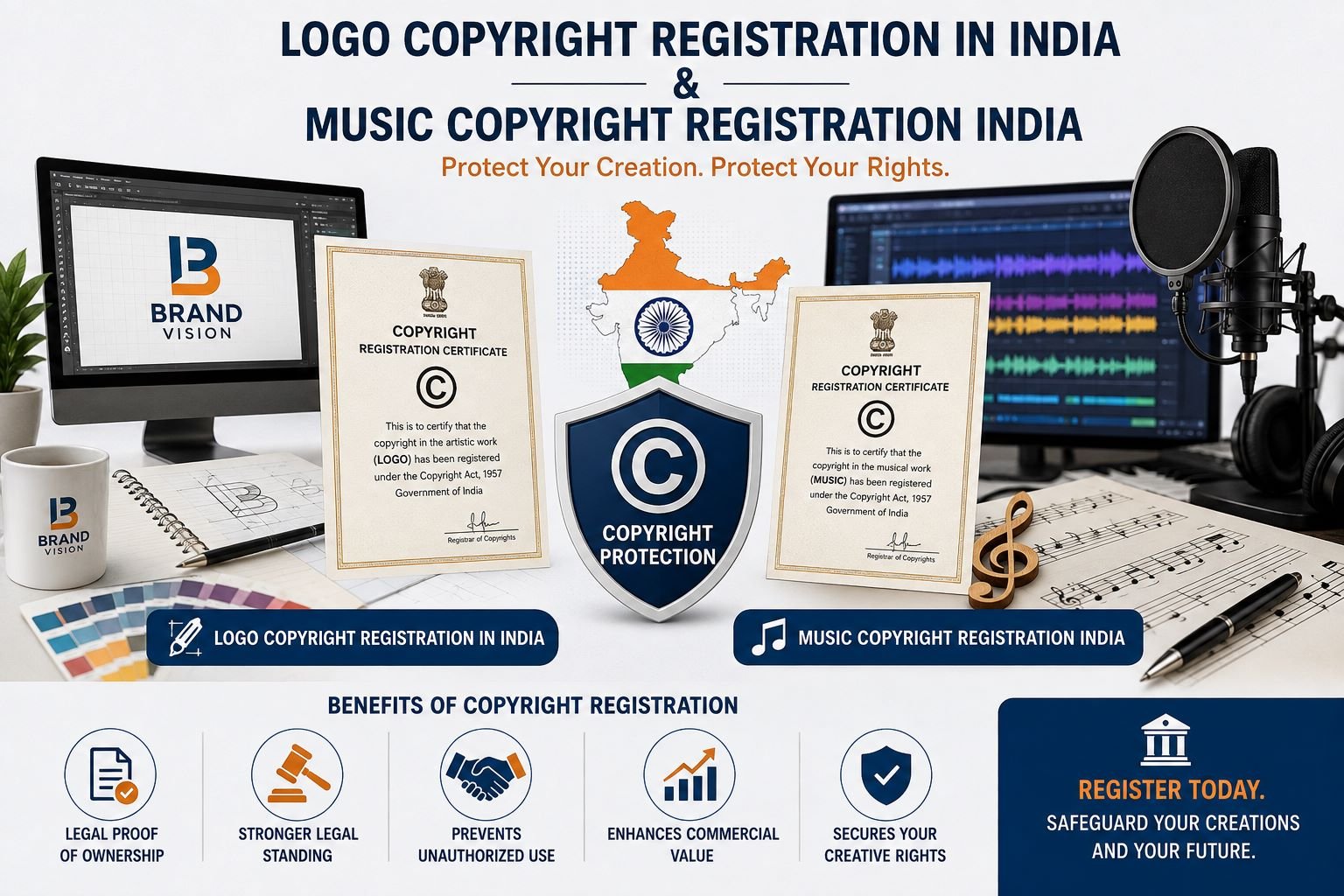
A logo can become the visual identity of a company, while a piece of music can develop into a valuable commercial asset used across streaming platforms, films, advertisements, social media, events and digital content. When creative work has business value, establishing clear ownership becomes increasingly important.
This is where Logo Copyright Registration in India and Music Copyright Registration India become relevant. Copyright law provides creators with rights over qualifying original works, while registration can create a useful official record of the work and the ownership claimed by the applicant.
For businesses, designers, musicians, composers, producers and content creators, understanding what copyright actually protects is the first step towards building a stronger intellectual property strategy.
Understanding Copyright Protection in India
Copyright is a form of intellectual property protection available to various original creative works. In India, copyright is principally governed by the Copyright Act, 1957 and associated rules.
An important point is that copyright protection does not normally begin only after registration. Eligible original work generally receives copyright protection when it is created. Registration, however, can provide valuable documentary evidence concerning authorship and ownership.
This makes registration particularly useful when creative work is commercially important, licensed to third parties or vulnerable to unauthorised reproduction.
What Does Logo Copyright Registration in India Protect?
Logo Copyright Registration in India is relevant when a logo contains sufficiently original artistic elements capable of copyright protection.
For example, a business may commission a designer to develop a distinctive graphical symbol incorporating original illustrations, shapes or artistic arrangements. The original artistic expression contained within that design may potentially receive copyright protection.
Copyright is concerned with the creative expression itself. It should not be confused with ownership of a business concept, marketing idea or general visual style.
For businesses, this distinction is important because logos often involve both copyright and trademark considerations.
Logo Copyright and Trademark Protection Are Different
A common mistake is assuming that registering copyright over a logo provides exactly the same protection as registering it as a trademark.
It does not.
| Area | Copyright Protection | Trademark Protection |
| Primary objective | Protect creative expression | Protect commercial brand identity |
| Logo relevance | Original artistic design | Brand/source identifier |
| Key concern | Unauthorised copying | Confusingly similar commercial use |
| Main legislation | Copyright Act, 1957 | Trade Marks Act, 1999 |
| Typical users | Artists, designers and copyright owners | Businesses and brand owners |
A creatively designed business logo can potentially involve both rights. Consequently, companies developing valuable brands may need to evaluate copyright and trademark protection separately rather than treating them as interchangeable.
Why Businesses Consider Logo Copyright Registration in India
A professional logo may appear on websites, packaging, advertisements, brochures, mobile applications, marketplaces, social media profiles and physical products.
As its visibility increases, so can the possibility of copying or unauthorised reuse.
Businesses consider Logo Copyright Registration in India because registration can help establish an official record relating to the work.
Potential benefits include:
- Creating formal documentation concerning the copyrighted work
- Supporting evidence of claimed ownership
- Strengthening intellectual property records
- Helping during licensing and commercial negotiations
- Providing useful documentation when addressing unauthorised copying
- Creating clearer records for future transfers or assignments
Registration should nevertheless be supported by proper ownership documentation.
Who Owns a Logo Created by a Designer?
This is an important issue that businesses sometimes overlook.
Imagine that a startup pays a freelance designer to create its logo. The company begins using the design immediately and assumes that payment automatically resolves every copyright ownership issue.
Copyright ownership can depend on authorship, contractual arrangements and applicable provisions of copyright law.
A well-drafted agreement should therefore clearly address:
- Who created the artwork
- Who will own the copyright
- Whether copyright is being assigned
- What rights are transferred
- Territory and duration where relevant
- Permitted commercial uses
Clarifying ownership before applying for registration can prevent complications later.
How Logo Copyright Registration in India Works
The copyright registration procedure generally starts with an application to the Copyright Office.
Applicants should first determine whether their logo qualifies as an artistic work and identify the correct author and copyright owner.
The broad procedure involves:
- Preparing the logo and ownership documents.
- Filing the appropriate copyright application.
- Providing the required particulars about the work.
- Uploading the artistic work.
- Submitting applicable supporting documents.
- Paying the prescribed government fee.
- Receiving a Diary Number.
- Completing examination and responding to objections or discrepancies, if any.
Where an artistic work is used or capable of being used in relation to goods or services, additional requirements involving the Trade Marks Registry can apply.
Documents to Prepare for Logo Copyright Registration
The exact documentation varies depending on the circumstances of the application.
Commonly relevant documents can include:
- Copy of the logo artwork
- Applicant’s particulars
- Author’s details
- Copyright owner’s information
- Assignment agreement, where applicable
- No-objection certificate where required
- Power of Attorney when filed through an authorised representative
- Publication details, where relevant
- Trade Marks Registry-related documentation where legally applicable
Businesses should ensure that names and ownership details remain consistent across the application and supporting agreements.
What Is Music Copyright Registration India?
Music Copyright Registration India is particularly relevant to composers, lyricists, musicians, producers, record labels and businesses that commercially exploit original music.
Music copyright is more complex than many people initially assume because a commercially released song can contain multiple intellectual property rights.
For instance, the composition, lyrics and final recorded track are not necessarily the same copyrighted work.
Understanding the Different Rights Inside a Song
Consider an original song created for a film.
One person may compose the melody. Another may write the lyrics. Singers and musicians may perform the song, while a producer or music company may control rights relating to the final sound recording.
The copyright structure may therefore involve:
- Musical work
- Literary work in the lyrics
- Sound recording
- Performers’ rights
- Contractual licensing or assignment rights
This distinction becomes extremely important when filing Music Copyright Registration India applications.
Musical Work Versus Sound Recording
The difference can be understood simply.
| Musical Work | Sound Recording |
| Protects the musical composition | Protects the recorded sounds |
| Associated primarily with the composer | May involve a producer as defined by law |
| Can exist before recording | Exists after sounds are recorded |
| Separate copyright category | Separate copyright category |
For example, composing an original melody creates a musical work. Recording that composition with instruments and vocals creates a sound recording that can involve separate rights.
Understanding exactly what is being registered prevents incorrect applications.
Why Music Copyright Registration India Is Important
Music can now travel globally within minutes through streaming services, social platforms, video-sharing websites and digital advertising.
That accessibility creates opportunities for creators, but it can also make unauthorised reproduction easier.
Music Copyright Registration India can provide creators and copyright owners with stronger documentation concerning their work.
It can also become useful when negotiating:
- Music licensing agreements
- Film and television usage
- Advertising rights
- Digital distribution
- Commercial performances
- Synchronisation arrangements
- Content partnerships
- Assignment or transfer agreements
Creators should establish ownership before entering significant commercial licensing arrangements.
How to Apply for Music Copyright Registration India
The applicant should first identify precisely what needs protection.
Is the application for the musical composition? Lyrics? A sound recording? Multiple separate works?
Once the category has been determined, the broad process involves preparing the application, entering authorship and ownership information, uploading the required work, providing supporting documentation and paying the applicable fee.
After filing, applicants should retain the Diary Number and monitor communications from the Copyright Office.
If discrepancies or objections arise, they should be addressed within the applicable procedure rather than ignored.
Common Mistakes Creators Should Avoid
Copyright applications can become complicated because of relatively simple errors.
Frequent problems include:
- Confusing a musical work with a sound recording
- Assuming one application automatically protects every element of a song
- Giving inconsistent author and owner details
- Failing to document copyright assignments
- Registering logo artwork without considering trademark-related requirements
- Assuming payment to a freelancer automatically resolves ownership
- Submitting incomplete supporting documents
- Ignoring Copyright Office communications
Proper preparation before filing is usually more efficient than correcting ownership problems afterwards.
Frequently Asked Questions
1. Is Logo Copyright Registration in India mandatory?
No. Eligible copyright generally arises automatically, but registration can provide valuable documentary evidence.
2. Can an original logo qualify for copyright?
Yes. Original artistic elements within a logo may qualify for copyright protection.
3. Is copyright the same as trademark registration?
No. Copyright protects eligible creative expression, while trademarks primarily protect commercial brand identifiers.
4. Can I obtain both copyright and trademark protection for my logo?
Potentially, yes, if the logo meets the applicable requirements under both legal frameworks.
5. What is Music Copyright Registration India?
It is the process of registering eligible musical or related copyrighted works with India’s Copyright Office.
6. Are song lyrics and music protected separately?
They can represent different categories of copyright-protected works.
7. Is a sound recording the same as a musical work?
No. A composition and the recording of sounds are distinct copyright categories.
8. Can unpublished creative work be registered?
Yes, copyright registration is available for qualifying published and unpublished works.
9. Who owns a commissioned logo?
Ownership depends on the circumstances, legal provisions and contractual arrangements. Written agreements are important.
10. Can copyright be transferred to another person or company?
Yes. Copyright can be assigned subject to applicable legal requirements.
https://newsgrow.blogspot.com/2026/08/logo-copyright-registration-in-india.html