
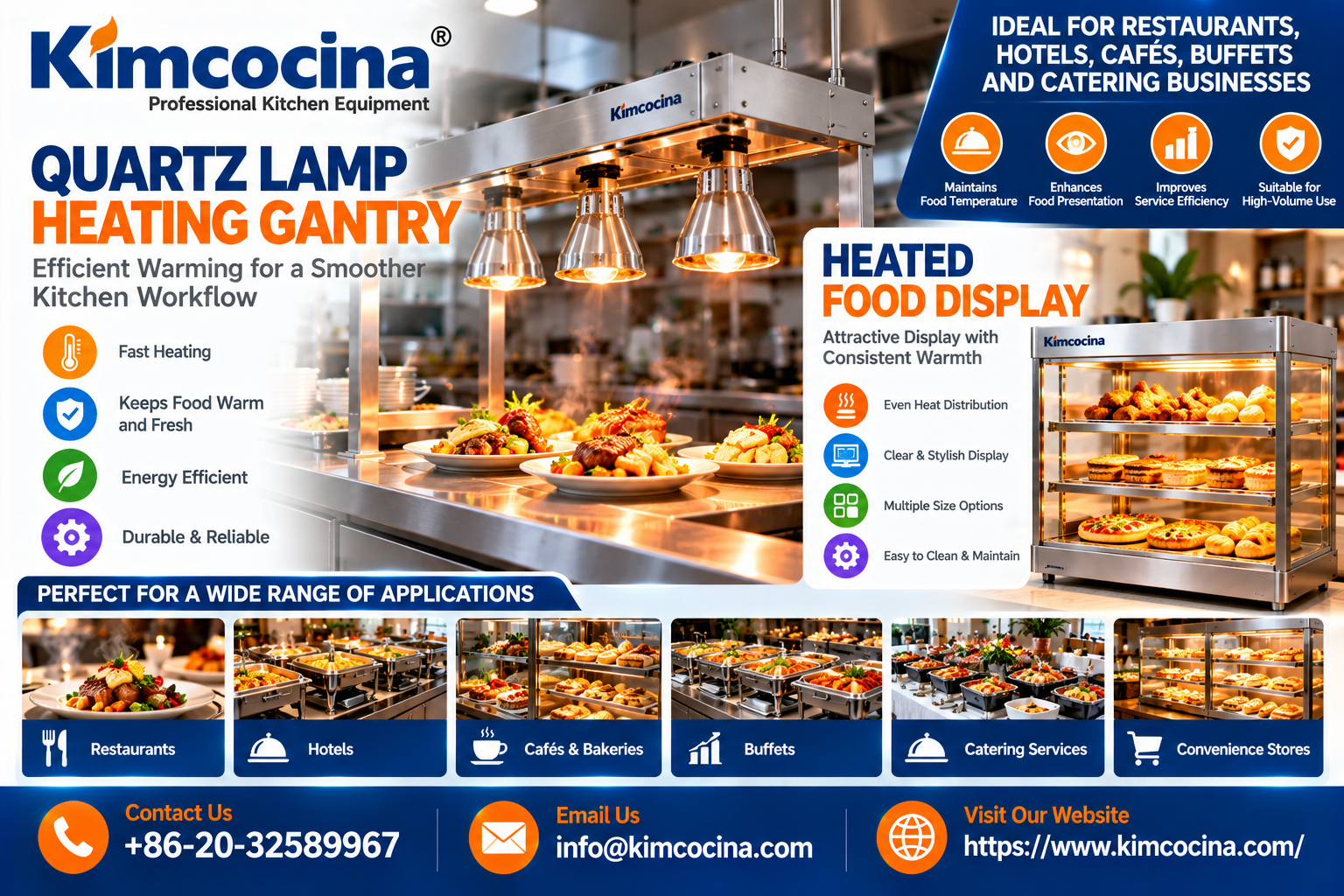
Restaurants, hotels, cafés, buffets, bakeries, canteens, and catering businesses are increasingly redesigning service counters to make prepared food easier to organize, present, and serve. As customers expect faster service alongside attractive presentation, operators are paying more attention to the equipment positioned between the kitchen and the point of sale.
Among these solutions, the quartz lamp heating gantry is attracting attention for suitable pass and counter applications, while the heated food display continues to play an important role in presenting appropriate prepared foods in customer-facing environments. Together, these equipment categories reflect a broader shift toward service areas that combine practical workflow with stronger food presentation.
Quartz Lamp Heating Gantry Supports the Final Service Stage
Commercial kitchens can prepare food efficiently but still experience delays during the final stage of service.
Orders may need to be plated, checked, garnished, packaged, or collected before reaching customers. A quartz lamp heating gantry can be incorporated into an appropriate pass or service area to provide overhead heat during this transition.
Its usefulness depends heavily on correct equipment selection and installation.
Operators should consider the dimensions of the working area, the type of food being handled, expected service volume, available utilities, and manufacturer recommendations.
Rather than treating the gantry as an isolated appliance, businesses can plan it as part of the complete path from cooking to collection.
Heated Food Display Combines Presentation With Service
In many food businesses, customers make purchasing decisions after seeing the available products.
A heated food display can provide a dedicated area for presenting suitable prepared foods while supporting an organized service environment.
Applications may include cafés, bakeries, convenience-oriented food counters, canteens, takeaway operations, and other businesses where prepared products are offered for customer selection.
Visibility matters in these settings.
An organized display can help customers understand what is available without relying entirely on menu descriptions. This can be particularly useful during busy periods when employees need to process orders efficiently.
Front-of-House Equipment Is Becoming Part of Merchandising
Traditionally, foodservice equipment decisions were often driven primarily by kitchen production.
That approach is changing.
Customer-facing equipment is increasingly being considered as part of merchandising strategy. The way food is arranged, labeled, illuminated, and accessed can influence how easily customers make purchasing decisions.
A well-planned heated food display can help create a structured presentation rather than an overcrowded counter.
Businesses can group appropriate products logically, maintain clear product identification, and establish straightforward replenishment procedures.
Presentation should remain practical. Staff still require easy access for serving, cleaning, monitoring, and replenishing the display.
Service-Pass Design Can Reduce Unnecessary Movement
Restaurant productivity is influenced by the distance employees repeatedly travel during a shift.
If chefs finish dishes in one location but servers collect them from another poorly positioned area, unnecessary movement can quickly accumulate.
A quartz lamp heating gantry positioned within a carefully designed service pass can help establish a clearly defined handover point for appropriate prepared meals.
Kitchen employees know where finished orders should go, while front-of-house staff know where collection takes place.
Different Service Models Require Different Layouts
There is no universal counter design that suits every food business.
A hotel buffet has different requirements from a bakery. A staff canteen operates differently from a takeaway outlet, while a restaurant service pass has different priorities from a self-service counter.
For this reason, the heated food display should be selected according to the intended service model rather than appearance alone.
Operators can evaluate expected product variety, customer flow, replenishment frequency, available counter space, staff access, and cleaning requirements.
Similarly, the size and position of a quartz lamp heating gantry should correspond with the service-pass configuration and intended application.
Product Turnover Should Influence Capacity Planning
More display capacity is not automatically better.
An oversized display filled with slowly moving products can complicate replenishment planning, while insufficient capacity may create frequent interruptions during busy periods.
Businesses should study actual product turnover.
A heated food display can then be selected around realistic peak-period requirements and the number of appropriate products that need to be presented.
The same principle applies to pass equipment. Operators should consider how many completed dishes typically reach the finishing area at the same time before determining the appropriate workstation dimensions.
Counter Design Can Improve Customer Flow
Customer movement is especially important in self-service and counter-service businesses.
When product categories are difficult to see or the collection process is unclear, customers may spend longer deciding where to go.
Strategic placement of a heated food display can help establish a more understandable service sequence.
For example, businesses can consider how customers approach the counter, where they select products, where staff serve or package items, and where payment or collection occurs.
Good equipment placement supports this sequence without creating unnecessary obstacles.
Cleaning Access Deserves Early Consideration
Visual presentation depends on cleanliness.
Equipment located near customers should therefore be selected with routine cleaning in mind.
Before purchasing, operators can review how easily relevant surfaces and removable components can be accessed and what procedures the manufacturer recommends.
A quartz lamp heating gantry should also be positioned so appropriate cleaning and maintenance tasks can be completed without unnecessary difficulty.
Documented routines can clarify which tasks are completed during service, after closing, or at scheduled maintenance intervals.
Utility and Installation Planning Prevents Surprises
Commercial heating and display equipment can have specific installation requirements.
Operators should review electrical specifications, equipment dimensions, operating clearances, countertop suitability, and any other requirements specified for the individual model.
This planning is particularly important when equipment is being incorporated into a new service counter.
Making these decisions during the design stage can be easier than modifying a completed counter after equipment arrives.
Frequently Asked Questions
What is a quartz lamp heating gantry?
A quartz lamp heating gantry is commercial foodservice equipment designed to provide overhead heat for suitable food holding, finishing, or service-pass applications.
What is a heated food display?
A heated food display is equipment designed to present suitable prepared foods within a heated display environment for commercial service applications.
Where can heated food displays be used?
They may be suitable for cafés, bakeries, canteens, hotels, takeaway counters, convenience-oriented food outlets, and other appropriate foodservice operations.
Where is a heating gantry normally positioned?
Depending on its design, it may be installed around a service pass, preparation counter, or another appropriate food holding area.
Can heated display equipment improve food presentation?
Yes. A structured display can help businesses organize products and make available choices more visible to customers.
How should display capacity be selected?
Consider peak demand, product range, turnover, available counter space, replenishment frequency, and the intended service model.
Why is customer flow important when positioning a display?
Equipment placement can influence how easily customers view products, make selections, move through the service area, and complete their purchase.
Does a quartz lamp heating gantry require regular cleaning?
Yes. Cleaning and maintenance should follow the instructions supplied by the equipment manufacturer and applicable operational procedures.
Should electrical requirements be checked before purchasing?
Yes. Businesses should confirm the electrical and installation requirements of the specific equipment before purchase and installation.
What should operators compare when selecting commercial heating equipment?
They should review intended application, capacity, dimensions, installation requirements, controls, cleaning access, maintenance needs, workflow compatibility, and manufacturer specifications.
Media Contact
Commercial Foodservice Equipment Enquiries
Phone: +86-20-32589967
Email: info@kimcocina.com
Official Website: kimcocina.com
