
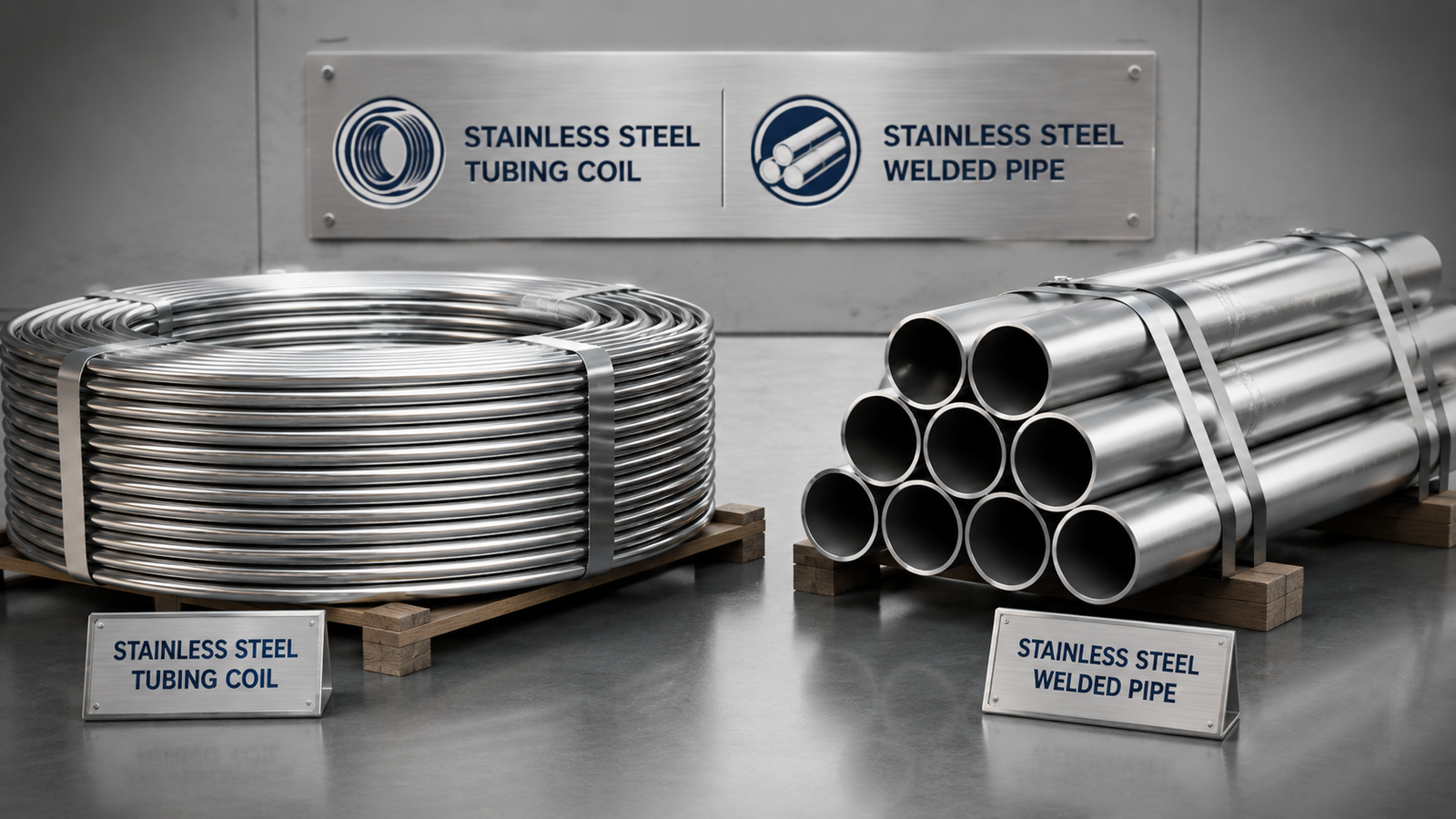
Modern industries require piping and tubing systems that can withstand corrosion, pressure, temperature changes, chemical exposure and demanding operating environments. Two widely used solutions are Stainless Steel Tubing Coil and Stainless Steel Welded Pipe. Although both are manufactured from stainless steel, their construction, dimensions, installation methods and applications can differ considerably.
Understanding these differences is important for engineers, fabricators, procurement teams and project managers who need reliable material for fluid transportation, instrumentation, heat exchange, structural fabrication and process systems.
This guide explains their manufacturing, grades, performance characteristics, applications, selection factors and long-term value.
What Is Stainless Steel Tubing Coil?
A Stainless Steel Tubing Coil is a continuous length of stainless steel tube supplied in coiled form instead of straight sections. The extended continuous length significantly reduces the number of joints, connectors and fittings required during installation.
Tubing coils are commonly manufactured in smaller outside diameters and are particularly suitable for instrumentation, hydraulic control, chemical dosing, heat transfer and fluid handling applications.
The coil format also improves installation flexibility because the tubing can be unrolled and routed around equipment, structures and restricted areas.
Typical industries using stainless steel tubing coils include:
- Oil and gas
- Petrochemical processing
- Chemical manufacturing
- Food and beverage
- Pharmaceutical production
- Marine engineering
- Power generation
- Instrumentation systems
- Heat exchanger manufacturing
- Hydraulic equipment
Corrosion resistance is one of the most important reasons stainless steel tubing is selected for these demanding environments.
How Stainless Steel Tubing Coil Is Manufactured
The manufacturing method depends on whether the tube is seamless or welded.
For seamless tubing, a stainless steel billet is processed into a hollow tube and subsequently cold drawn to achieve the required dimensions. Welded tubing is typically formed from stainless steel strip and joined along the longitudinal seam.
After forming, several processing stages may be carried out:
- Cold drawing or dimensional reduction
- Heat treatment or solution annealing
- Straightening before coiling
- Surface cleaning
- Pickling and passivation
- Dimensional inspection
- Pressure or non-destructive testing
- Coiling and packaging
Careful manufacturing is essential because dimensional accuracy directly affects compatibility with compression fittings, valves and instrumentation components.
Advantages of Stainless Steel Tubing Coil
A major advantage of Stainless Steel Tubing Coil is the ability to install long continuous runs.
Fewer connections generally mean fewer potential leakage points. This can be particularly valuable in instrumentation and process applications where system reliability is critical.
Additional benefits include:
- Excellent corrosion resistance
- Reduced number of fittings
- Faster installation over long distances
- Good pressure capability
- Compact transportation and storage
- Easy routing around equipment
- Suitable for aggressive fluids
- Strong temperature resistance
- Clean and hygienic surface options
- Long service life
Coiled tubing can also reduce fabrication work because installers do not need to join multiple short tube sections.
What Is Stainless Steel Welded Pipe?
A Stainless Steel Welded Pipe is manufactured by forming stainless steel plate, sheet or strip into a cylindrical shape and welding the longitudinal seam.
Modern welding technologies can produce strong, consistent joints suitable for many industrial applications.
Welded stainless steel pipe is widely used for transporting:
- Water
- Chemicals
- Oil
- Gas
- Food products
- Process fluids
- Steam
- Cooling liquids
It is also used for structural fabrication, architectural projects and equipment manufacturing.
Compared with seamless pipe, welded pipe can often be produced economically in larger diameters and a broader range of wall thicknesses.
Manufacturing Process of Stainless Steel Welded Pipe
The manufacturing process begins with stainless steel strip or plate selected according to the required grade and dimensions.
The material is progressively formed into a cylindrical shape. The edges are then welded together using a controlled welding process.
Common welding technologies include TIG, laser welding and other automated fusion welding processes.
After welding, the pipe may undergo:
- Weld bead treatment
- Heat treatment
- Sizing
- Straightening
- Pickling
- Passivation
- Polishing
- Hydrostatic testing
- Eddy-current testing
- Dimensional inspection
Quality control is particularly important around the weld seam because the joint must meet the mechanical and corrosion requirements of the intended application.
Common Stainless Steel Grades
Material grade selection influences corrosion resistance, strength, weldability and temperature performance.
304 stainless steel is one of the most commonly used grades for general industrial applications. It provides good corrosion resistance and fabrication characteristics.
316 and 316L stainless steel contain molybdenum, which improves resistance to chloride environments. These grades are frequently selected for marine, chemical and pharmaceutical systems.
321 stainless steel contains titanium and is often considered for applications involving elevated temperatures.
Duplex stainless steels combine characteristics of austenitic and ferritic structures, providing higher strength and improved resistance to certain forms of corrosion.
The correct grade should always be selected according to actual process conditions rather than price alone.
Stainless Steel Tubing Coil vs Stainless Steel Welded Pipe
| Feature | Stainless Steel Tubing Coil | Stainless Steel Welded Pipe |
| Supply Form | Continuous coil | Straight pipe lengths |
| Typical Diameter | Smaller | Small to large |
| Number of Joints | Low | Depends on installation |
| Flexibility | High | Limited |
| Installation | Easy for continuous routes | Suitable for fixed pipelines |
| Common Use | Instrumentation and hydraulic systems | Process and structural pipelines |
| Storage | Compact coil | Requires longer storage space |
| Fittings | Fewer fittings needed | More joints may be required |
| Surface Options | Annealed, pickled or polished | Pickled, polished or industrial finish |
| Pressure Suitability | Grade and wall dependent | Grade and wall dependent |
Neither product is universally better. Selection depends on operating pressure, diameter, installation layout, fluid, temperature and applicable engineering standards.
Important Applications
Stainless Steel Tubing Coil is frequently used where narrow tubing must travel through complex equipment layouts.
Instrumentation systems are a good example. Continuous tubing connects pressure transmitters, valves, control panels and measuring instruments while minimising intermediate connections.
Heat exchangers also use stainless steel coils because the material provides corrosion resistance while allowing efficient heat transfer.
Stainless Steel Welded Pipe, meanwhile, is commonly selected for larger process pipelines where fluid must be transported between tanks, machines and processing units.
Food processing plants may use polished welded stainless steel pipes because smooth internal surfaces support hygienic cleaning practices.
Corrosion Resistance and Surface Protection
Stainless steel protects itself through a chromium-rich passive oxide layer.
However, incorrect fabrication, contamination or aggressive environmental conditions can compromise performance.
Pickling removes scale and contaminants created during manufacturing, while passivation helps restore and strengthen the protective surface.
For demanding installations, designers should consider exposure to:
- Chlorides
- Acids
- Alkalis
- Saltwater
- Elevated temperatures
- Cleaning chemicals
- Atmospheric contamination
Proper material grade selection remains essential because stainless steel is corrosion resistant rather than completely corrosion proof.
How to Select the Right Product
Purchasers should evaluate more than just dimensions and price.
Important selection parameters include:
- Stainless steel grade
- Outside diameter
- Wall thickness
- Pressure rating
- Operating temperature
- Fluid composition
- Surface finish
- Manufacturing method
- Required tolerance
- Testing requirements
- Applicable specifications
- Length or coil size
Certification and traceability should also be verified for critical industrial applications.
Material test certificates can provide information regarding chemical composition and mechanical properties.
Quality Inspection and Testing
Reliable manufacturers usually implement dimensional, visual and mechanical inspection procedures.
Testing may include hydrostatic testing, eddy-current examination, ultrasonic inspection or other non-destructive methods depending on the specification and application.
Chemical composition verification confirms that the material corresponds to the required stainless steel grade.
Dimensional inspection may check:
- Outside diameter
- Wall thickness
- Ovality
- Length
- Surface condition
- Weld quality
Consistent testing reduces the risk of premature failure after installation.
Cost and Long-Term Value
The cheapest tubing or pipe is not always the most economical solution.
Material cost should be considered together with installation labour, maintenance requirements, downtime risk and expected service life.
A Stainless Steel Tubing Coil can reduce installation costs because fewer fittings and joints are needed over long distances.
Similarly, Stainless Steel Welded Pipe can provide cost-effective performance for large-diameter systems where seamless pipe may be unnecessarily expensive.
Life-cycle cost analysis is therefore more useful than comparing purchase prices alone.
Frequently Asked Questions
1. What is a stainless steel tubing coil?
It is stainless steel tubing supplied in long continuous coils for instrumentation, hydraulic, chemical and process applications.
2. Why is stainless steel tubing supplied in coils?
Coiling enables longer continuous installation runs and reduces the number of fittings and joints.
3. What is stainless steel welded pipe?
It is pipe manufactured by forming stainless steel strip or plate into a cylindrical shape and welding the longitudinal seam.
4. Is welded stainless steel pipe reliable?
Yes, when properly manufactured, welded and tested according to appropriate specifications.
5. Which stainless steel grade is commonly used?
Grades 304, 304L, 316 and 316L are among the most commonly used, depending on operating conditions.
6. Is 316 stainless steel suitable for marine environments?
316 stainless steel generally provides better chloride resistance than 304, although suitability depends on actual exposure conditions.
7. What industries use stainless steel tubing coils?
Oil and gas, petrochemical, food, pharmaceutical, power generation, marine and instrumentation industries commonly use them.
8. Can welded pipe handle pressure?
Yes. Pressure capability depends on pipe dimensions, material grade, manufacturing quality and applicable design standards.
9. Why is passivation important?
Passivation helps restore the chromium-rich protective layer that supports stainless steel’s corrosion resistance.
10. Which is better: tubing coil or welded pipe?
The better option depends on diameter, pressure, routing, process fluid, installation requirements and project specifications.