
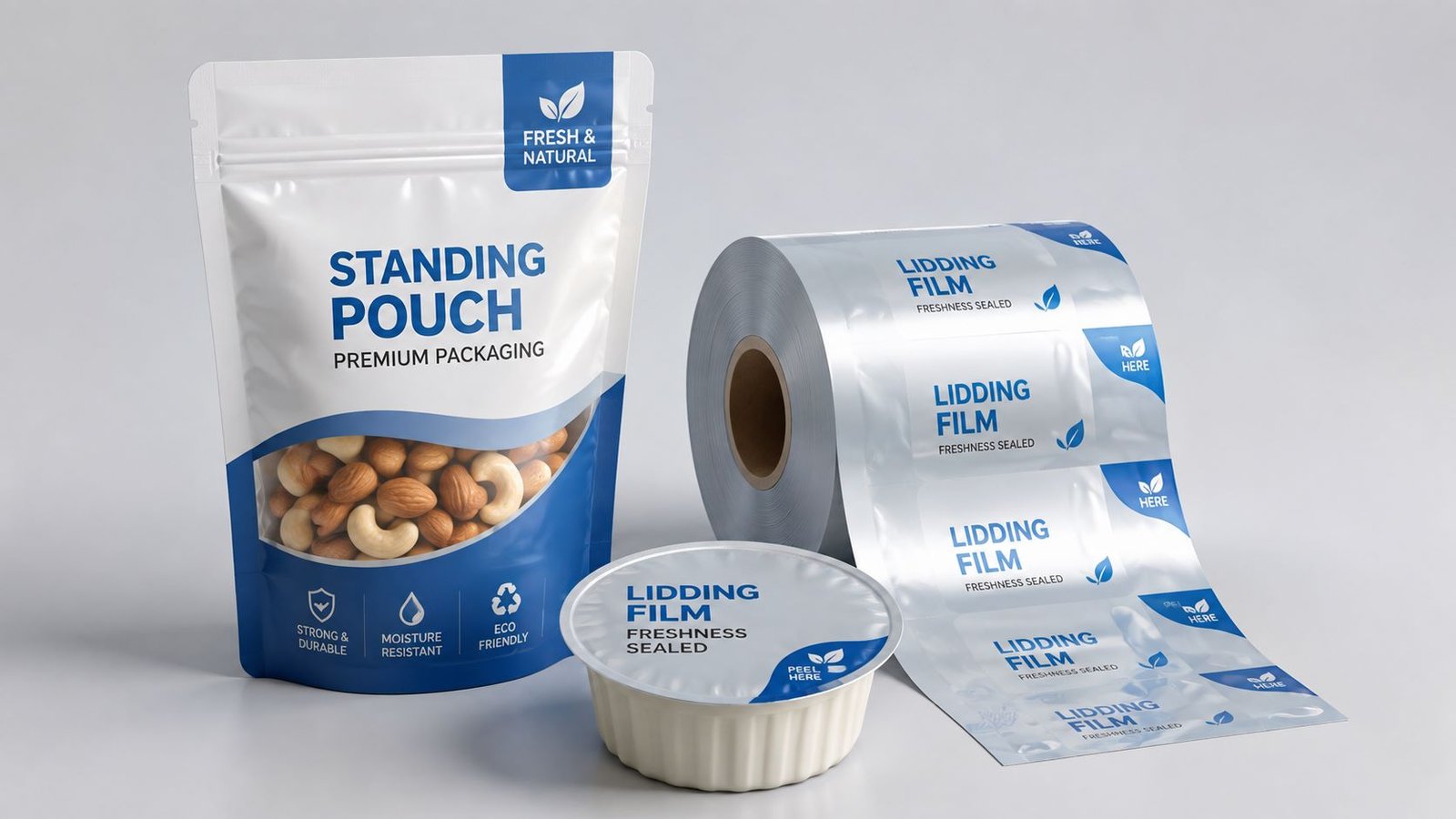
Flexible packaging has become an essential part of modern food, beverage, pharmaceutical, personal care, and household product distribution. Among the most versatile packaging formats are the standing pouch and lidding film. Although they perform different functions, both solutions help manufacturers protect products, improve shelf presentation, control material usage, and create convenient packaging for consumers.
Understanding their structures, barrier properties, sealing requirements, printing options, and application suitability is important before selecting the right packaging material.
What Is a Standing Pouch?
A standing pouch, commonly called a stand-up pouch, is a flexible package designed with a bottom gusset that enables it to remain upright on a retail shelf. Unlike conventional flat pouches, its self-supporting construction provides better product visibility while requiring considerably less rigid material than bottles, jars, or containers.
Depending on the product, pouches can be manufactured using laminated structures containing polyethylene, polypropylene, polyester, aluminium foil, metallised films, or specialised barrier layers.
Typical applications include:
- Dry fruits and nuts
- Coffee and tea
- Spices and seasoning
- Pet food
- Protein powder
- Snacks and confectionery
- Sauces and liquid products
- Detergents and cleaning products
- Personal care products
- Nutritional supplements
Additional features such as resealable zippers, tear notches, handles, transparent windows, valves, and spouts can enhance functionality.
How Does a Standing Pouch Work?
The design combines flexible film with a specially formed gusset at the base. When filled, the bottom expands and creates a stable foundation.
A typical multilayer structure may contain:
- An outer printable layer for branding and graphics.
- A middle barrier layer for protection against oxygen, moisture, light, or aroma loss.
- An inner food-contact and heat-sealing layer.
The precise structure depends heavily on what is being packed. Coffee, for example, may require stronger oxygen and aroma barriers than dry products with shorter shelf-life expectations.
Good packaging development therefore starts with the product rather than simply selecting a pouch according to appearance.
Important Benefits of Standing Pouches
The popularity of the standing pouch comes from its combination of practicality, branding potential, and material efficiency.
Strong Shelf Presentation
Because the pack stands vertically, its front and back panels provide substantial printable areas for branding, product information, nutritional details, instructions, and regulatory information.
Consumer Convenience
Zippers allow repeated opening and closing, while tear notches improve first-time opening. Spouted versions can simplify the dispensing of liquids and semi-liquid products.
Efficient Transportation
Unfilled pouches are lightweight and occupy relatively little storage space compared with rigid packaging. Their lower packaging weight can also improve logistics efficiency, although overall environmental performance should always be assessed across the complete packaging lifecycle.
Product Protection
High-barrier laminates can limit exposure to moisture, oxygen, UV light, contamination, and external odours. Barrier requirements must be matched to the sensitivity and intended shelf life of the packed product.
What Is Lidding Film?
Lidding film is a flexible material designed to seal the opening of trays, cups, tubs, containers, and similar packaging formats. It is widely used in food processing because it can create a secure closure while allowing manufacturers to select specific properties such as peelability, barrier protection, anti-fog performance, or compatibility with modified atmosphere packaging.
Common applications include:
- Dairy cups
- Ready-meal trays
- Fresh meat
- Poultry
- Seafood
- Fresh produce
- Desserts
- Yoghurts
- Sauces and dips
- Pharmaceutical trays
Unlike a stand-up pouch that forms the complete package, lidding film normally works together with a rigid or semi-rigid container.
How Lidding Film Sealing Works
During packaging, the film is positioned over the container and sealed around its rim through controlled heat, pressure, and dwell time.
The quality of the seal depends on several factors:
- Tray or container material
- Film sealant layer
- Sealing temperature
- Applied pressure
- Contact time
- Surface contamination
- Packaging equipment configuration
Common substrates include PET, PP, PE, aluminium, and other packaging materials. Selecting compatible film and tray structures is essential because an unsuitable combination can cause weak seals, leakage, excessive peeling force, or packaging failure.
Key Properties of High-Quality Lidding Film
Different products require different technical specifications.
Barrier Performance
Barrier films help control oxygen and moisture transmission. This can be particularly important for meat, cheese, prepared foods, and products that are sensitive to oxidation.
Peelability
Easy-peel films provide consumer-friendly opening while maintaining adequate seal integrity during processing, storage, and distribution.
Anti-Fog Performance
Condensation can make refrigerated packages difficult to see through. Anti-fog lidding film helps maintain transparency so consumers can inspect the product more easily.
Puncture Resistance
Packaging for products containing bones, sharp corners, or rigid components may require improved puncture and mechanical resistance.
Standing Pouch vs Lidding Film
| Feature | Standing Pouch | Lidding Film |
| Packaging format | Complete flexible pack | Closure for tray or container |
| Shelf display | Stands independently | Depends on container |
| Resealable option | Frequently available | Less common |
| Typical products | Snacks, powders, liquids | Meat, dairy, meals, produce |
| Printing area | Large front and back panels | Mainly top surface |
| Barrier options | Available | Available |
| Easy-peel capability | Possible | Widely used |
| Container required | No | Yes |
Neither format is universally better. Selection depends on product characteristics, machinery, shelf-life requirements, distribution conditions, convenience expectations, and marketing objectives.
How to Select the Right Packaging Structure
Manufacturers should evaluate packaging technically rather than choosing solely on price.
Consider:
- Product sensitivity to moisture and oxygen.
- Required shelf life.
- Filling temperature.
- Storage temperature.
- Packaging-machine compatibility.
- Seal-strength requirements.
- Transportation conditions.
- Food-contact compliance where applicable.
- Printing and branding requirements.
- End-user convenience.
Pilot trials and seal testing are advisable before large-scale commercial production.
Material and Sustainability Considerations
Flexible packaging can use less material by weight than many rigid alternatives, but sustainability cannot be determined by weight alone.
The complete assessment should consider material composition, product protection, food-waste prevention, manufacturing requirements, transportation, collection systems, and actual recyclability within the target market.
Mono-material structures are increasingly explored where performance requirements allow them, because they can potentially improve compatibility with certain recycling streams. However, high-barrier products may still require more complex structures.
The most responsible packaging specification balances product safety, functionality, material efficiency, shelf life, and end-of-life considerations.
Frequently Asked Questions
1. What products can be packed in a standing pouch?
A standing pouch can accommodate snacks, coffee, spices, powders, pet food, liquids, sauces, supplements, and many household products.
2. Is a standing pouch waterproof?
Many structures provide excellent moisture protection, but performance depends on the films, laminate construction, seals, and closure system used.
3. Can standing pouches be resealed?
Yes. Manufacturers can add press-to-close zippers, sliders, spouts, or other resealable closures.
4. What is lidding film used for?
Lidding film seals trays, cups, tubs, and containers used for food, pharmaceutical, healthcare, and other applications.
5. Can lidding film be easy to peel?
Yes. Peelable structures can be engineered to provide secure sealing combined with convenient consumer opening.
6. What is anti-fog lidding film?
It is film designed to reduce visible condensation and maintain product visibility, particularly in refrigerated packaging.
7. Can lidding films provide oxygen barriers?
Yes. Specific multilayer structures can provide controlled oxygen-barrier performance when required.
8. Which is better: standing pouch or lidding film?
The answer depends on the product. Pouches provide a complete flexible pack, while lidding films are intended to seal containers.
9. Can both packaging formats be custom printed?
Yes. Both formats can support branded graphics, product details, instructions, promotional information, and regulatory information.
10. How should manufacturers choose packaging thickness?
Thickness should be determined through product weight, barrier needs, puncture resistance, filling process, machinery, transport conditions, and required durability.
Read more – https://newsgrow.blogspot.com/2026/08/foil-lid-and-stand-up-pouch.html
https://newsgrow.blogspot.com/2026/08/spout-pouch-and-stand-up-pouch-with.html
https://newsgrow.blogspot.com/2026/08/stand-up-pouch-filling-machines.html
https://newsgrow.blogspot.com/2026/08/why-zipper-stand-up-pouch-packaging-is.html