
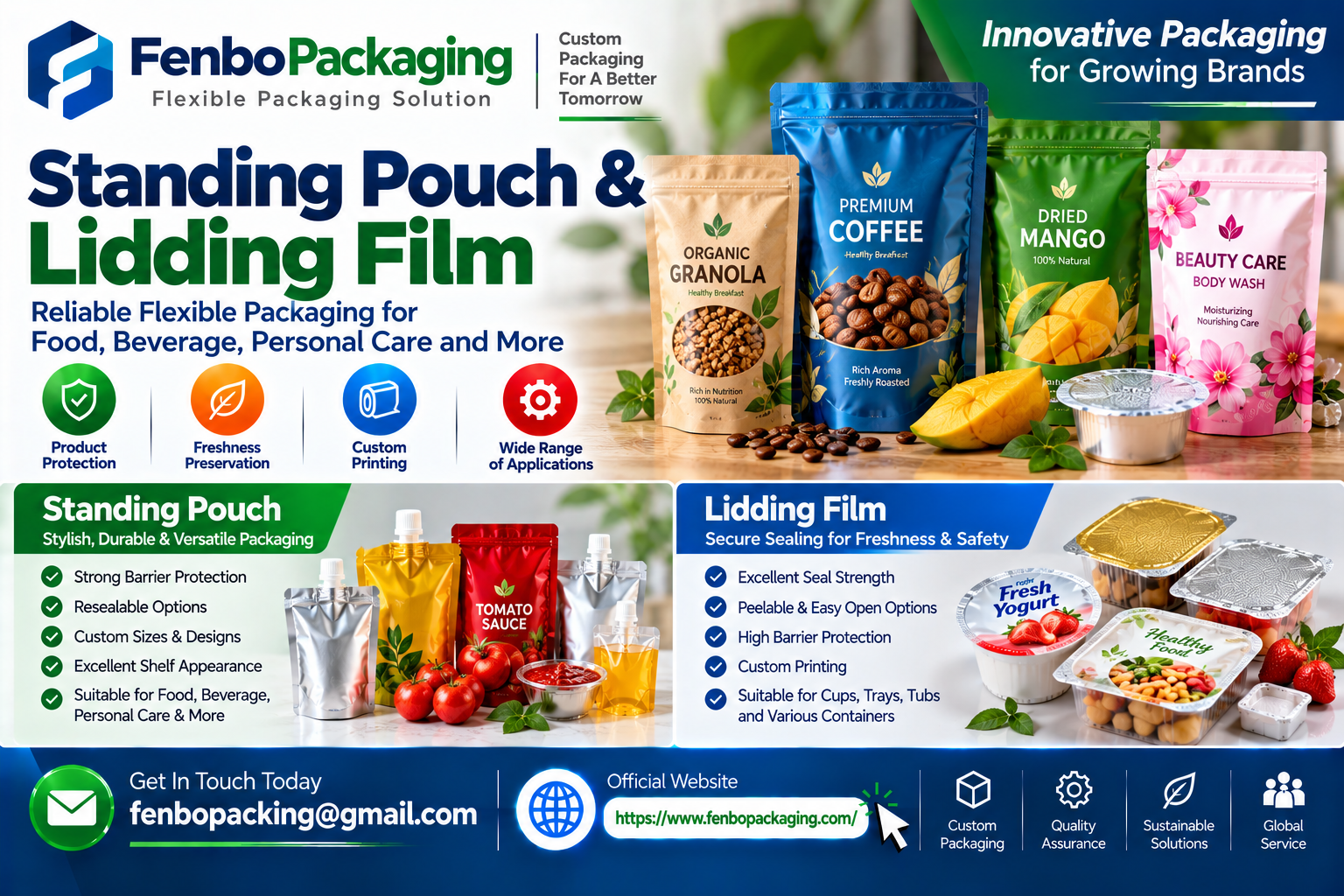
As manufacturers and consumer brands explore convenient, protective, and visually appealing packaging solutions, flexible packaging continues to support product development across multiple industries.
A standing pouch offers businesses a practical packaging format that combines shelf presentation, convenient handling, and customizable material structures. Its ability to stand upright makes it suitable for various food, beverage, cosmetic, and household products.
Meanwhile, Lidding Film provides a sealing solution for trays, cups, and containers where product protection, freshness, and convenient opening are important considerations.
Understanding these packaging technologies can help businesses select suitable materials, improve product presentation, and meet specific manufacturing requirements.
Growing Importance of Standing Pouch Packaging
A standing pouch, also known as a stand-up pouch, is a flexible packaging container designed to remain upright on a suitable surface when filled.
The design generally incorporates a bottom gusset that expands to create a stable base.
Unlike certain conventional packaging formats, standing pouches provide flexible options for storage, printing, and product presentation.
Common applications include:
- Coffee beans and powdered beverages.
- Snacks, nuts, and dried fruits.
- Pet food and nutritional products.
- Spices and food ingredients.
- Personal care products.
- Detergent and household product refills.
- Selected industrial powders and granules.
Packaging performance depends on material selection, pouch construction, and the characteristics of the product being packed.
What Is a Standing Pouch?
A standing pouch is a flexible package manufactured using suitable plastic films, laminated structures, or other application-specific materials.
Its expandable bottom allows the filled package to stand independently when its design and contents provide sufficient stability.
Manufacturers can customize pouches according to dimensions, capacity, printing requirements, and closure preferences.
Zipper Standing Pouches
Resealable zippers allow consumers to reopen and close compatible packaging.
High-Barrier Pouches
Specialized material structures help protect products against selected environmental factors such as moisture or oxygen.
Transparent Window Pouches
A clear section allows customers to view the packaged product.
Custom Printed Pouches
Printed graphics support brand identity, product information, and retail presentation.
The appropriate design depends on product requirements and intended storage conditions.
Understanding Lidding Film in Flexible Packaging
Lidding Film is a flexible packaging material used to seal trays, cups, and other compatible containers.
It may be supplied in rolls for automated packaging equipment and designed with specific sealing, barrier, and opening characteristics.
Lidding films are commonly used for food packaging applications involving prepared meals, dairy products, snacks, and other suitable products.
Heat-Sealable Lidding Films
These films use a compatible sealing layer to bond with container surfaces under controlled heat and pressure.
Peelable Lidding Films
Peelable structures are designed to allow convenient opening while maintaining appropriate sealing performance before use.
High-Barrier Lidding Films
Selected multilayer structures provide protection against oxygen and moisture transmission.
Anti-Fog Lidding Films
Specialized films can help reduce condensation-related fogging in suitable applications, improving product visibility.
Standing Pouch vs Lidding Film: Key Differences
Although both belong to flexible packaging, their functions are different.
| Feature | Standing Pouch | Lidding Film |
| Main purpose | Contain and protect products | Seal compatible containers |
| Structure | Flexible pouch with a gusset | Flexible rollstock or cut film |
| Common applications | Coffee, snacks, powders, refills | Food trays, cups, ready meals |
| Customization | Size, zipper, printing, barriers | Thickness, sealing, printing, barriers |
| Packaging equipment | Pouch filling and sealing systems | Tray or cup sealing systems |
Choosing between them depends on packaging design, filling equipment, and consumer requirements.
Industries Using Modern Flexible Packaging
Different industries use flexible packaging to meet product-specific requirements.
Food and Beverage: Pouches support dry food packaging, while lidding materials may seal dairy cups and prepared food trays.
Cosmetics: Flexible pouches can package selected personal care products and refills.
Pet Food: Suitable pouches provide convenient storage and retail presentation.
Household Products: Certain cleaning formulations can be packed in compatible flexible structures.
Ready-to-Eat Meals: Specialized lidding materials may support tray sealing under appropriate processing conditions.
Food-contact applications require suitable materials and compliance with applicable regulations.
Important Benefits of Customized Flexible Packaging
Attractive Product Presentation
Printable packaging surfaces create opportunities for brand communication and clear labeling.
Convenient Handling
Properly designed closures and packaging shapes can improve everyday consumer convenience.
Flexible Manufacturing Options
Different film structures, dimensions, and sealing systems support varied product requirements.
Product Protection
Selected materials provide barrier characteristics appropriate for particular products.
Efficient Storage
Some flexible packaging formats can reduce storage requirements compared with certain rigid alternatives.
These benefits vary according to package construction and the product involved.
How to Choose the Right Packaging Material
Businesses evaluating a standing pouch or Lidding Film should establish technical specifications before production.
Important considerations include:
- Product Type: Identify whether the contents are liquid, powder, solid, or semi-solid.
- Barrier Requirements: Determine required protection against moisture, oxygen, and light.
- Material Compatibility: Verify suitability for the product and packaging equipment.
- Sealing Performance: Evaluate seal strength and processing conditions.
- Packaging Dimensions: Select appropriate sizes, capacities, and thicknesses.
- Printing Requirements: Prepare artwork and labeling information.
- Storage Conditions: Consider temperature, humidity, transportation, and shelf-life requirements.
Testing representative samples under actual production conditions can help identify potential packaging problems.
Quality Testing in Flexible Packaging Manufacturing
Reliable packaging requires suitable manufacturing controls and inspection procedures.
Depending on the application, testing may include seal strength evaluation, leak testing, dimensional inspection, puncture resistance, and oxygen or water vapor transmission measurements.
For lidding applications, manufacturers should confirm compatibility with the container material and sealing equipment.
For standing pouches, gusset strength, zipper performance, and pouch stability may also require evaluation.
Appropriate testing helps reduce the risk of packaging failures during storage and distribution.
Sustainable Packaging Considerations
Businesses are increasingly evaluating material efficiency and waste management when choosing packaging.
Flexible structures may reduce packaging weight in certain applications. However, recyclability depends on material composition and available collection systems.
Multilayer films can create recycling challenges, while selected mono-material designs may offer alternatives where technically suitable.
Environmental claims should be supported by relevant evidence rather than assumptions.
Frequently Asked Questions (FAQs)
1. What is a standing pouch?
A standing pouch is a flexible packaging container with a bottom gusset that helps it remain upright when filled.
2. What is Lidding Film?
Lidding film is a flexible material used to seal compatible cups, trays, and food packaging containers.
3. Which products are suitable for standing pouches?
Coffee, snacks, powders, dried foods, pet food, and certain household products are common examples.
4. Are standing pouches customizable?
Yes. Sizes, printed designs, materials, zippers, windows, and barrier structures may be customized.
5. Can lidding films be used for food packaging?
Yes, when their materials and manufacturing processes meet applicable food-contact requirements.
6. What is peelable lidding film?
It is a film designed to form a suitable seal while allowing consumers to open the package by peeling.
7. Are standing pouches moisture-resistant?
Selected material structures provide moisture resistance, but performance depends on construction and sealing.
8. What affects flexible packaging costs?
Material structure, printing, dimensions, order volume, closures, and testing requirements influence costs.
9. Are standing pouches recyclable?
Some structures may be recyclable where suitable recycling systems exist. Material composition determines eligibility.
10. How can businesses select a packaging manufacturer?
Evaluate manufacturing capabilities, material quality, sample testing, technical support, and commercial requirements.
Media Contact
Industry: Flexible Packaging Manufacturing & Customized Packaging Solutions
Service Enquiries: Standing Pouches, Lidding Films, Custom Printed Packaging & Flexible Packaging Materials
Email: fenbopacking@gmail.com
Official Website: https://www.fenbopackaging.com/