
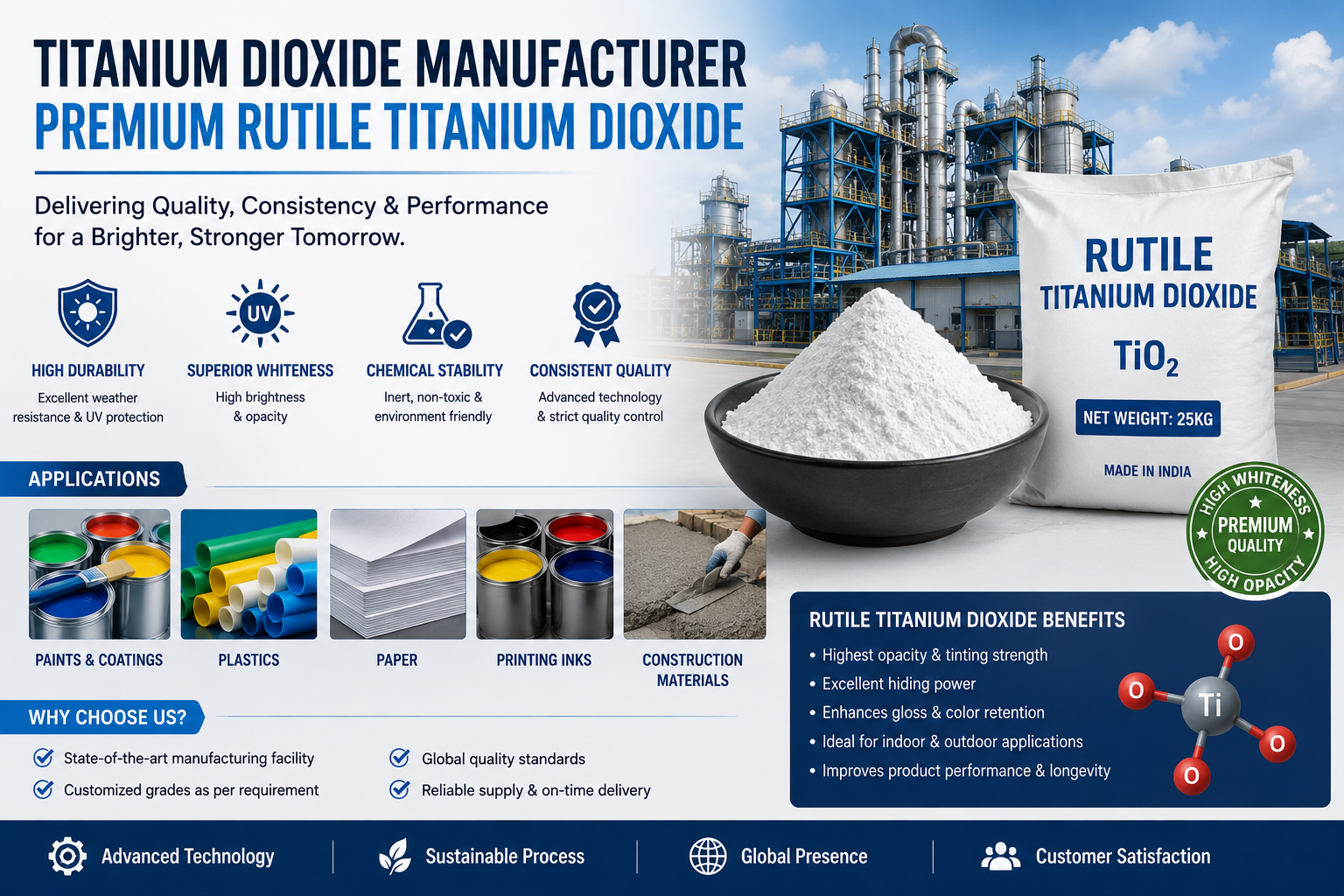
The global industrial chemicals sector is witnessing steady growth in demand for Titanium Dioxide Manufacturer output, especially in the production of Rutile Titanium Dioxide, which is widely used as a premium white pigment across paints, plastics, coatings, and paper industries.
As industries prioritize durability, opacity, and brightness in end products, titanium dioxide continues to remain one of the most important industrial raw materials worldwide. Manufacturers are now focusing on advanced processing technologies to improve purity, performance, and environmental compliance.
Understanding Titanium Dioxide Manufacturer Operations
A Titanium Dioxide Manufacturer is responsible for producing high-grade TiO₂ pigment through either the sulfate process or chloride process. These production methods determine the final quality, brightness, and particle structure of the pigment.
Core Responsibilities of Manufacturers
- Processing raw ilmenite or rutile ore
- Producing high-purity titanium dioxide pigment
- Ensuring particle size control and brightness consistency
- Meeting industrial-grade quality standards
- Supplying coatings, plastics, inks, and paper industries
Why Manufacturing Quality Matters
- Directly impacts product whiteness and opacity
- Determines UV resistance in coatings
- Affects durability and weather resistance
- Influences cost efficiency in industrial applications
What Is Rutile Titanium Dioxide?
Rutile Titanium Dioxide is the most stable crystalline form of TiO₂ and is widely preferred in high-performance applications. Compared to anatase form, rutile offers better durability, higher refractive index, and superior weather resistance.
Key Characteristics of Rutile Titanium Dioxide
- High opacity and brightness
- Excellent UV resistance
- Strong weather durability
- High refractive index
- Suitable for outdoor applications
Applications of Rutile Titanium Dioxide in Industries
The demand for Rutile Titanium Dioxide continues to rise due to its versatility across multiple sectors.
Major Application Areas
- Paints and coatings industry
- Plastic manufacturing
- Printing inks
- Paper industry
- Automotive coatings
- Construction materials
- Cosmetic formulations (controlled grades)
Rutile vs Anatase Titanium Dioxide
| Feature | Rutile Titanium Dioxide | Anatase Titanium Dioxide |
| Crystal Structure | Dense and stable | Less dense |
| UV Resistance | High | Moderate |
| Weather Durability | Excellent | Lower |
| Use Case | Outdoor coatings, plastics | Indoor applications |
| Brightness | Slightly lower but more durable | Higher initial brightness |
Global Demand Trends for Titanium Dioxide Manufacturer Industry
The Titanium Dioxide Manufacturer sector is experiencing strong growth due to increasing demand from construction, automotive, and packaging industries.
Key Market Drivers
- Rapid urbanization and infrastructure growth
- Expansion of automotive coatings market
- Increasing demand for premium plastics
- Rising consumption of packaged goods
- Technological advancements in pigment processing
Production Process in Titanium Dioxide Manufacturing
Step-by-Step Overview
- Mining of titanium ore (ilmenite or rutile)
- Chemical processing using sulfate or chloride method
- Purification and impurity removal
- Crystal formation control (rutile conversion if needed)
- Milling and surface treatment
- Final packaging and quality testing
Quality Control Parameters
- Particle size distribution
- Brightness level
- Oil absorption rate
- UV stability
- Chemical purity
Industrial Importance of Rutile Titanium Dioxide
The role of Rutile Titanium Dioxide in industrial applications is crucial due to its long-lasting performance and resistance to environmental factors.
Key Benefits in Industry Use
- Enhances product lifespan
- Improves surface protection in coatings
- Reduces pigment degradation
- Provides superior coverage with less material
- Ensures stable performance in harsh environments
Emerging Trends in Titanium Dioxide Manufacturing
The industry is evolving with new technologies and sustainability goals.
Latest Developments
- Low-waste chloride processing systems
- Eco-friendly pigment production techniques
- Nano-scale titanium dioxide innovations
- Energy-efficient manufacturing plants
- Improved recycling of industrial by-products
- Increased demand for high-purity rutile grades
Comparison of Titanium Dioxide Manufacturing Processes
| Factor | Sulfate Process | Chloride Process |
| Raw Material Flexibility | High | Limited (high-grade ore required) |
| Environmental Impact | Higher waste output | Cleaner process |
| Product Quality | Standard grade | High-grade rutile TiO₂ |
| Cost Efficiency | Lower setup cost | Higher efficiency long-term |
| Industrial Preference | Developing markets | Advanced industries |
Key Considerations When Choosing a Titanium Dioxide Manufacturer
What Buyers Should Evaluate
- Purity and grade consistency
- Production technology used
- Compliance with environmental standards
- Supply chain reliability
- Technical support availability
- Packaging and logistics capability
Red Flags to Avoid
- Unverified quality certifications
- Inconsistent particle quality
- Lack of technical data sheets
- Poor customer feedback
- Non-transparent sourcing methods
Frequently Asked Questions (FAQs)
1. What does a Titanium Dioxide Manufacturer do?
A manufacturer produces TiO₂ pigment used in paints, plastics, coatings, and other industrial applications.
2. What is Rutile Titanium Dioxide used for?
It is used in coatings, plastics, inks, paper, and automotive finishes due to its durability and UV resistance.
3. Why is rutile preferred over anatase?
Rutile offers better weather resistance and long-term stability compared to anatase.
4. Is Titanium Dioxide safe for industrial use?
Yes, it is widely used globally under regulated safety standards.
5. Which industries use Titanium Dioxide the most?
Paints, plastics, paper, cosmetics, and construction industries.
6. What is the main difference between rutile and anatase forms?
Rutile is more durable, while anatase has higher initial brightness.
7. How is Titanium Dioxide produced?
Through sulfate or chloride chemical processes using titanium ore.
8. What makes a good Titanium Dioxide Manufacturer?
Consistency, purity, advanced technology, and compliance with standards.
9. Is Rutile Titanium Dioxide suitable for outdoor use?
Yes, it is highly resistant to UV rays and weather conditions.
10. Why is demand for Titanium Dioxide increasing?
Due to growth in construction, automotive, and packaging industries worldwide.