
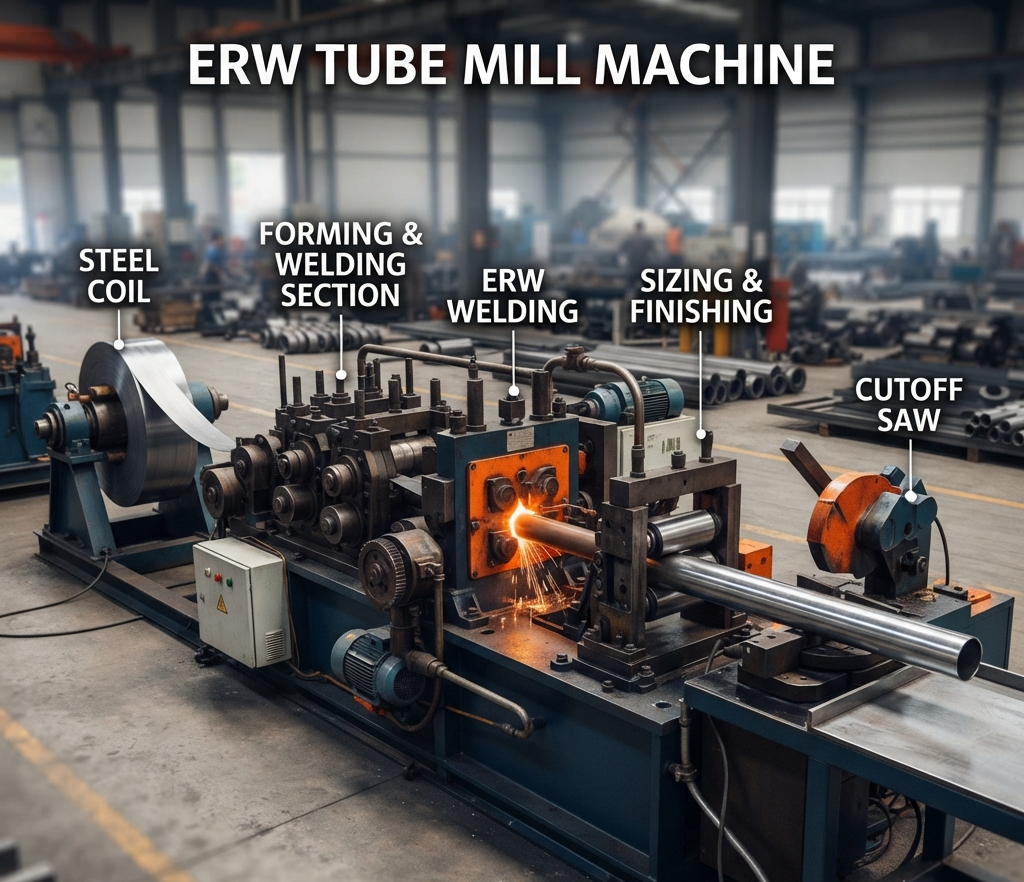
Tube manufacturing is undergoing a technological shift as producers increasingly adopt automated equipment, digital process monitoring, advanced welding systems, and intelligent quality-control technologies. The Tube Mill Machine, once primarily associated with mechanical forming and welding operations, is becoming an integrated production platform designed for higher efficiency, flexibility, and operational control.
The ERW Tube Mill Machine is at the center of this transition. Electrical Resistance Welding allows metal strip to be continuously formed and welded into tubes, making ERW technology an important production method for a wide range of industrial applications.
The industry’s future is now moving beyond conventional automation. Connected sensors, predictive maintenance, machine vision, artificial intelligence, and energy-management technologies are expected to influence the next generation of tube production.
A Manufacturing Technology Built Over Decades
Tube manufacturing did not begin with today’s sophisticated production lines.
Early processes involved forming metal sheets or strips and joining their edges through mechanical and welding methods. Production was comparatively slow, and maintaining uniform dimensions depended heavily on machinery settings and operator experience.
The rapid expansion of industrial infrastructure changed those requirements.
Construction projects, vehicle manufacturers, engineering companies, machinery producers, and infrastructure developers needed greater volumes of standardized metal tubes.
This demand accelerated the development of continuous production technology.
Continuous Roll Forming Changes Tube Production
Continuous roll forming became an important breakthrough in tube manufacturing.
Instead of shaping each tube individually, manufacturers could feed a continuous metal strip through multiple forming stations. Each station gradually changed the geometry of the material until it approached the required tube profile.
This method increased production efficiency while reducing unnecessary handling.
The basic concept remains central to many modern Tube Mill Machine systems.
However, forming alone was not enough. Manufacturers also needed an efficient method of continuously joining the strip edges.
ERW Technology Creates Continuous Welding
Electrical Resistance Welding provided an effective solution.
An ERW Tube Mill Machine brings the edges of formed metal strip together and uses electrical resistance to generate heat at the joining area. Controlled pressure completes the welding process as the material continues moving through the line.
This approach allows forming and welding to operate as interconnected stages of a continuous production process.
A typical ERW line can contain:
- Uncoiler and coil handling
- Strip leveling and preparation
- Forming stands
- Welding section
- Weld bead removal
- Sizing section
- Cutting equipment
- Straightening
- Inspection systems
The exact arrangement varies according to tube specifications and production requirements.
Digital Controls Reshape the Modern Tube Mill
The modern Tube Mill Machine is increasingly dependent on electronic control and automation.
Programmable logic controllers, sensors, servo drives, digital interfaces, and automated monitoring systems allow production teams to manage a wide range of machine functions.
Modern systems may monitor:
- Production speed
- Welding parameters
- Motor loads
- Strip alignment
- Roll positions
- Tube dimensions
- Cutting operations
- Machine alarms
The shift from manual adjustment to digital control can improve repeatability and make production data easier to analyze.
Smart Sensors Could Change Maintenance
Machine reliability is becoming an increasingly important part of tube manufacturing economics.
A production line may contain dozens of critical mechanical and electrical components. A failure in one area can interrupt the entire process.
Smart sensors can provide information about component condition while the line is operating.
Temperature, vibration, electrical performance, and other signals can be analyzed to identify unusual behavior.
This creates opportunities for predictive maintenance.
Instead of repairing equipment only after a failure, manufacturers can potentially identify warning signs and schedule maintenance before serious disruption occurs.
Artificial Intelligence Enters Quality Management
Quality inspection is also changing.
Traditional inspection methods can identify defects, but they may require manual observation or sampling. Machine vision can provide continuous observation of products as they move through the production line.
Artificial intelligence can potentially analyze images and production information to recognize unusual patterns.
Future systems could assist with identifying:
- Surface defects
- Weld abnormalities
- Dimensional inconsistencies
- Tube alignment issues
- Repeated production defects
AI could therefore become an important support tool for both quality inspection and process optimization.
Energy Efficiency Gains Industrial Attention
The future of tube manufacturing is also being influenced by energy concerns.
Electricity consumption can represent a significant part of manufacturing operating costs. Producers are therefore increasingly interested in efficient motors, drives, welding equipment, and production controls.
Future ERW Tube Mill Machine systems may use intelligent energy management to reduce unnecessary power consumption during different production conditions.
Material efficiency is equally important.
Reducing scrap through better forming control, accurate welding, and real-time inspection can improve production economics while reducing material waste.
Flexible Production Becomes More Valuable
Industrial customers are increasingly requesting different product specifications.
A manufacturer may need to produce tubes with varying diameters, wall thicknesses, profiles, or material grades.
This creates pressure for faster production changeovers.
Future Tube Mill Machine technology is likely to emphasize flexibility through automated settings, digital recipes, faster tooling adjustments, and modular production systems.
Manufacturers able to switch between products efficiently may be better positioned to serve diverse customer requirements.
The Industry 4.0 Connection
The next generation of tube manufacturing is expected to become increasingly connected.
A smart factory could allow the tube mill to communicate with production planning, quality management, maintenance, and inventory systems.
Production information could be collected automatically and used to evaluate:
- Equipment efficiency
- Production losses
- Quality trends
- Maintenance requirements
- Material utilization
- Energy consumption
This level of connectivity could transform the tube mill from an individual machine into an important part of a broader digital manufacturing ecosystem.
Key Differences Between Tube Mill and ERW Tube Mill
| Category | Tube Mill Machine | ERW Tube Mill Machine |
| Definition | Broad tube production equipment | Tube mill using electrical resistance welding |
| Core operation | Forming and related processes | Continuous forming and ERW welding |
| Welding | Depends on configuration | Integrated resistance welding |
| Production | Varies by machine type | Generally continuous |
| Automation | Depends on design | Often advanced |
| Main focus | Tube manufacturing | Welded tube manufacturing |
Understanding this distinction can help manufacturers define their equipment requirements more accurately.
Applications Continue Across Industrial Sectors
The versatility of steel tubing supports demand from a wide range of industries.
ERW tube products can be used in:
- Building construction
- Structural fabrication
- Automotive production
- Furniture manufacturing
- Agricultural equipment
- Industrial machinery
- Infrastructure
- General engineering
Each application can require different dimensions, material properties, surface conditions, and manufacturing standards.
What Equipment Buyers Should Evaluate
Manufacturers planning to invest in new equipment should consider the complete production requirement rather than focusing only on machine speed.
Important factors include:
- Raw material type
- Tube diameter
- Wall thickness
- Required output
- Welding requirements
- Tooling flexibility
- Automation level
- Quality inspection
- Energy efficiency
- Maintenance support
- Future upgrade options
A well-planned investment can help manufacturers avoid production limitations as their business expands.
Frequently Asked Questions
What is a Tube Mill Machine?
A Tube Mill Machine is industrial equipment used to form metal strip into tubes and may integrate welding, sizing, cutting, straightening, and inspection.
What is an ERW Tube Mill Machine?
An ERW Tube Mill Machine uses electrical resistance welding to join the edges of formed metal strip continuously.
Why is ERW important in tube manufacturing?
ERW enables forming and welding to be integrated into a continuous production line, supporting efficient welded tube manufacturing.
What industries use ERW tubes?
ERW tubes are used in construction, automotive, furniture, agriculture, machinery, infrastructure, and general engineering.
How has tube mill technology changed?
It has moved from mechanically controlled and labor-intensive production toward automated, digitally monitored manufacturing.
What role do sensors play?
Sensors can monitor machine conditions and production parameters, providing information for process control and maintenance.
What is predictive maintenance?
Predictive maintenance uses equipment data to identify potential failures before they cause major production interruptions.
Can AI improve tube quality?
AI can potentially support machine vision, defect detection, process analysis, and quality trend monitoring.
Why is flexible production important?
Manufacturers increasingly need to produce different tube specifications, making quick changeovers and adaptable tooling valuable.
What is the future of tube mill technology?
The industry is moving toward smart, connected, automated, energy-efficient, and increasingly data-driven production systems.
Read more – https://tandtlawassociates.com/past-and-future-of-erw-tube-mill-line-and-tube-mill-line/
https://newsgrow.blogspot.com/2026/08/erw-tube-mill-line-and-tube-mill-line.html
https://tandtlawassociates.com/tube-mill-machine-and-erw-tube-mill-machine-past-present-and-future/