
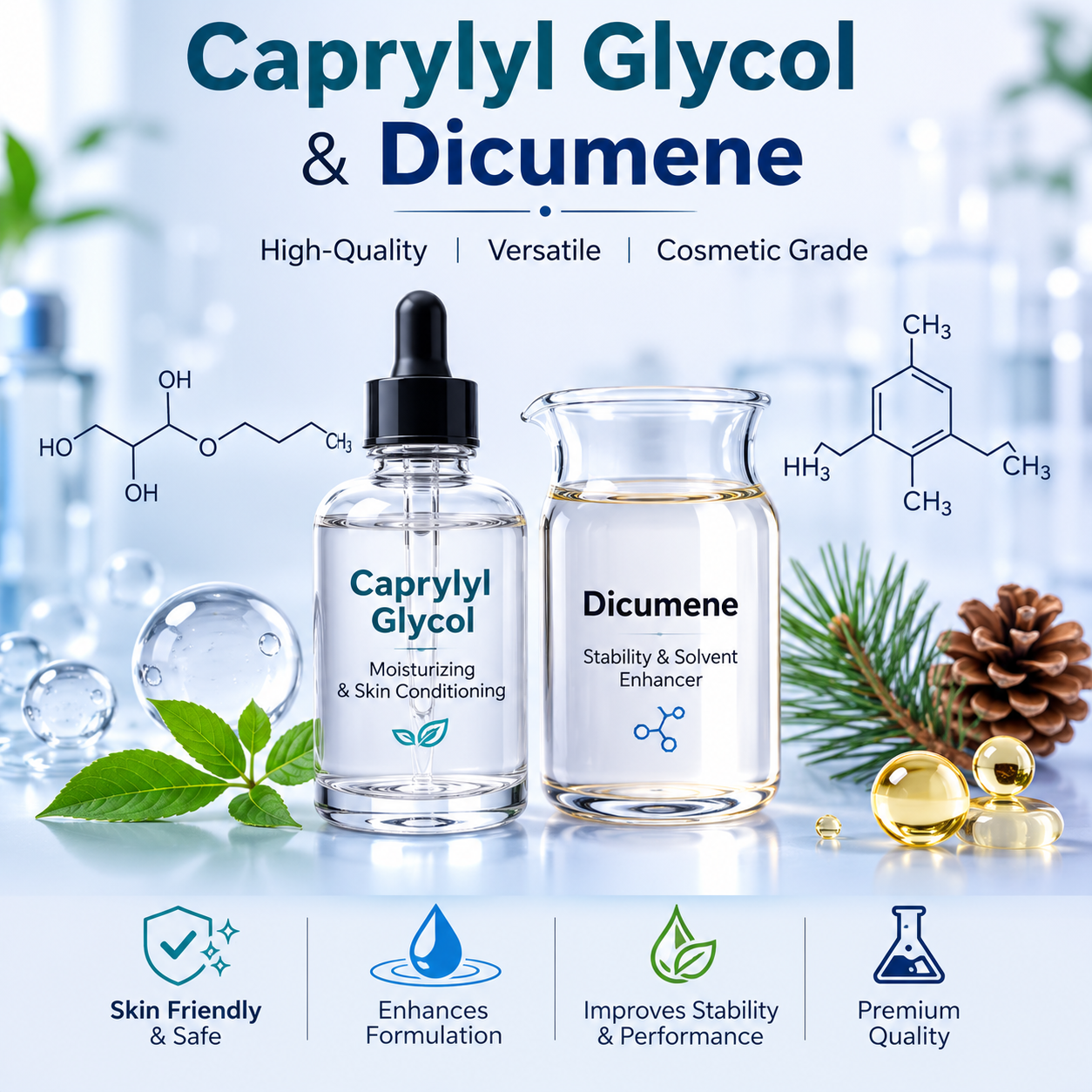
The chemical industry relies on specialized ingredients that improve product performance, stability, and safety. Among these important compounds, Caprylyl Glycol and Dicumene have gained significant attention in cosmetics, pharmaceuticals, and industrial manufacturing. Although they serve entirely different purposes, both chemicals play a crucial role in modern formulations and production processes.
This guide explores the properties, applications, benefits, and safety considerations of Caprylyl Glycol and Dicumene, helping businesses and consumers understand why these compounds are increasingly important across multiple industries.
What is Caprylyl Glycol?
Caprylyl Glycol is a multifunctional ingredient commonly used in skincare, cosmetics, and personal care products. It is a colorless liquid derived from caprylic acid and belongs to the glycol family.
It is widely recognized for its:
- Moisturizing properties
- Antimicrobial benefits
- Preservation-enhancing capabilities
- Skin-conditioning effects
Because of its ability to hydrate the skin while supporting product preservation, Caprylyl Glycol has become a preferred ingredient in modern cosmetic formulations.
Key Properties of Caprylyl Glycol
| Property | Description |
| Chemical Type | Humectant and emollient |
| Appearance | Clear liquid |
| Solubility | Slightly soluble in water |
| Main Function | Moisturizing and preservation |
| Industries | Cosmetics, skincare, pharmaceuticals |
Benefits of Caprylyl Glycol in Cosmetics
The popularity of Caprylyl Glycol is primarily driven by its multifunctionality.
1. Excellent Moisturizer
It helps attract and retain moisture in the skin, leaving products with a smooth and soft texture.
2. Improves Product Preservation
Many cosmetic brands use Caprylyl Glycol to boost the effectiveness of preservatives and reduce the need for harsher chemicals.
3. Enhances Skin Feel
It creates a silky and lightweight sensation in lotions, creams, and serums.
4. Supports Clean Beauty Trends
Consumers increasingly prefer products containing gentle ingredients, and Caprylyl Glycol fits perfectly into many clean-label formulations.
Common Applications of Caprylyl Glycol
You can find Caprylyl Glycol in numerous products, including:
- Face creams
- Sunscreens
- Body lotions
- Shampoos
- Hair conditioners
- Makeup products
- Serums and moisturizers
- Baby care products
What is Dicumene?
Dicumene, also known as diisopropylbenzene, is an aromatic hydrocarbon widely used as an intermediate in chemical manufacturing. It is produced through alkylation processes and serves as an important raw material in industrial applications.
Unlike Caprylyl Glycol, which is primarily associated with personal care products, Dicumene is heavily utilized in chemical production and industrial synthesis.
Key Properties of Dicumene
| Property | Description |
| Chemical Name | Diisopropylbenzene |
| Chemical Family | Aromatic Hydrocarbon |
| Appearance | Colorless liquid |
| Main Uses | Chemical intermediate |
| Industries | Petrochemicals, manufacturing |
Major Applications of Dicumene
Dicumene plays an essential role in the production of several industrial materials.
Production of Peroxides
It is commonly used in the manufacture of organic peroxides, which serve as initiators in polymer production.
Polymer Manufacturing
Various plastic and resin manufacturing processes depend on Dicumene-based intermediates.
Chemical Synthesis
Many specialty chemicals and industrial compounds are synthesized using Dicumene.
Petrochemical Industry
The petrochemical sector uses Dicumene in several manufacturing processes because of its stability and efficiency.
Industries Using Dicumene
Some of the major industries utilizing Dicumene include:
- Chemical manufacturing
- Plastic production
- Petrochemicals
- Polymer industries
- Industrial research laboratories
- Specialty chemical production
Comparison Between Caprylyl Glycol and Dicumene
| Feature | Caprylyl Glycol | Dicumene |
| Primary Use | Cosmetic ingredient | Industrial chemical |
| Industry | Personal care | Petrochemical |
| Function | Moisturizer and preservative booster | Chemical intermediate |
| Consumer Exposure | Direct | Limited |
| Physical Form | Clear liquid | Colorless liquid |
Why These Chemicals Matter in Modern Industries
Both Caprylyl Glycol and Dicumene contribute significantly to product innovation and manufacturing efficiency.
Importance of Caprylyl Glycol
- Improves skincare formulations
- Enhances product shelf life
- Supports clean beauty formulations
- Provides skin-conditioning benefits
Importance of Dicumene
- Enables advanced chemical synthesis
- Supports polymer production
- Helps manufacture specialty chemicals
- Improves industrial efficiency
Safety Considerations
Safety of Caprylyl Glycol
When used within recommended concentrations, Caprylyl Glycol is generally considered safe for cosmetic applications. Manufacturers follow strict formulation guidelines to ensure product safety.
Safety of Dicumene
Because Dicumene is primarily an industrial chemical, proper handling procedures, storage conditions, and safety regulations must be followed to minimize exposure risks.
Future Market Trends
Several market trends are increasing demand for both compounds.
Growing Demand for Caprylyl Glycol
- Rising skincare consumption
- Demand for multifunctional ingredients
- Expansion of clean beauty products
- Increasing preference for mild preservatives
Growing Demand for Dicumene
- Expansion of chemical manufacturing
- Increasing polymer production
- Rising industrial investments
- Growing demand for specialty chemicals
Frequently Asked Questions (FAQs)
1. What is Caprylyl Glycol used for?
It is primarily used in cosmetics and skincare products as a moisturizer and preservative booster.
2. Is Caprylyl Glycol safe for skin?
Yes, it is generally considered safe when used in approved concentrations.
3. What products contain Caprylyl Glycol?
Lotions, creams, shampoos, serums, and makeup products commonly contain it.
4. What is Dicumene?
Dicumene is an aromatic hydrocarbon used as an industrial chemical intermediate.
5. Which industries use Dicumene?
Petrochemical, polymer, and specialty chemical industries widely use it.
6. Is Dicumene used in cosmetics?
No, Dicumene is mainly used for industrial manufacturing.
7. Why is Caprylyl Glycol popular in skincare?
Because it moisturizes the skin and supports product preservation.
8. Can Caprylyl Glycol replace preservatives?
It usually works alongside preservatives rather than replacing them completely.
9. Why is Dicumene important in manufacturing?
It acts as a valuable intermediate in producing various industrial chemicals.
10. Is handling Dicumene regulated?
Yes, industrial safety guidelines govern its handling and storage.