
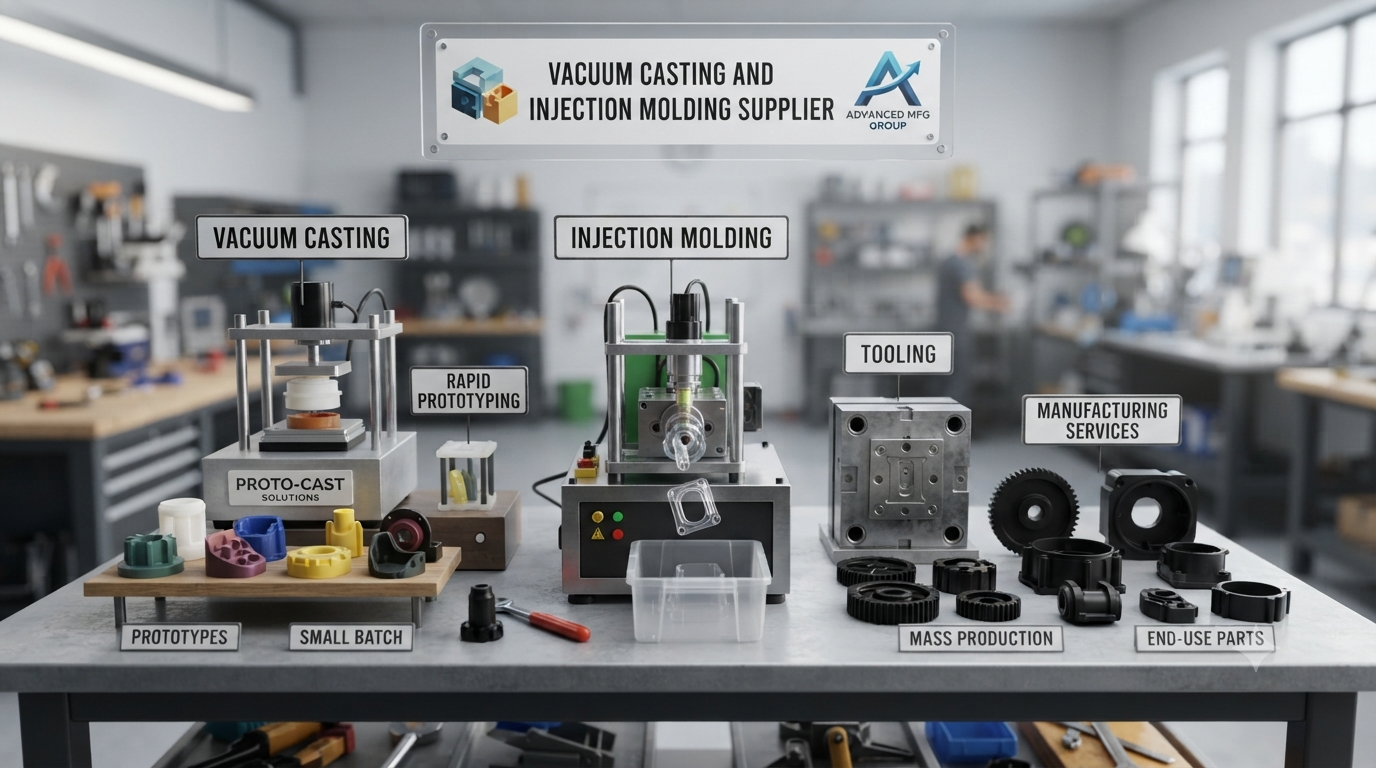
Modern product manufacturing is no longer simply about producing a plastic component. Engineers and product developers need to prove a design, test its performance, evaluate its appearance and determine whether it can be manufactured economically before committing to large-scale production. This is where vacuum casting and an experienced injection molding supplier can play complementary roles.
Instead of treating these technologies as alternatives, manufacturers increasingly use them at different stages of product development. Vacuum casting is particularly useful when realistic parts are required in relatively small quantities, while injection moulding becomes more practical when a validated design needs repeatable production at scale.
Understanding where each process fits can help companies control tooling investment, reduce redesign risk and make better manufacturing decisions.
Why Vacuum Casting Matters During Product Development
A digital CAD model may look perfect on a computer screen, but physical production can reveal problems that are difficult to identify digitally.
A housing may feel uncomfortable when held. Two components may interfere during assembly. A snap-fit feature may require modification. A wall may need strengthening. The surface texture might not produce the intended appearance.
Vacuum casting allows manufacturers to investigate these issues using realistic physical parts before committing to production tooling.
A master model is first manufactured, commonly through CNC machining or high-resolution additive manufacturing. Silicone is then formed around the master to create a flexible mould. Once the master is removed, polyurethane casting material can be introduced into the cavity under vacuum.
The vacuum environment helps reduce trapped air and allows resin to reach small features within the mould.
The resulting components can provide realistic representations of the intended product and can be useful for engineering, visual and commercial evaluation.
Where Vacuum Casting Creates Practical Value
The strongest advantage of vacuum casting is flexibility during the uncertain stages of development.
A business preparing a completely new product may not know whether the final design will remain unchanged. Investing immediately in a metal injection mould could therefore create unnecessary financial risk.
Vacuum-cast components can instead be produced for:
- Engineering evaluation
- Assembly testing
- Ergonomic studies
- Customer demonstrations
- Exhibition samples
- Product photography
- Packaging evaluation
- Market testing
- Limited production requirements
- Pre-production verification
Consider an electronics manufacturer developing a new control unit. Ten early prototypes may be sufficient for engineering evaluation, but the company might subsequently require 40 additional units for customer demonstrations and field testing.
This is a situation where vacuum casting may provide a practical bridge between initial prototyping and full production.
Understanding the Role of an Injection Molding Supplier
An injection molding supplier becomes increasingly important when the product design is stable and production quantities begin to increase.
Injection moulding involves heating thermoplastic material until it reaches a processable state and injecting it under controlled pressure into an engineered metal mould. After cooling and solidification, the mould opens and the completed component is ejected.
Although the principle sounds straightforward, reliable injection moulding requires detailed engineering knowledge.
A competent injection molding supplier must consider factors such as:
- Component geometry
- Material flow
- Wall thickness
- Shrinkage
- Cooling behaviour
- Gate position
- Draft angles
- Parting lines
- Undercuts
- Ejection
- Weld lines
- Surface requirements
- Dimensional tolerances
These considerations can influence not only how the mould is designed but also how consistently the component performs during repeated manufacturing cycles.
From CAD File to Vacuum-Cast Component
The quality of vacuum casting begins long before resin enters the silicone mould.
Stage 1: Design Assessment
The manufacturer reviews the CAD model to understand geometry, dimensions, assembly features and required appearance.
Areas requiring particular attention can be identified before manufacturing starts.
Stage 2: Master Model Production
A master pattern is manufactured with close attention to dimensional and surface requirements.
Because the silicone mould reproduces the master, imperfections in the master can also appear in subsequent castings.
Stage 3: Silicone Tool Preparation
Liquid silicone is poured around the prepared master model. Once cured, the mould is carefully opened and the original pattern removed.
Stage 4: Resin Selection
A suitable polyurethane resin is selected according to the intended characteristics of the component.
Depending on the project, properties such as rigidity, flexibility, colour, transparency or temperature behaviour may be considered.
Stage 5: Casting Under Vacuum
The resin is introduced into the silicone tool while vacuum equipment helps minimise unwanted air.
Stage 6: Post-Processing
After curing and demoulding, excess material is removed. Painting, polishing, texturing, printing or assembly can then be completed when required.
Vacuum Casting and Injection Moulding Compared
The most useful comparison is not simply which technology is “better”, but which technology is appropriate for the current manufacturing stage.
| Manufacturing Factor | Vacuum Casting | Injection Molding Supplier |
| Tool type | Silicone mould | Metal production mould |
| Initial tooling investment | Lower | Higher |
| Typical production purpose | Prototype and low volume | Repeated production |
| Design flexibility | High | Lower after tooling |
| Tool life | Limited | Designed for extended use |
| Production materials | Mainly casting resins | Commercial thermoplastics |
| Production speed per part | Moderate | Fast after setup |
| Repeatability | Good | Excellent |
| Large-volume economics | Less suitable | Highly suitable |
| Design validation | Excellent | Usually follows validation |
The expected lifetime quantity of a product should therefore influence the manufacturing strategy.
Why Moving Directly to Injection Moulding Can Be Risky
Speed is important in product development, but skipping validation can create expensive complications.
Suppose a company approves a metal mould before thoroughly checking its physical prototype. Production begins, and engineers later discover that an internal mounting boss interferes with an electronic component.
Correcting the problem may require modifying the mould. Depending on its location and complexity, changes could involve machining, inserts, welding or more extensive tooling work.
A structured development route can instead look like this:
- Product concept
- CAD development
- Initial prototype
- Vacuum casting
- Assembly and functional testing
- Design refinement
- DFM assessment
- Injection mould manufacturing
- Trial production
- Mass production
This sequence does not eliminate every manufacturing risk, but it creates opportunities to identify problems earlier.
Material Selection for Injection Moulding
Material choice should be based on the actual operating environment rather than simply selecting a familiar plastic.
An experienced injection molding supplier may work with materials including:
- ABS for general housings and consumer products
- Polypropylene for lightweight and chemically resistant applications
- Polycarbonate where toughness or transparency may be required
- Nylon for mechanical and engineering components
- POM for low-friction precision components
- PMMA for transparent applications
- TPE and TPU for flexible components
- Reinforced engineering polymers for demanding applications
Material selection should consider mechanical loading, environmental exposure, temperature, dimensional stability, appearance and regulatory requirements relevant to the application.
Design for Manufacturing Before Tooling
One of the most valuable services an injection molding supplier can provide is Design for Manufacturing, commonly called DFM.
DFM examines whether a component has been designed in a way that supports reliable production.
Important areas include wall thickness, draft, radii, ribs, bosses, gates, ejector positions and undercuts.
Wall Thickness
Large and sudden variations in wall thickness can contribute to uneven cooling, sink marks or distortion.
Draft Angles
Suitable draft helps components release from the mould without unnecessary damage or ejection difficulty.
Ribs and Bosses
These features can strengthen or support a component, but poor proportions may contribute to visible sink marks or moulding difficulties.
Undercuts
Undercuts can require sliders, lifters or other tooling mechanisms, potentially increasing mould complexity.
Quality Control Should Start Before Production
Quality inspection should not be treated as something that happens only after thousands of components have been manufactured.
Good manufacturing control begins with clearly defined requirements.
A professional injection molding supplier may evaluate:
- Critical dimensions
- Cosmetic surfaces
- Colour consistency
- Assembly fit
- Material requirements
- Functional characteristics
- Surface defects
- Part deformation
Customers should clearly identify critical-to-quality dimensions in technical drawings rather than assuming every dimension has identical importance.
Advantages of Combining Vacuum Casting and Injection Moulding
Using vacuum casting and injection moulding within one coordinated development programme can create several practical advantages.
These include:
- Earlier identification of design problems
- Better physical evaluation before tooling
- Reduced pressure to finalise an immature design
- Realistic samples for customer approval
- Easier transition towards production
- Better understanding of cosmetic requirements
- Opportunity to verify assembly procedures
When the same manufacturer handles prototype and production stages, engineering information can also move more efficiently between teams.
How to Evaluate an Injection Molding Supplier
Price should be considered, but the lowest tooling quotation does not necessarily represent the lowest total project cost.
When evaluating an injection molding supplier, consider:
- Tool design and manufacturing capability
- DFM support
- Experience with required materials
- Dimensional inspection capability
- Prototype manufacturing options
- Surface finishing services
- Production capacity
- Quality management
- Engineering communication
- Post-production and assembly support
A supplier that identifies potential manufacturing problems before tooling begins can provide greater long-term value than one that simply accepts a CAD file and quotation request.
Information to Provide When Requesting a Manufacturing Quote
A detailed request allows the manufacturer to evaluate the project more accurately.
Ideally, provide:
- STEP or another suitable 3D CAD file
- 2D technical drawings
- Estimated production quantity
- Required plastic or material characteristics
- Surface finish
- Colour
- Critical tolerances
- Intended application
- Assembly requirements
- Expected production schedule
For vacuum casting, also explain the purpose of the parts. A visual presentation model may have different requirements from a functional engineering prototype.
Frequently Asked Questions
1. What is vacuum casting?
Vacuum casting is a low-volume manufacturing process that uses silicone moulds and casting resins to reproduce detailed prototype or pre-production components.
2. Why is vacuum used during casting?
Vacuum conditions help minimise trapped air and improve the resin’s ability to reproduce detailed mould features.
3. Is vacuum casting suitable for prototypes?
Yes. It is particularly useful when multiple realistic prototypes are required for testing, presentation or product validation.
4. Can vacuum casting replace injection moulding?
Usually not for large production quantities. The processes are better suited to different manufacturing stages.
5. What does an injection molding supplier provide?
An injection molding supplier may provide DFM, mould design, tooling, material processing, moulding, inspection, finishing and assembly.
6. Why does injection moulding require higher initial investment?
Production generally requires precisely engineered aluminium or steel tooling, which requires specialised design and machining.
7. Which process is suitable for low-volume manufacturing?
Vacuum casting is often suitable when relatively small quantities of production-like components are required.
8. What is DFM?
Design for Manufacturing is the process of reviewing a component to identify features that may affect manufacturability, quality, tooling complexity or cost.
9. Can injection moulding produce complex components?
Yes, although complex geometry may require sophisticated mould features such as sliders, lifters, inserts or specialised gating arrangements.
10. When should injection moulding begin?
It generally makes sense once the product design has been sufficiently validated and expected production volumes justify tooling investment.
https://newsgrow.blogspot.com/2026/08/rapid-injection-molding-and-china-rapid.html
https://newsgrow.blogspot.com/2026/08/aluminum-prototype-and-sheet-metal.html
https://newsgrow.blogspot.com/2026/08/deep-information-about-sheet-metal.html
https://newsgrow.blogspot.com/2026/08/vacuum-casting-and-injection-molding.html